Allergic skin disease associated with environmental allergies or food allergies commonly causes erythema and pruritus of the concave pinnae and external ear canals in dogs and cats (see Atopic Dermatitis in Dogs and Feline Atopic Skin Syndrome, as well as information on food-induced hypersensitivity reactions in animals).
Common environmental allergens include house dust, house dust mites, molds, and pollens (tree, grass, or weed). The allergic condition predisposes affected animals to development of secondary bacterial or yeast otitis externa. Otitis externa can extend from the external ear canal to affect the pinna.
Clinical signs of allergic pinnal dermatitis include erythema, papules, crusts, and lichenification. In addition, contact hypersensitivity to otic preparations can cause lesions on the inner aspect of the pinna (see aural contact dermatitis). Other sites on the body, such as the face (ie, periocular region, muzzle, chin), axilla, groin, and feet, are also often affected.
Diagnosis and treatment of allergic skin diseases are discussed in the topics Atopic Dermatitis in Dogs and Feline Atopic Skin Syndrome.
Feline mosquito bite hypersensitivity (see ) is an allergic reaction to mosquito bites in cats.
Feline mosquito bite hypersensitivity can cause an ulcerative and crusted dermatitis of the pinnae, nose, and less commonly the footpads, eyelids, chin, and lips of cats. Lesions progress from papules to plaques that can become crusted and ulcerated and coalesce to affect extensive areas. Pruritus is a consistent clinical sign, and regional lymphadenopathy can occur. In severe cases, fever or other systemic signs can develop.

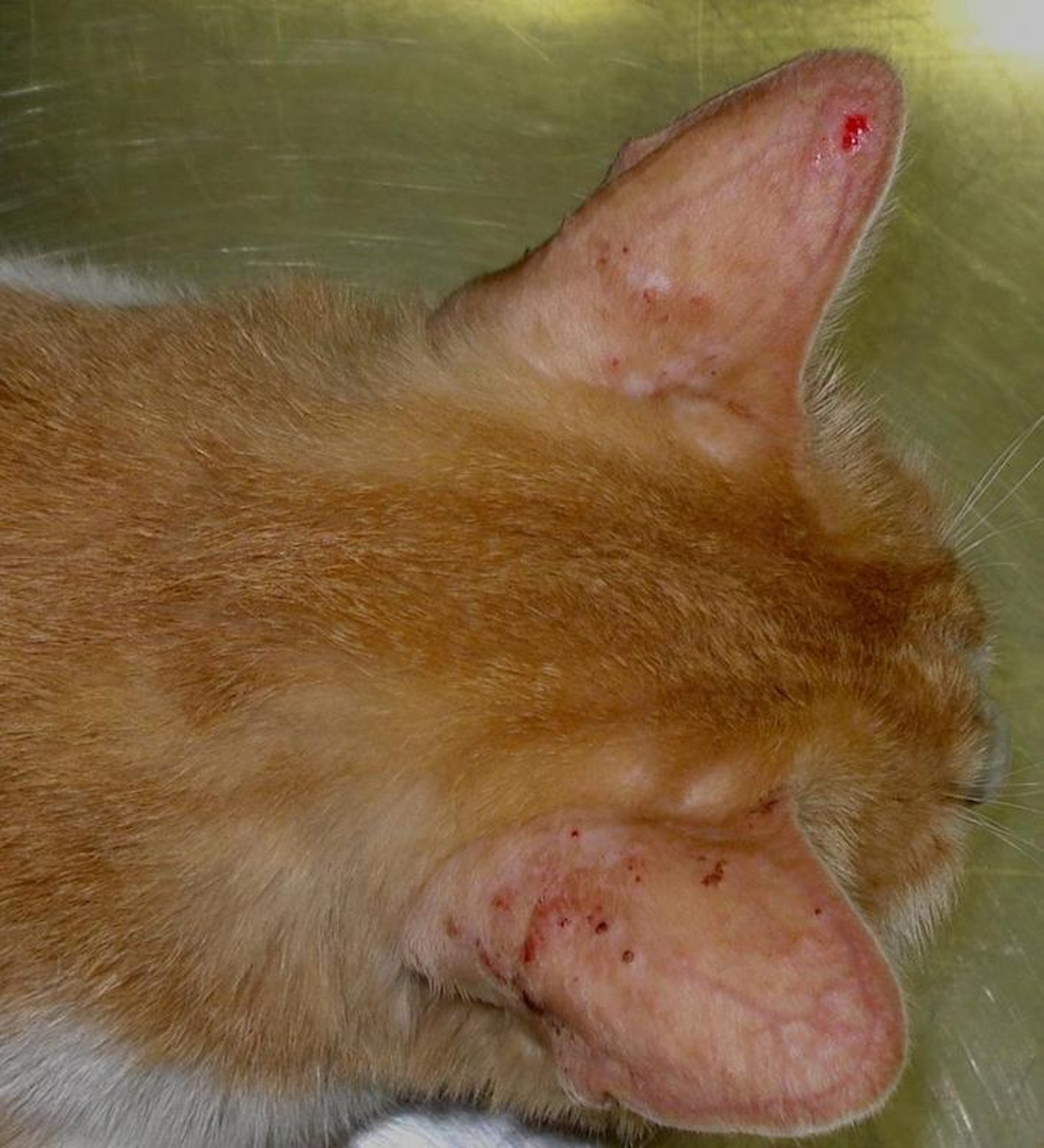
Multiple papules covered with hemorrhagic crusts localized to the convex aspect of the pinnae in a cat.
Courtesy of Dr. Michele Corazza.
Histologically, lesions of feline mosquito bite hypersensitivity are characterized by severe superficial and deep perivascular to interstitial eosinophilic dermatitis, often associated with flame figures (dermal collagen fibers coated with granules from degranulated eosinophils), folliculitis, and furunculosis (bacterial infection of hair follicles).
A differential diagnosis of feline mosquito bite hypersensitivity includes the following:
herpesvirus ulcerative dermatitis
other causes of eosinophilic dermatitis (food allergy, atopy, idiopathic)
Treatment of feline mosquito bite hypersensitivity includes insect control measures such as keeping cats indoors at dusk and dawn, when mosquitoes are most active. Systemic anti-inflammatory doses of glucocorticoids might be necessary in severe cases.
For More Information
Olivry T, DeBoer DJ, Favrot C, et al. Treatment of canine atopic dermatitis: 2015 updated guidelines from the International Committee on Allergic Diseases of Animals (ICADA). BMC Vet Res. 2015;11:210.
Santoro D, Pucheu-Haston CM, Prost C, Mueller RS, Jackson H. Clinical signs and diagnosis of feline atopic skin syndrome: detailed guidelines for a correct diagnosis. Vet Dermatol. 2021;32(1):26-e6.
Mueller RS, Nuttall T, Prost C, Schulz B, Bizikova P. Treatment of the feline atopic syndrome—a systematic review. Vet Dermatol. 2021;32(1):43-e8.
Also see pet owner content regarding allergies and the outer ear in dogs and cats.