The secondary survey of emergency patients is the process of obtaining relevant and thorough historical information, performing a complete physical examination, and collecting general diagnostic information. These data are used to direct the formulation of a specific diagnostic, therapeutic, and monitoring plan. (See the .)

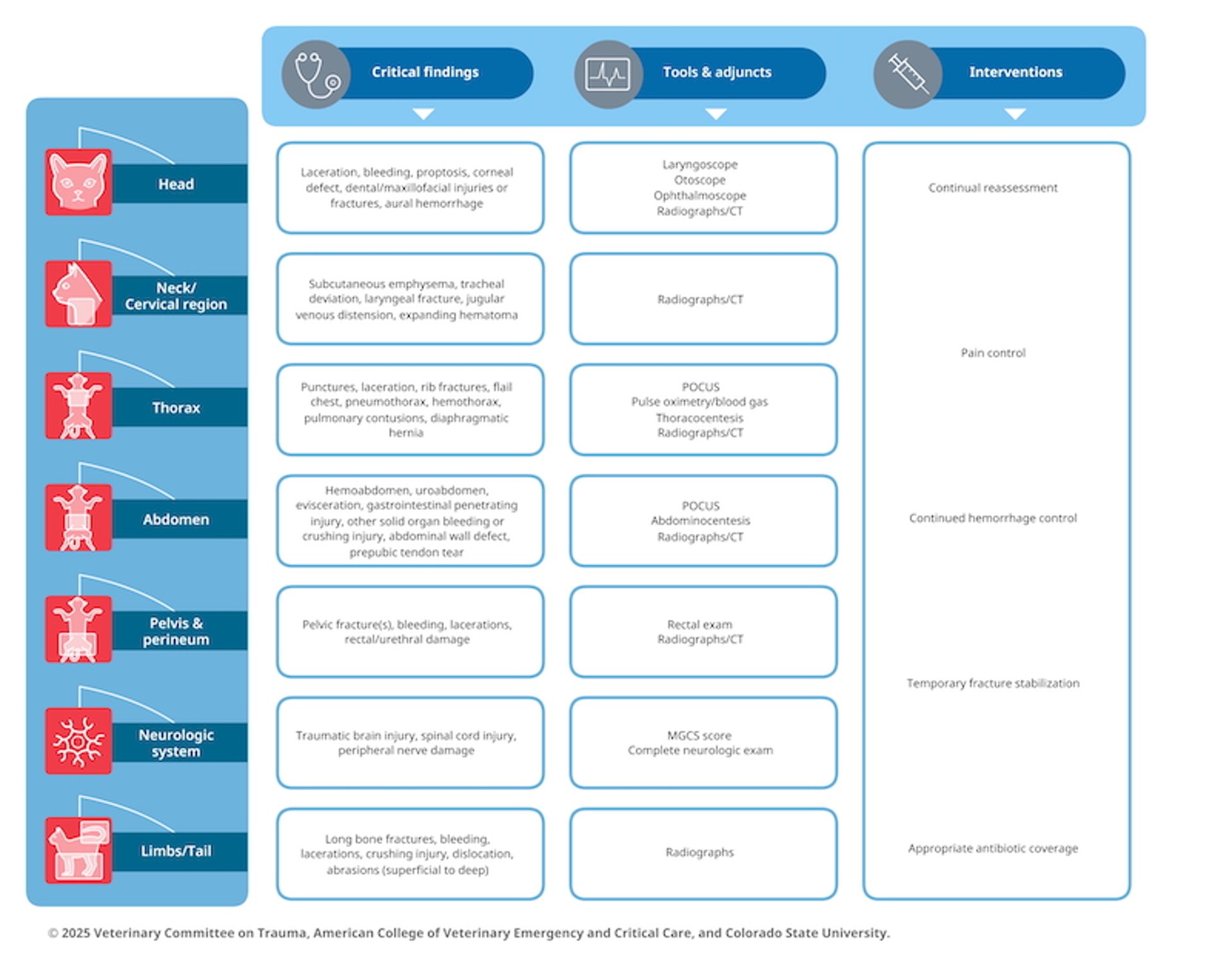
The secondary survey is performed after the primary survey and initial stabilization are complete.
Courtesy of the Veterinary Committee on Trauma, American College of Veterinary Emergency and Critical Care, and Colorado State University.
The history should be recorded in a concise format. The owner or caretaker can provide additional information pertinent to the reason for initial evaluation, such as when the animal was last completely normal. A chronology of the daily progression of abnormalities since the onset of clinical signs can be useful. Background information includes past medical problems, toxicoses, medications, drug and food sensitivities, blood transfusions, travel history, date of last vaccinations, and other preventive care. Other organ systems not seemingly involved should also be historically evaluated. Details of the specific disease process are obtained and may help direct diagnostics and care.
A thorough physical examination should be performed, being systematic in the evaluation. Particular attention is given to heart and lung auscultation for abnormalities, and to abdominal, rectal, and joint palpation for pain or enlargements. A thorough neurological and orthopedic examination is often warranted. Acute abdominal pain requires auscultation of the abdomen for bowel sounds to localize the problem to the reticuloendothelial, reproductive, urinary, or GI systems; to the peritoneal space; or to the muscle, skin, nerves, or fat around the abdominal wall. Fever of unknown origin directs examination to the peritoneal cavity and to the reproductive, urinary, pulmonary, and cardiovascular systems.
An initial minimum database should consist of a PCV, total solids, glucose, and BUN. Other important diagnostic tests include urinalysis (before fluid administration), venous or arterial blood gas, electrolyte panel, CBC, and serum chemistry panel. When coagulation disorders are suspected or surgery is anticipated, blood smears to estimate platelet number; buccal bleeding time to evaluate platelet function; and a clotting profile, such as an activated clotting time or prothrombin time and activated partial thromboplastin time, are warranted. Thromboelastography has emerged as a method to identify risk of hypercoagulation and hyperfibrinolysis.
A deficit in any of the first three components of the primary survey (ie, airway, breathing, circulation) will quickly result in anaerobic metabolism due to poor oxygen delivery to the tissues. This can rapidly result in type A lactic acidosis. Lactate can be accurately, easily, and rapidly measured with several point-of-care analyzers. Normal serum lactate concentration in dogs and cats is < 2 mmol/L. Lactate concentrations normalize rapidly with treatment of the underlying condition of poor oxygen delivery to tissues, and normalization is associated with improved rates of survival to discharge.
Lactate concentration can be used along with other parameters as an end point of resuscitation in hypovolemic animals. Initial increases in blood lactate concentration have been reported to be associated with an increase in complications and mortality rate in certain diseases in small animals; however, recent evidence supports that resolving hyperlactatemia is associated with improved survival rates (1, 2, 3, 4, 5).
Various scoring systems, such as the animal trauma triage score, may provide some useful prognostic information. The modified Glasgow Coma Scale is a useful monitoring tool for patients with neurological injury; the composite Glasgow Pain Scale helps to identify patients in need of analgesia.
Key Points
A secondary survey should be performed for identification of, and therapy for, the underlying disease etiology along with any concurrent illness or injury.
As the patient stabilizes, a thorough history should be collected and reviewed, especially when the cause of the illness is not immediately apparent.
A thorough physical examination, focusing on all pertinent systems, should be performed in a systematic manner to thoroughly identify abnormalities that may help direct diagnostics or care.
For More Information
Short form of the Glasgow pain scale for dogs. Italian Society of Veterinary Regional Anesthesia and Medicine.
Acute pain assessment scale for cats. Animalcare UK Practice Assistance Centre.
Devey JJ, Linklater A, Kirby R. Wounds and bandages. In: Kirby R, Linklater A, eds. Monitoring and Intervention for the Critically Ill Small Animal: The Rule of 20. John Wiley and Sons. 2017; 373-387.
Kirpenstein J, ter Haar G. Reconstructive Surgery and Wound Management of the Dog and Cat. Manson Publishing; 2013.
Also see pet owner content regarding emergency care for dogs and cats and emergency care for horses.
References
Zhang L, Grobman M. The prognostic value of point-of-care blood glucose and lactate in canine and feline pyothorax: a retrospective analysis. Front Vet Sci. 2025;12:1581701. doi:10.3389/fvets.2025.1581701
Young AA, Cooper E, Yaxley P, Haging GG. Evaluation of geriatric trauma in dogs with moderate to severe injury (6169 cases): a VetCOT registry study. J Vet Emerg Crit Care (San Antonio). 2022;32(3);386-396. doi:10.1111/vec.13165
Fages A, Soler C, Fernández-Salesa N, Conte G, Degani M, Briganti A. Perioperative outcome in dogs undergoing emergency abdominal surgery: a retrospective study on 82 cases (2018-2020). Vet Sci. 2021;8(10):209. doi:10.3390/vetsci8100209
Blutinger AL, Zollo AM, Weltman J, Prittie J. Prospective evaluation of plasma lactate parameters for prognosticating dogs with shock. J Vet Emerg Crit Care (San Antonio). 2021;31(3):351-359. doi:10.1111/vec.13046
Green TI, Tonozzi CC, Kirby R, Rudloff E. Evaluation of initial plasma lactate values as a predictor of gastric necrosis and initial and subsequent plasma lactate values as a predictor of survival in dogs with gastric dilatation-volvulus: 84 dogs (2003-2007). J Vet Emerg Crit Care (San Antonio). 2011;21(1):36-44. doi:10.1111/j.1476-4431.2010.00599.x