The nervous system of horses consists of the central nervous system (CNS) and the peripheral nervous system (PNS).
The CNS of horses consists of the brain and spinal cord.
The brain has three main parts:
brainstem, which controls basic life functions (like breathing, heart rate, alertness)
cerebrum, which is responsible for awareness, thinking, learning, and purposeful behavior
cerebellum, which helps control balance and smooth, coordinated movement
The spinal cord is a tube of nerves that runs along the horse's spine. It is divided into sections that correspond to the bones of the spine. From neck to tail, these are the cervical, thoracic, lumbar, and sacralsections of the spinal cord.
The brain and spinal cord are covered by protective layers called the meninges and are cushioned by cerebrospinal fluid (CSF) that surrounds the brain and spinal cord.
Nervous system, horse

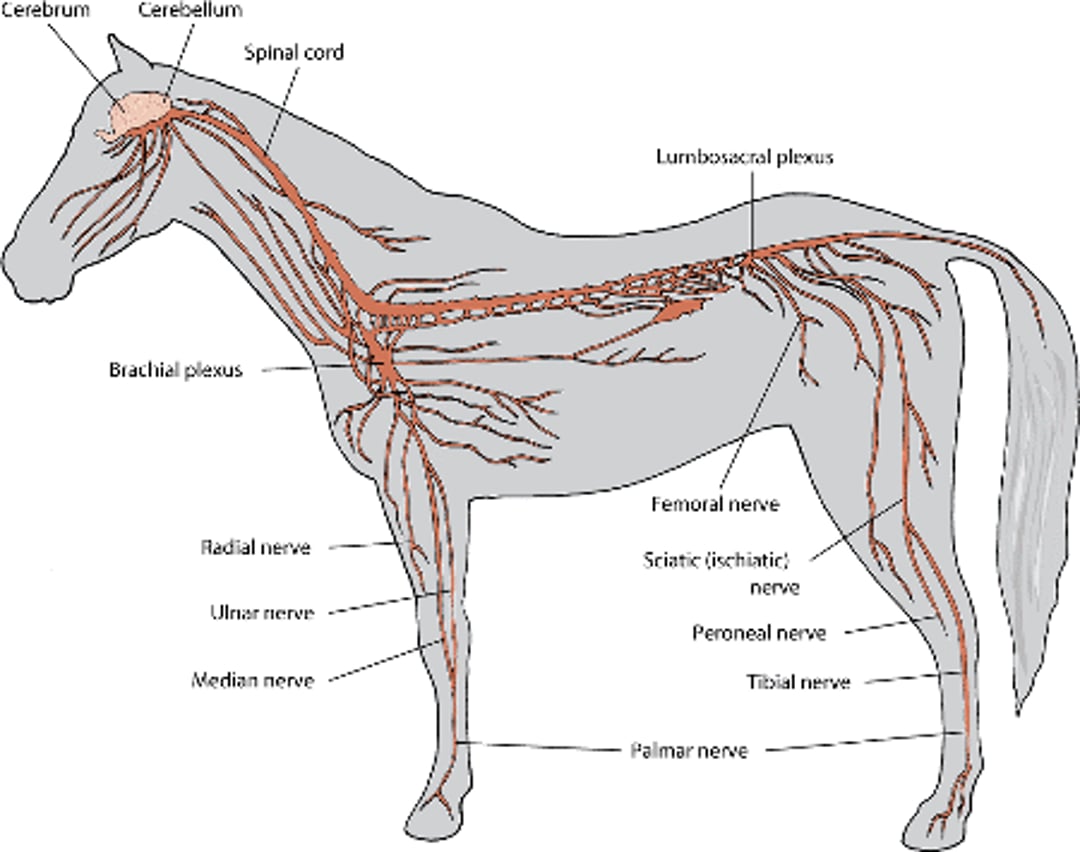
The PNS consists of nerves that branch out from the brain and spinal cord to the rest of the horse's body.
The peripheral nerves originate in:
spinal nerves (from the spinal cord), which send branches to the legs, chest, belly, tail, and skin
cranial nerves (from the brainstem), which send branches to the head and face
Neurons
Both the CNS and PNS contain billions of nerve cells called neurons. Neurons connect to form circuits, and signals travel through them as electrical messages.
When an electrical signal reaches the end of a neuron, the neuron releases chemical messengers called neurotransmitters, which pass the message to another neuron, a muscle, or a gland.
There are three types of neurons:
Sensory neurons carry information to the horse's spinal cord and brain. Such information includes pain, touch, temperature, body position, taste, hearing, balance, vision, and smell.
Motor neurons carry commands from the brain and spinal cord to the horse's muscles, creating movement and strength. In the spinal cord, motor neurons travel in bundles called tracts.
The autonomic nervous system controls automatic body functions, such as heart rate, digestion, and pupil size, which require no conscious effort on the part of the horse.