Aseptic necrosis of the femoral head (also known as Legg-Calvé-Perthes disease) in dogs is a primary, idiopathic, noninflammatory deterioration of the femoral head and neck, associated with ischemia and avascular necrosis of the bone.
Metaphyseal osteopathy in dogs represents a primary idiopathic condition characterized by aseptic osteonecrosis of the femoral head and neck. By contrast, the disease described in cats resembles a capital physeal dysplasia syndrome in which metaphyseal bone loss and pathological fractures occur while the epiphysis remains largely unaffected.
The exact cause of aseptic necrosis of the femoral head is unknown. A hereditary component has been suggestedin some breeds (1, 2, 3). Infarction of the bone leads to collapse of the femoral head and neck, followed by revascularization, resorption, and remodeling.
Aseptic necrosis of the femoral head generally occurs in young miniature and small-breed dogs, especially terriers, between 4 and 11 months old. The lesion is often bilateral.
Clinical signs include hindlimb lameness, atrophy of the thigh muscles, and crepitus and pain during manipulation of the hip joint.
Radiography reveals irregular bone density of the femoral head and neck, collapse, and fragmentation of the bone. Joint incongruity can also be observed (see ). Chronic cases show evidence of osteoarthritis.

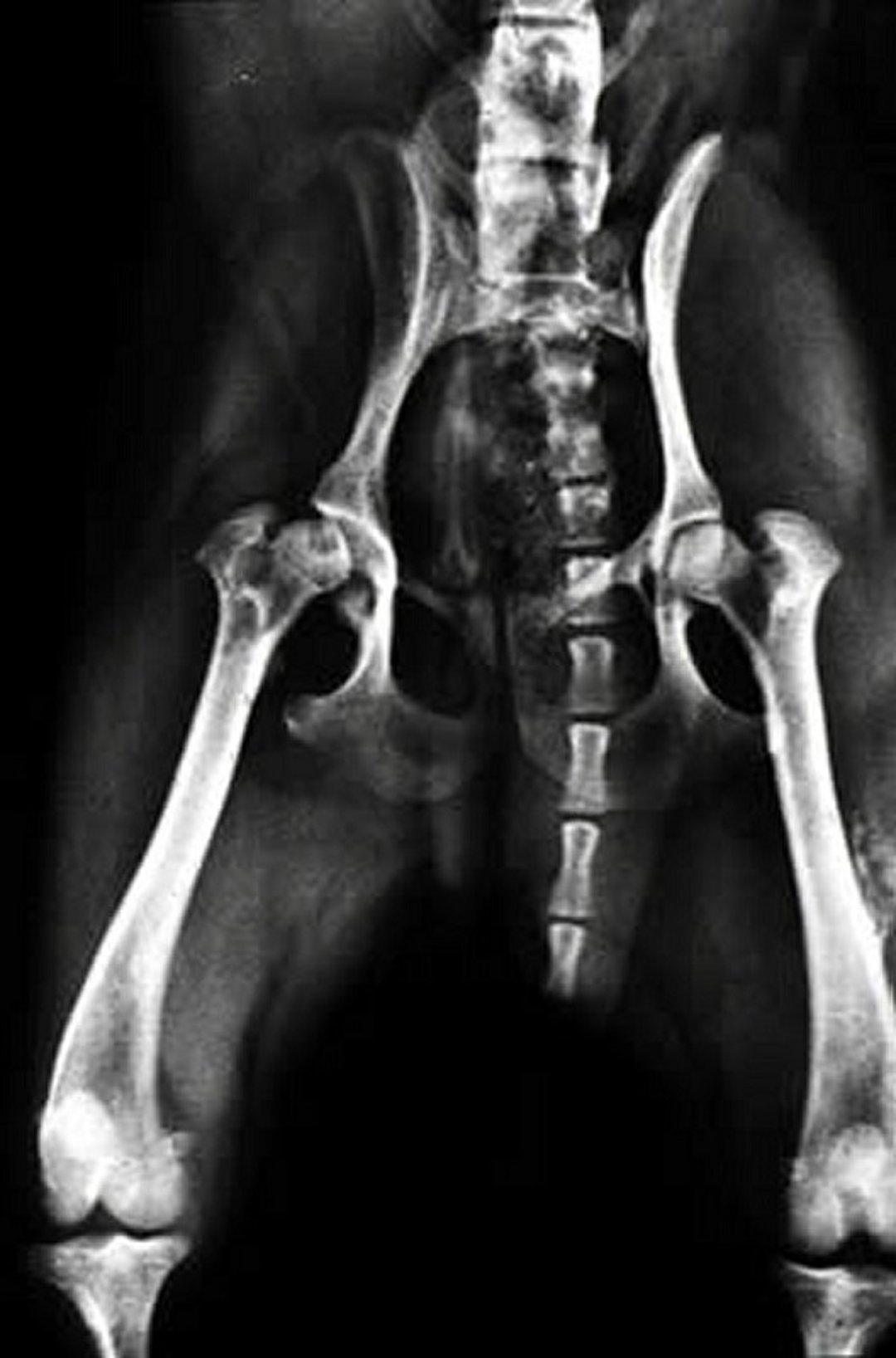
Ventrodorsal pelvic radiograph from a dog with aseptic necrosis of the right femoral head and neck. Note the joint incongruity and bone lysis.
Courtesy of Dr. Ronald Green.
For dogs with aseptic necrosis of the femoral head, although conservative management has been reported early in the course of disease, < 25% of dogs respond completely (4). Recommended treatment is femoral head and neck ostectomy (FHO) and early postoperative physical therapy to stimulate limb use. Total hip replacement is also a management option.
The prognosis for recovery is excellent after surgery.
Key Points
Aseptic necrosis of the femoral head is a primary, idiopathic, noninflammatory deteriorative condition associated with ischemic necrosis due to compromised blood supply to the femoral epiphysis.
Clinical signs include hindlimb lameness, crepitus and pain on hip manipulation, and muscle atrophy.
Radiography shows flattening, osteolytic foci, and collapse of the femoral head, with progressive development of osteoarthritis.
The treatment of choice is femoral head and neck ostectomy (FHO) or total hip replacement in select cases.
For More Information
Jankovits DA, Liska WD, Kalis RH. Treatment of avascular necrosis of the femoral head in small dogs with micro total hip replacement. Vet Surg. 2012;41(1):143-147.
Demko J, McLaughlin R. Developmental orthopedic disease. Vet Clin North Am Small Anim Pract. 2005;35(5):1111-1135.
Harasen G. Legg-Perthes disease in dogs. Vet Partner. 2007. Revised November 27, 2018.
Williams K, Hunter T, Ward E. Legg-Calve-Perthes disease. VCA Animal Hospitals; 2023.
Legg-Calve-Perthes. Orthopedic Foundation for Animals. Accessed September 16, 2025.
Also see pet owner content regarding aseptic necrosis of the femoral head in dogs.
References
Robinson R. Legg-Calve-Perthes disease in dogs: genetic aetiology. J Small Anim Pract. 1992;33(6):275-276. doi:10.1111/j.1748-5827.1992.tb01139.x
Pidduck H, Webbon PM. The genetic control of Perthes' disease in toy poodles—a working hypothesis. J Small Anim Pract. 1978;19(12):729-733. doi:10.1111/j.1748-5827.1978.tb05564.x
Vasseur PB, Foley P, Stevenson S, Heitter D. Mode of inheritance of Perthes' disease in Manchester terriers. Clin Orthop Relat Res. 1989;244:281-292. doi:10.1097/00003086-198907000-00031
Aguado E, Goyenvalle E. Legg Calvé Perthes disease in the dog. Morphologie. 2021;105(349):143-147. doi:10.1016/j.morpho.2020.11.011