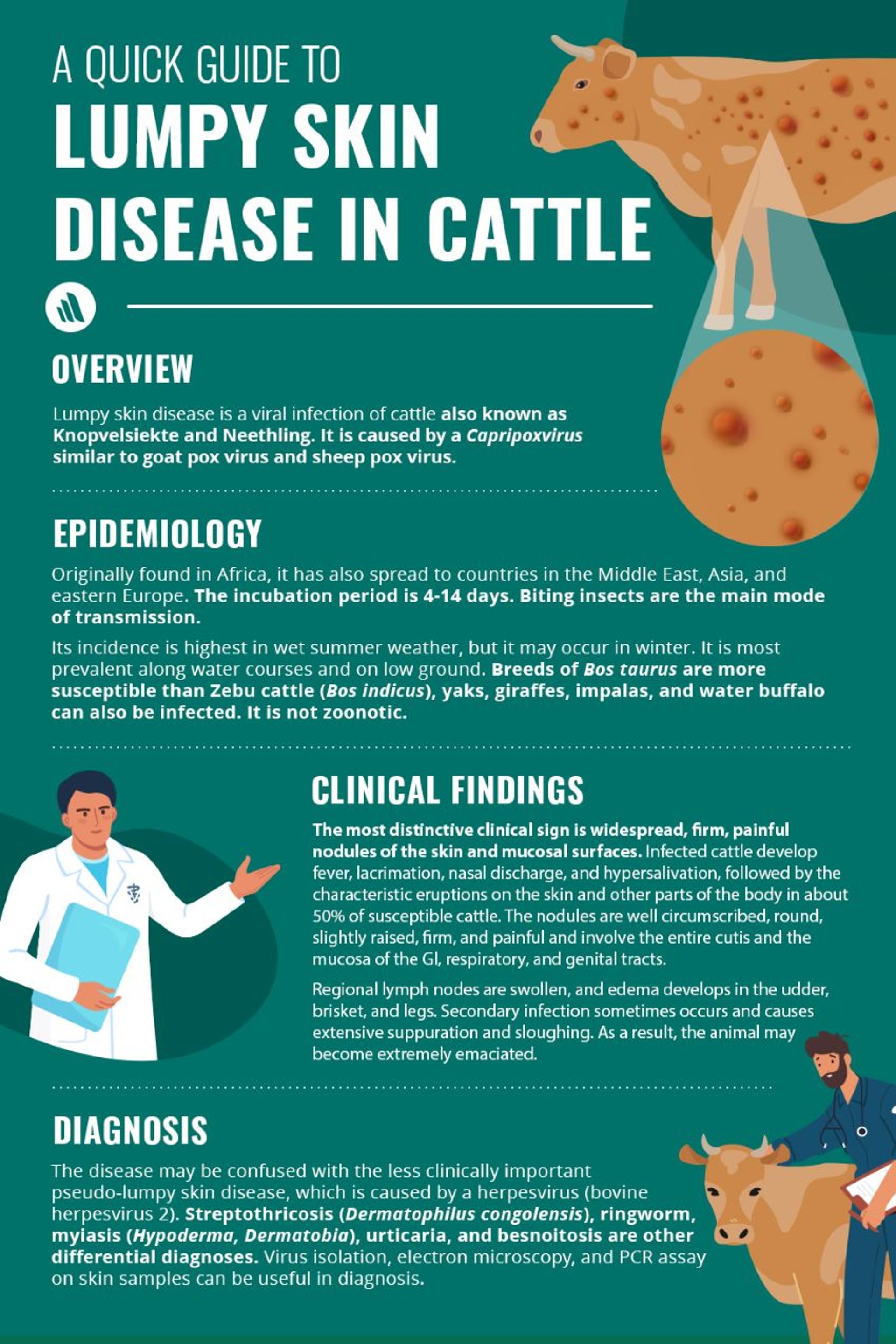
Lumpy skin disease is a viral infection of cattle, buffalo, and wild ungulates. Found mainly in Africa, it has spread to the Middle East, the Balkans, Asia, and, most recently, southern Europe. Clinical signs include characteristic skin eruptions, fever, lacrimation, and hypersalivation. Diagnosis is usually based on virus isolation and PCR assay. Attenuated vaccines help control outbreaks.
Lumpy skin disease is an infectious, eruptive, occasionally fatal disease of cattle, buffalo, and wild ungulates that is characterized by nodules on the skin and other parts of the body. Secondary bacterial infection often aggravates the condition.
Historically, lumpy skin disease was found in southern and eastern Africa; however, it extended northward into most of Africa, then to the Middle East and the Balkans. Most recently, it has been reported in Georgia, Russia, the Indian subcontinent, and China, as well as in southern Europe (in 2025, in Italy, France, and Spain) (1, 2, 3, 4, 5).
For a one-page reference on this topic, see the .

Etiology of Lumpy Skin Disease in Cattle
The causative agent of lumpy skin disease is lumpy skin disease virus (LSDV), a member of the genus Capripoxvirus. It is closely related to the sheeppox and goatpox viruses. LSDV has a double-stranded DNA genome.
Epidemiology of Lumpy Skin Disease in Cattle
Lumpy skin disease virus (LSDV) is thought to be transmitted by biting insects, including biting flies, midges, and mosquitoes, which act as mechanical vectors. That the disease is often associated with hot and humid environmental conditions probably reflects the prevalence of biting insects.
There is also evidence of transstadial and even transovarial survival of LSDV in some ticks, which might enable longer-term environmental survival.
LSDV can often be found in oral secretions of infected cattle; therefore, direct transmission is also possible. Direct transmission was considered relatively inefficient; however, there has been evidence of emerging LSDV strains that are more transmissible without the need for vectors.
Because LSDV is an environmentally resilient poxvirus, routes of transmission on fomites such as equipment cannot be ruled out and might explain some of the long-distance jumps in the disease’s spread.
African buffalo and other wildlife species (eg, antelope and giraffes) are susceptible to LSDV infection and might contribute to persistence of the disease. Sheep, goats, pigs, and horses appear resistant.
LSDV is not zoonotic.
Clinical Findings of Lumpy Skin Disease in Cattle
Cattle infected by LSDV develop fever, lacrimation, nasal discharge, and hypersalivation, followed by characteristic eruptions on the skin and other parts of the body, including the trachea, lungs, and abomasum. These widespread lesions often become secondarily infected and are associated with decreased milk yield, mastitis and sometimes abortion, infertility in bulls, decreased appetite, and pneumonia. Severely affected animals are often emaciated.
Morbidity associated with lumpy skin disease can reach almost 100%; the mortality rate, however, is variable—usually < 10% but reaching 80% in some Indian outbreaks (6).
Lumpy skin disease nodules are well circumscribed, round, slightly raised, firm, and painful, and they involve the entire cutis and mucosa of the GI, respiratory, and genital tracts. Nodules can develop on the muzzle and within the nasal and buccal mucous membranes. Skin nodules contain a firm, creamy-gray or yellow mass of tissue. Regional lymph nodes are swollen, and edema develops in the udder, brisket, and legs.
Secondary infection occurs in some cases of lumpy skin disease, causing extensive suppuration and sloughing; as a result, the animal can become extremely emaciated, and euthanasia might be warranted. In time, either the nodules regress or necrosis of the skin results in hard, raised areas (“sitfasts”) clearly separated from the surrounding skin. These areas slough to leave ulcers (see ), which heal and scar. Virus particles can be found in the skin nodules for up to a month.

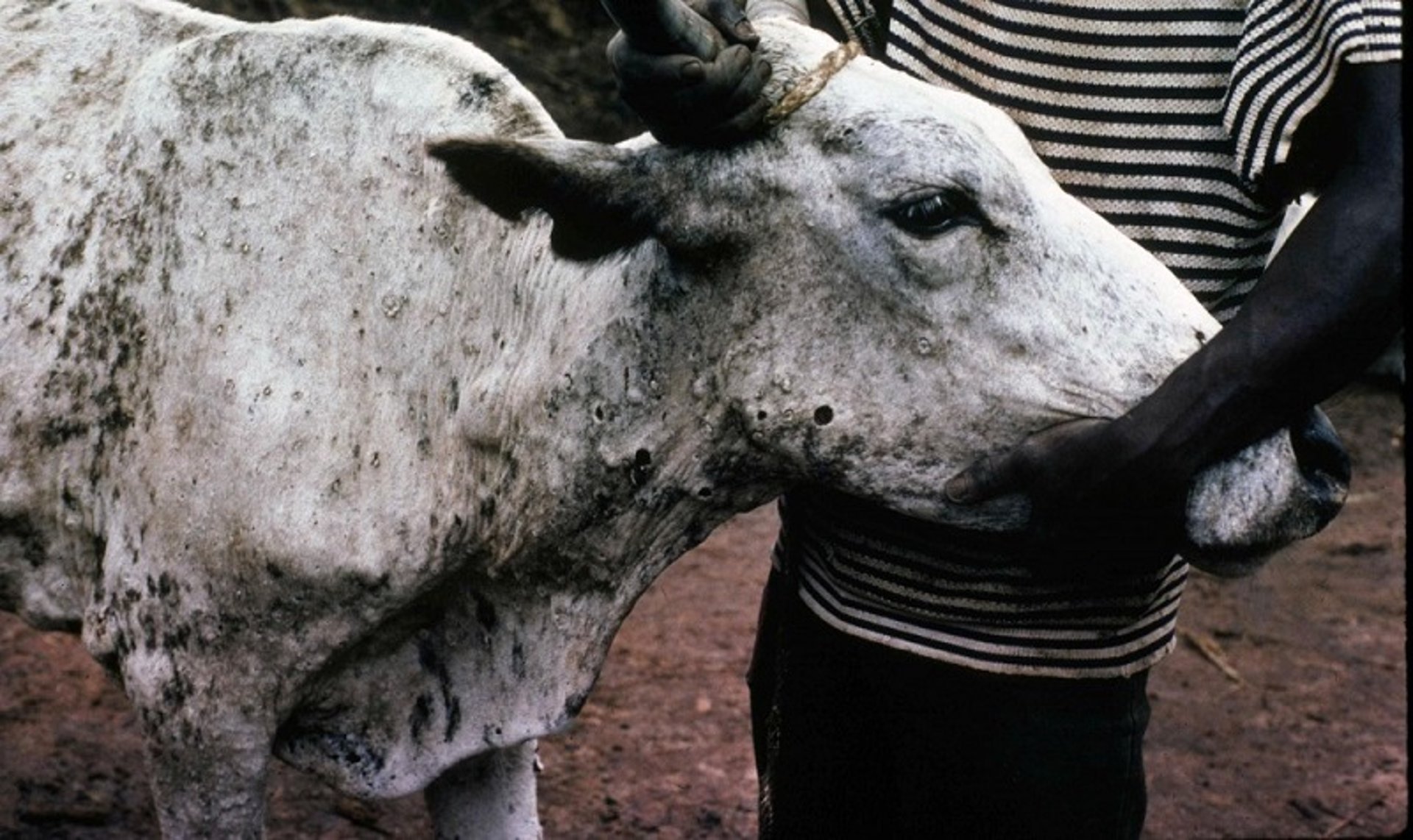
A cow in Ghana, West Africa, with lumpy skin disease ulcers from which the sitfasts have separated. Note also the enlarged superficial cervical lymph nodes (prescapular lymph nodes).
Courtesy of Dr. Max Bonniwell, Oban, Scotland.
Diagnosis of Lumpy Skin Disease in Cattle
PCR assay
Virus isolation
Histological evaluation
Lumpy skin disease can be confused with the less clinically important pseudo–lumpy skin disease, which is caused by a herpesvirus (bovine herpesvirus 2). These diseases can be similar clinically; in many parts of the world, however, herpesvirus lesions are confined to the teats and udders of cows, and the disease is called bovine herpes mammillitis. Differentiation is usually based on clinical signs and can be confirmed by isolation and/or PCR assay.
Dermatophilus congolensis can also cause skin nodules in cattle.
Treatment and Prevention of Lumpy Skin Disease in Cattle
Vaccination
Hygiene
Quarantine
The spread of lumpy skin disease beyond Africa is alarming, and the disease is considered a major global threat by WOAH. Owing to the various mechanisms of LSDV transmission and the environmental resilience of the virus, quarantine restrictions, although important, have proved to be of limited use.
The current approach in Europe is stamping-out culls and emergency vaccination plans.
In areas where lumpy skin disease is more established, vaccination is the best form of control, and several vaccines are available and used in different circumstances. Live attenuated LSDV vaccine provides the best protection; however, there are fears about reversion to virulence and evidence of vaccine strain spread.
Live attenuated sheeppox and goatpox virus vaccines are slightly less protective against lumpy skin disease, but possibly safer in cattle; however, the use of such live vaccines in areas where sheeppox and goatpox viruses are not usually found is considered risky because these vaccine strains could also spread to sheep and goats.
Killed homologous vaccines, although less effective, can provide reasonable protection against lumpy skin disease, and they remove the risk of reversion. However, they require two initial doses, which is not always practicable.
Some live attenuated vaccines have been modified to enable DIVA (differentiating infected from vaccinated animals) tests by either PCR assay or antibody testing, thus enabling eradication approaches that combine vaccination with test-and-cull.
Key Points
Lumpy skin disease was originally limited to southern and eastern Africa but has spread to the Middle East, Asia, and eastern and southern Europe.
The most distinctive clinical sign is the presence of widespread, firm, painful nodules of the skin and mucosal surfaces.
Several vaccines are available to control the spread of infection.
References
World Organisation for Animal Health. Statement on recent lumpy skin disease outbreaks in Europe. Published July 3, 2025. Accessed February 2, 2026. https://www.woah.org/en/statement-on-recent-lumpy-skin-disease-outbreaks-in-europe
Hidayatik N, Khairullah AR, Yuliani MGA, et al. Lumpy skin disease: a growing threat to the global livestock industry. Open Vet J. 2025;15(2):541-555. doi:10.5455/OVJ.2025.v15.i2.5
Byadovskaya O, Prutnikov P, Shalina K, et al. The changing epidemiology of lumpy skin disease in Russia since the first introduction from 2015 to 2020. Transbound Emerg Dis. 2022;69(5):e2551-e2562. doi:10.1111/tbed.14599
Manjunathareddy GB, Saminathan M, Sanjeevakumar L, et al. Pathological, immunological and molecular epidemiological analysis of lumpy skin disease virus in Indian cattle during a high-mortality epidemic. Vet Q. 2024;44(1):1-22. doi:10.1080/01652176.2024.2398211
Anwar A, Na-Lampang K, Preyavichyapugdee N, Punyapornwithaya V. Lumpy skin disease outbreaks in Africa, Europe, and Asia (2005–2022): multiple change point analysis and time series forecast. Viruses. 2022;14(10):2203. doi:10.3390/v14102203
Akther M, Akter SH, Sarker S, et al. Global burden of lumpy skin disease, outbreaks, and future challenges. Viruses. 2023;15(9):1861. doi:10.3390/v15091861