Osteochondrosis is a developmental disorder of medium and large, rapidly growing dogs that is characterized by abnormal endochondral ossification of epiphyseal cartilage in the shoulder, elbow, stifle, and hock joints. Less commonly, it also affects the vertebral end plates.
Although the exact cause of osteochondrosis is unknown, excessive nutrition, rapid growth, trauma, and a hereditary component are suspected contributing factors. As a result of abnormal maturation and vascularity, deeper articular cartilage thickens and weakens, leading to cartilage cracks, fissures, and flap formation (osteochondritis dissecans [OCD]) after minor trauma or normal pressure on the joint.
Abnormal cartilage congruency and joint debris lead to synovitis, subsequent arthritis, and continued cartilage breakdown. Cartilage flaps can break loose ("joint mice") and attach to the joint capsule, get resorbed, or migrate and deleteriously affect joint motion.
Clinical signs of osteochondrosis are lameness, joint effusion, pain, and decreased range of motion in affected joints or limbs.
Locations of lesions associated with osteochondrosis include the caudal aspect of the head of the humerus (shoulder joint), the medial aspect of the humeral condyle (elbow joint), the femoral condyles (stifle joint), and the trochlear ridges of the talus (hock joint). In addition, a fragmented medial coronoid process and ununited anconeal process in the elbow joint might be related conditions.
Radiography is useful in identifying joint lesions associated with osteochondrosis; changes can include flattening of joint surfaces, subchondral bone lucency or sclerosis, osteophytosis, joint effusion, and joint mice (see and radiographs). Arthrography can be used to delineate cartilage flaps, and arthroscopy can also help to identify and guide the treatment of cartilage or joint lesions.

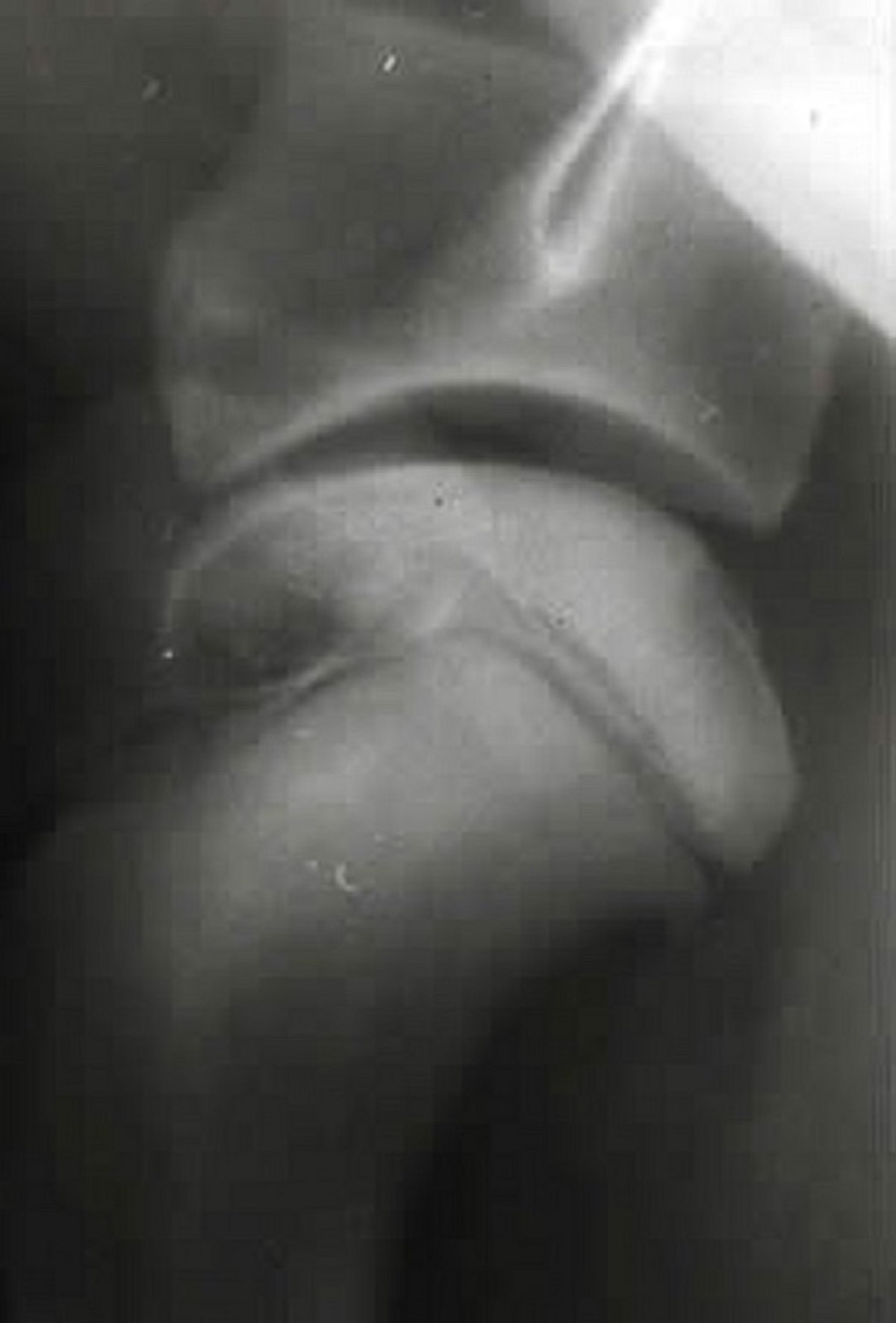
Mediolateral radiographic view of the shoulder joint in a 5-month-old Irish Wolfhound with osteochondrosis. Note the subchondral bone lucency and flattening of the caudal humeral head.
Courtesy of Dr. Ronald Green.

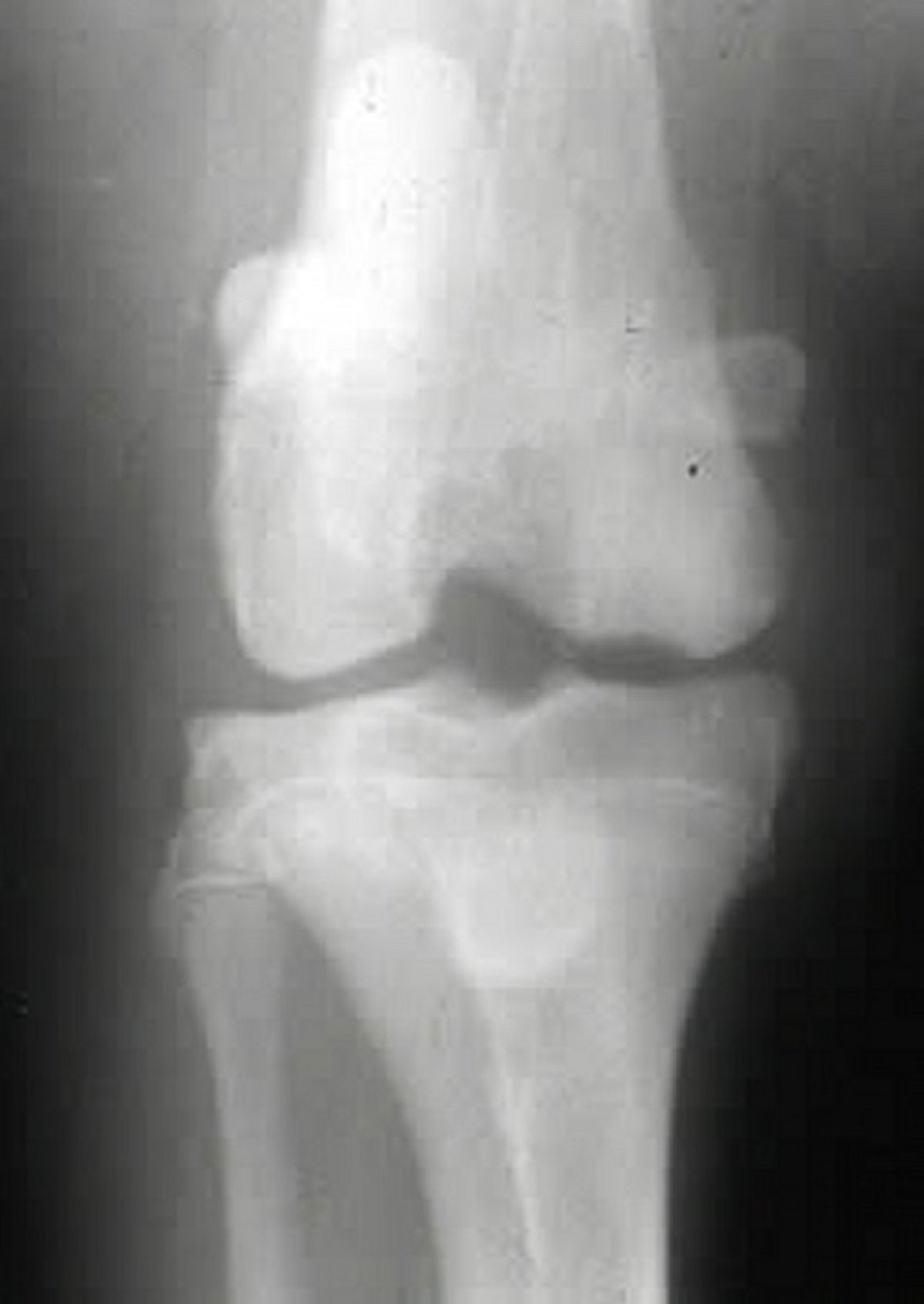
Craniocaudal radiographic view of the right stifle joint in a dog with osteochondrosis. Note the subchondral flattening of the medial femoral condyle.
Courtesy of Dr. Ronald Green.
CT imaging is highly useful for the diagnosis of OCD in dogs, because it provides detailed cross-sectional images that enable precise identification of subchondral bone defects, fragment size, and location—especially in joints where radiographic visualization is limited.
Treatment of osteochondrosis or OCD usually involves surgical excision of cartilage flaps or free-floating fragments, as well as curettage of subchondral bone to stimulate bleeding and fibrocartilage formation. Surgical options such as the osteochondral autograft transfer system (OATS) procedure and implantation of a synthetic allograft system are used in dogs with OCD lesions to restore joint surface congruity and function (resurfacing techniques), particularly in cases of large or nonhealing defects for which traditional curettage and fibrocartilage regeneration might be insufficient.
Animals with associated osteoarthritis (OA) could benefit from a multimodal approach to OA management, including weight management, exercise modification, and analgesics. (See Osteoarthritis in Dogs and Cats for treatment details.)
Nutraceuticalscontaining omega-3 fatty acids (particularly eicosapentaenoic acid [EPA] and docosahexaenoic acid [DHA]) have been reported to have beneficial effects in animals with OA. Various dosages of EPA and DHA have been investigated to treat different conditions, including OA, in companion animals (1).
The disease-modifying osteoarthritis drug (DMOAD) polysulfated glycosaminoglycan (4.4 mg/kg, IM, twice a week for 4 weeks, then once weekly) can also improve cartilage health.
Physical therapy performed by a certified physical therapist (including manual therapies, therapeutic exercises, hydrotherapy, physical therapies such as laser therapy, etc) are beneficial in animals with OA.
Regenerative medicine with intra-articular injections of platelet-rich plasma (PRP) and/or mesenchymal stem cells (MSCs) may also be considered for treating osteochondrosis. Although the use of MSCs is a promising treatment for OA, results from different studies are contradictory. Generally, evidence suggests that affected dogs might improve with intra-articular administration of MSCs and/or PRP. In very degenerated joints, however, this beneficial effect might not be very evident.
The prognosis for recovery from osteochondrosis or OCD is excellent for the shoulders, variable to guarded for the stifle joint, guarded for the elbow, and poorest for tarsal joints. Concomitant signs of degenerative joint disease (DJD), other joint conditions, or instability (hock joint) deleteriously affect recovery.
Key Points
Osteochondrosis is characterized by abnormal endochondral ossification in joints like the shoulder, elbow, stifle, and hock joints, leading to thickened cartilage, flap formation (osteochondritis dissecans [OCD]), and secondary osteoarthritis.
Radiography, arthroscopy, and CT are essential for identifying OCD lesions.
Osteochondrosis is usually treated surgically; multimodal management of associated osteoarthritis is also indicated.
For More Information
Dycus DL. Osteochondritis dissecans (OCD) in dogs. Vet Partner. 2021.
Sutalo S, Kühn M, Böttcher P. Patient-specific synthetic osteochondral resurfacing of an extensive shoulder OCD lesion in a dog. VCOT Open. 2024;7(1):e11-e16.
Franklin SP, Stoker AM, Murphy SM, et al. Outcomes associated with osteochondral allograft transplantation in dogs. Front Vet Sci. 2021;8:759610.
Murphy SC, Egan PM, Fitzpatrick NM. Synthetic osteochondral resurfacing for treatment of large caudocentral osteochondritis dissecans lesions of the humeral head in 24 dogs. Vet Surg. 2019;48(5):858-868.
Morgan JP, Wind A, Davidson AP. Hereditary Bone and Joint Diseases in the Dog: Osteochondroses, Hip Dysplasia, Elbow Dysplasia. Schlütersche; 2000.
Williams K, Hunter T, Yuill C. Osteochondritis dissecans (OCD) in dogs. VCA Animal Hospitals; 2023.
Osteochondrosis of the Shoulder. American College of Veterinary Surgeons.
Also see pet owner content regarding osteochondrosis in dogs.
References
Vendramini THA, Marchi PH, Olivindo RFG, et al. Exploring the efficacy and optimal dosages of omega-3 supplementation for companion animals. Nutr Res Rev. 2025;38(2):859-874. doi:10.1017/S0954422425100115