The sticktight flea (Echidnophaga gallinacea) is an occasional poultry pest in temperate areas and a major poultry pest in the subtropical and tropical New World. These fleas can be common in backyard poultry flocks and in areas where birds spend a lot of time outdoors or interface with wildlife.
Adult sticktight fleas are approximately half the size of cat fleas, dark brown, and laterally flattened (see ).

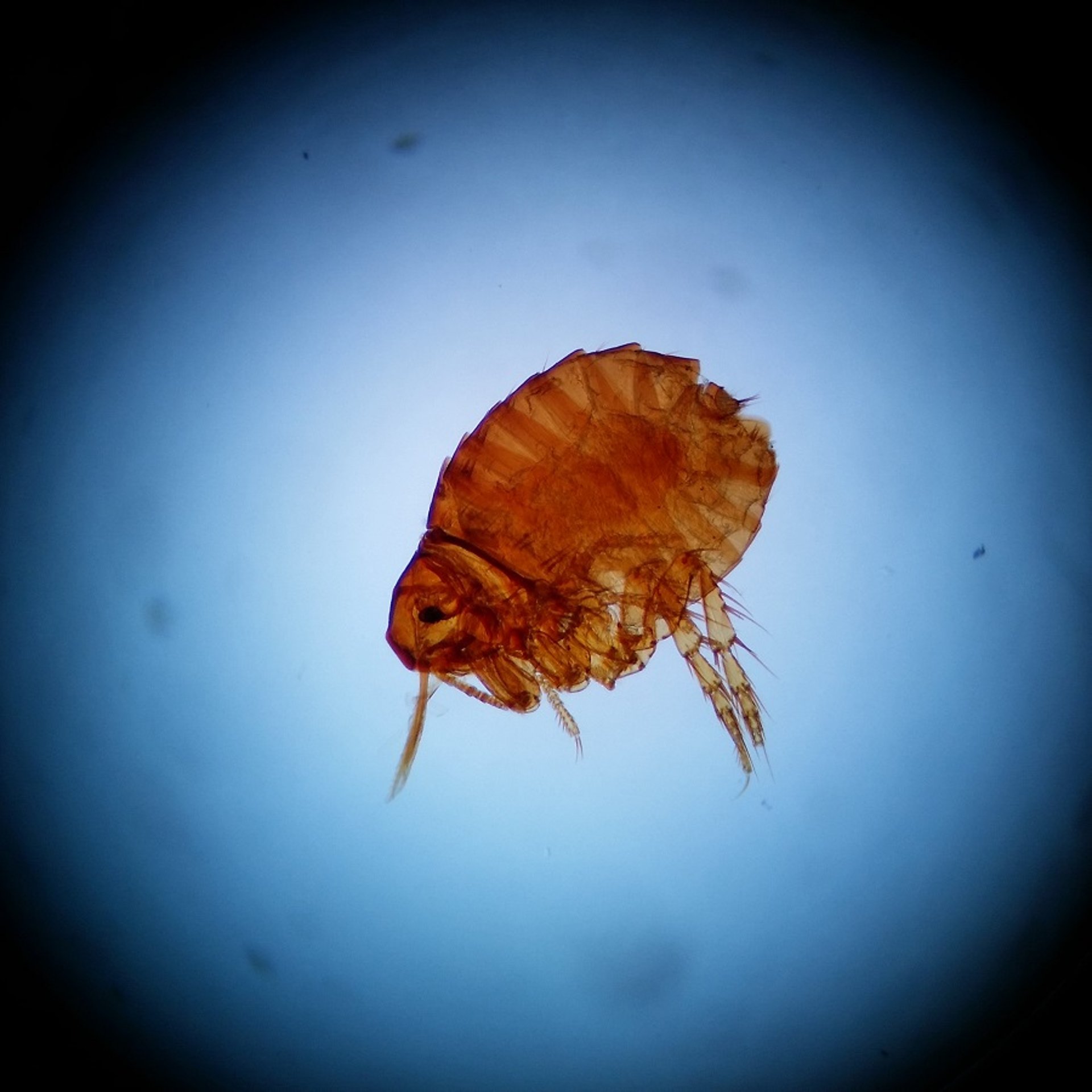
Photomicrograph of an adult sticktight flea, cleared and slide-mounted under light microscopy. Adult fleas are approximately 2 mm long and have a characteristic angular head with elongated mouthparts.
Courtesy of Dr. Amy Murillo.
Adult sticktight fleas embed in the skin of their host for days or weeks. On chickens, they prefer to attach to featherless areas, such as the wattles, comb, or face (see ).

Sticktight flea adults use their elongated mouthparts to embed in the skin of their chicken host. Female fleas remain attached, laying eggs that fall to the ground.
Courtesy of Dr. Amy Murillo.
Without detaching from the host, female sticktight fleas lay their eggs, which fall into the litter or soil. Larvae hatch and live on host blood excreted by adult fleas and on organic material in the litter or soil. Larvae develop best in sandy, well-drained soil. Larvae pupate and later emerge as adults, which then search for a host. This whole cycle takes approximately 1–2 months.
Hosts of adult sticktight fleas include chickens, turkeys, pigeons, pheasants, quail, humans, and many other mammals. Fleas cause irritation, restlessness, and blood loss that results in anemia and death, particularly in young birds.
The western chicken flea, or black hen flea (Ceratophyllus niger), seems to be confined to the Pacific coast area of the US and Canada. It breeds in animal droppings and feeds on birds only occasionally.
The European chicken flea (Ceratophyllus gallinae) is found worldwide. It breeds in nests and litter and is on birds only to feed. In addition to infesting chickens, it attacks many other birds, as well as humans and domestic pets. Heavy flea infestations cause host emaciation and decreased egg production.
The most important flea control measures are to remove infested litter and to dust the litter surface with permethrin or pyrethroids to kill immature fleas. Insect growth regulators such as methoprene are also effective. Adult sticktight fleas can be controlled by topical application of insecticides (typically permethrin) that are approved for on-animal use.
For More Information
Murillo A, Gerry A. Sticktight Flea (Echidnophaga gallinacea [Westwood]). Veterinary Entomology. August 2016. Accessed November 14, 2025.
Koehler PG, Pereira RM, Kaufman PE. Sticktight Flea, Echidnophaga gallinacea. University of Florida IFAS Extension. ENY-244. Updated May 2009. Accessed November 14, 2025.
Durden LA, Hinkle NC. Fleas (Siphonaptera). In: Mullen GR, Durden LA, eds. Medical and Veterinary Entomology. 3rd ed. Academic Press; 2019:145-169.
Knapp FW, Scheibner RA. Fleas affecting livestock and pets. In: Williams RE, Hall RD, Broce AB, Scholl PJ, eds. Livestock Entomology. Wiley-Interscience; 1985:183-189.
Sticktight Flea. Veterinary Entomology.