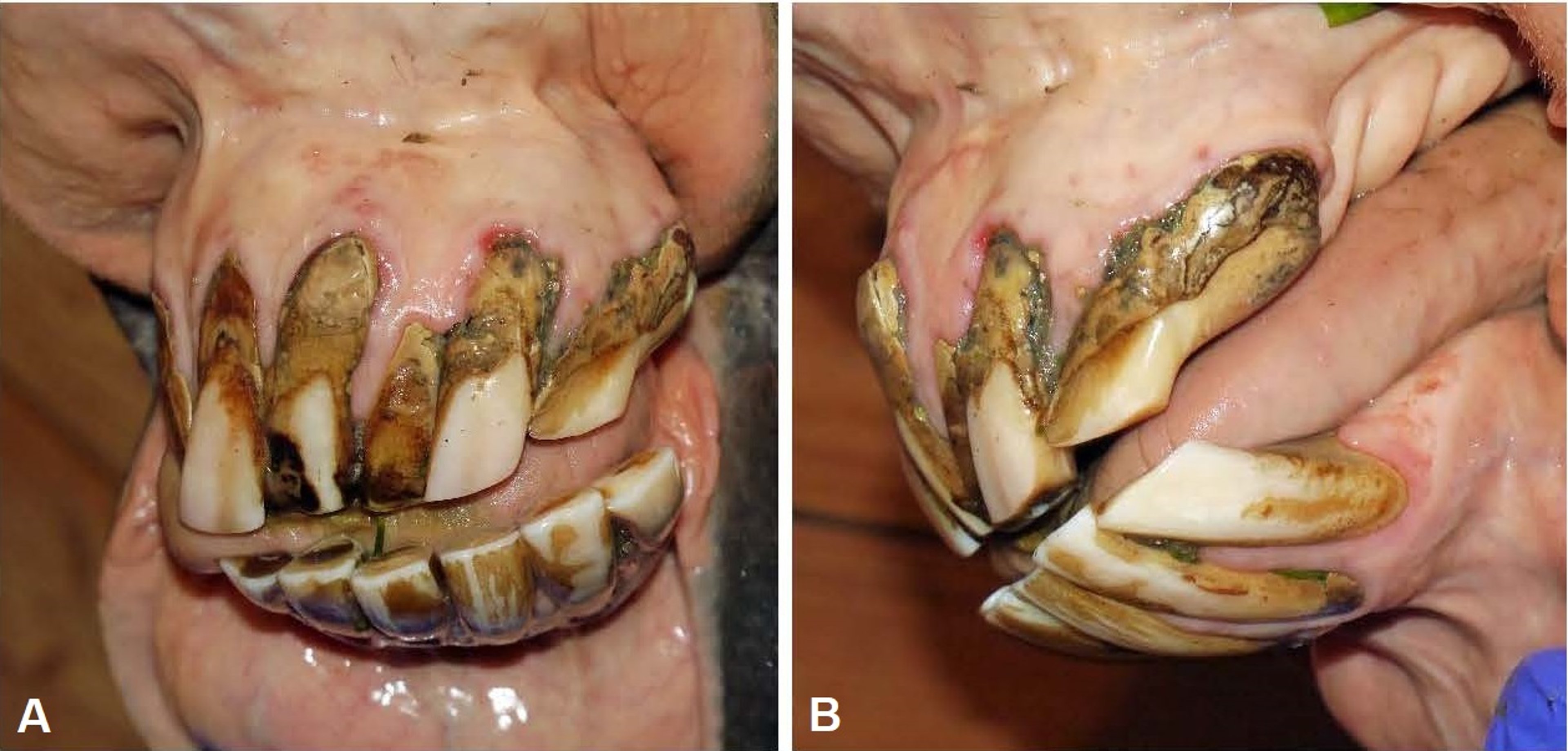
These photographs show severe equine odontoclastic tooth resorption and hypercementosis involving the upper and lower incisor teeth in a 24-year-old mare. The gums are severely recessed, exposing the roots. Yellowish-tan hyperplastic cementum has been deposited over some exposed areas.
Courtesy of Dr. Jack Easley.


Intraoral radiographs of the upper (A) and lower (B) incisors in a 24-year-old mare with severe equine odontoclastic tooth resorption and hypercementosis. The mandibula and maxillary bone appear osteoporotic. The periodontal spaces are irregular and poorly defined. The roots have varying amounts of hypercementosis. The reserve crowns and roots have a moth-eaten appearance, consistent with odontoclastic tooth resorption.
Courtesy of Dr. Jack Easley.
A type of dental disease encountered in older horses that usually involves the incisor and canine teeth is equine odontoclastic tooth resorption and hypercementosis (EOTRH). Internal and external tooth resorption and root hypercementosis are the two pathologic features of this disease. Clinical signs that indicate severe forms of the disease include gum recession, incisor gingivitis with carious-like lesions at the gingival margin of the crown, gingival draining tracts, tooth crown fractures, and discomfort when the incisors are manipulated. Diagnosis and disease staging depend on radiographic evaluation. EOTRH appears to be progressive as horses age, and the etiology is unclear. Incisor extraction is indicated if the patient appears to be suffering from pain induced by this disease.
For More Information
Henry TJ, Puchalski SM, Arzi B, Kass PH, Verstrete FJM. Radiographic evaluation in clinical practice of the types and stage of incisor tooth resorption and hypercementosis in horses. Eq Vet J. 2017; 49:486-492.
Lorello O, Foster DL, Levine DG, Boyle A, Engiles J, Orsini JA. Clinical treatment and prognosis of equine odontoclastic tooth resorption and hypercementosis. Eq Vet J. 2016;48:188-194.