Uterine prolapse is an emergent condition characterized by eversion of the postgravid uterus, immediately or soon after parturition, through the cervix and opening of the vulva. Tension on the vasculature of the uterus can lead to congestion, edema, and necrosis of the uterus if the condition is not identified and corrected promptly. Treatment is to replace the uterus, taking care to ensure that the uterine horns are completely replaced to avoid continued straining and recurrence of the prolapse.
Prolapse of the uterus can occur in any species; it is most common in dairy and beef cows and ewes, and less frequent in sows (see and uterine prolapse images). In a retrospective study, prevalence of uterine prolapse in dairy and beef cattle was reported as 0.6% and 1.0%, respectively (1).

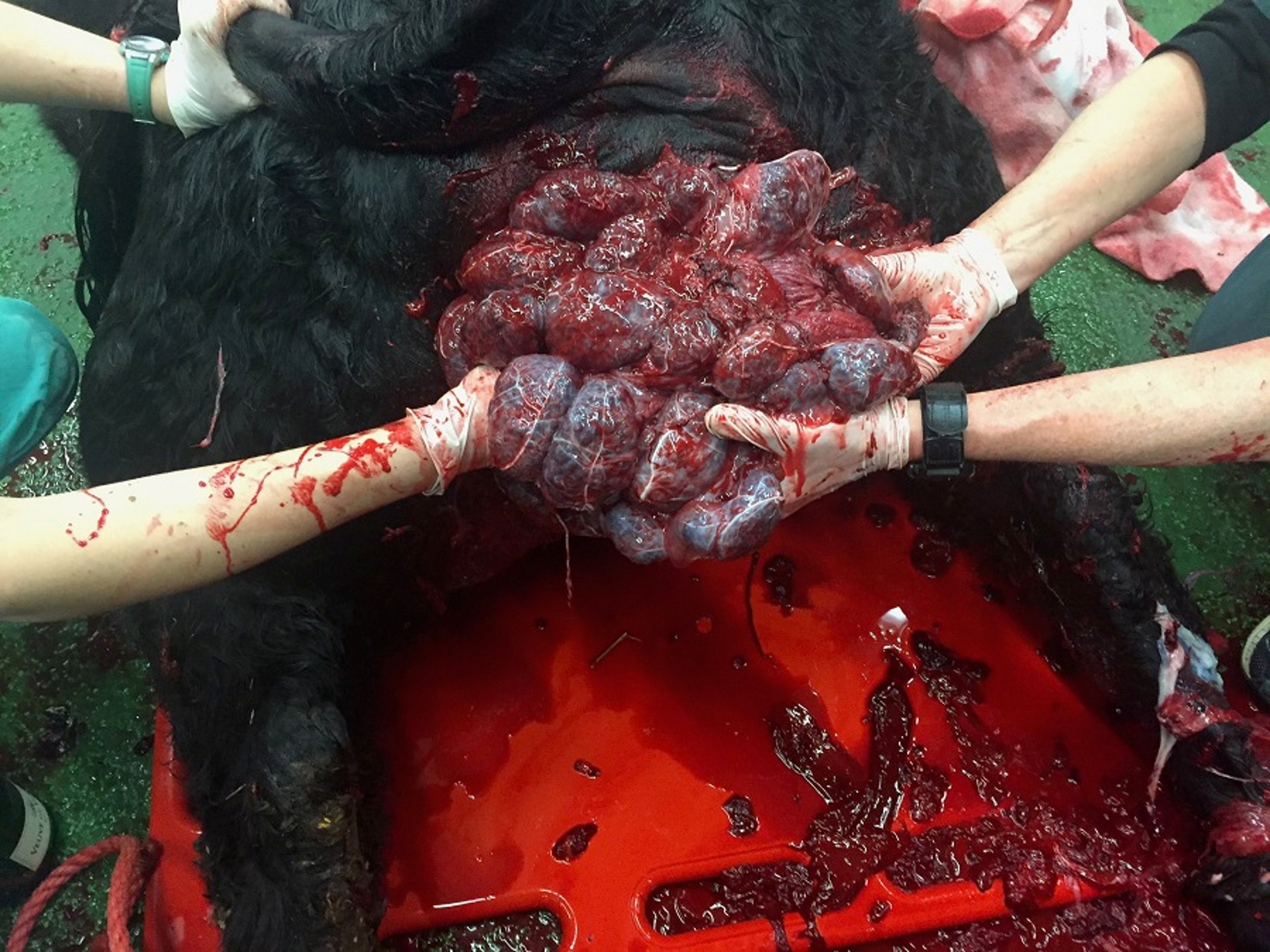
Uterine prolapse in a cow immediately after dystocia. The uterus has been cleaned; however, the fetal membranes are still attached to the caruncles. Forcible removal of fetal membranes should be avoided, and the uterus should be replaced with the fetal membranes still attached, if removal of the latter is not possible without causing trauma to the caruncles. Note the positioning of this cow in sternal recumbency with hindlimbs extended caudally and the uterus elevated to the level of the vulva; this position is often referred to as a "frog-legged" position.
Courtesy of Dr. Jennifer Roberts.


Complete uterine prolapse in a postpartum ewe after cleaning of the uterus and removal of fetal membranes.
Courtesy of Dr. Jennifer Roberts.
Uterine prolapse is rare in mares, bitches, queens, and rabbits.
Invagination of the tip of the uterus, excessive traction to relieve dystocia, prolonged straining due to retained fetal membranes, uterine atony, hypocalcemia, and lack of exercise have all been incriminated as contributory causes of uterine prolapse. In sheep, grazing estrogenic pasture grasses can also be a contributing factor.
Prolapse of the uterus occurs immediately after or within several hours of parturition, when the cervix is open and the uterus lacks tone. Affected cows usually have prolapse of the complete postgravid uterine horn, and the mass of uterus might hang below the tarsi.
The invagination of the contralateral horn, which is prevented from prolapse by the strong intercornual ligament, can be located by careful examination of the surface of the prolapsed organ. In sows, one horn can become everted while unborn piglets in the other horn prevent further prolapse.
In small animals, both uterine horns are usually involved in prolapse of the uterus.
Treatment of Uterine Prolapse and Eversion
Cleaning of prolapsed tissue
Removal of placenta, if appropriate
Epidural anesthetic to aid replacement
Manual replacement of prolapsed tissue
Medical therapy after reduction: oxytocin, calcium
Uterine prolapse is an emergency, and prompt treatment is required to preserve the life and future reproductive potential of the affected animal.
Pearls & Pitfalls
|
In cows, treatment of uterine prolapse involves gentle removal of the placenta (if still attached), thorough cleaning of the endometrial surface, and surgical repair of any full-thickness lacerations. If the fetal membranes do not separate easily, they should be left attached to the uterus to avoid damage to the underlying caruncular tissue. Applying sugar to the surface of the uterus or rinsing it with hypertonic saline solution might help to decrease edema and aid reduction of the prolapse. An epidural anesthetic should be administered before attempting to replace the uterus (ie, return it to its normal position).
If a cow with uterine prolapse is standing, the cleansed uterus should be elevated to the level of the vulva on a tray or hammock supported by assistants. If recumbent, the patient should be positioned sternally, with the hindlimbs extended caudally so that the cow is resting on its stifles (see ). This position tilts the pelvis cranially and ventrally to aid in replacement of the uterus.


To facilitate replacement of the prolapsed uterus in a recumbent cow, the cow should be placed in sternal recumbency with the hindlimbs extended caudally, as shown here.
Courtesy of Dr. Jennifer Roberts.
When elevating the cow's hindquarters to extend the hindlimbs caudally, care should be taken to lift the prolapsed uterus along with the hindquarters to prevent stretching and laceration of the uterine artery.
After cleaning the prolapsed organ, reduction of uterine prolapse in a cow is achieved by applying steady pressure beginning at the cervical portion (or at the level of the invagination of the non-prolapsed uterine horn) and gradually working toward the apex. Lubrication can be applied at the level of the cervix to facilitate replacement of the prolapse.
Depending on the duration of the prolapse, the tissue might be edematous and friable, and extreme care should be taken in handling the prolapsed tissue. To avoid perforating the uterus, a closed fist or palm (rather than fingertips) should be used to apply pressure.
After the cow's uterus has been replaced, a hand should be inserted to the tip of both uterine horns to make sure there is no remaining invagination that could incite abdominal straining and another prolapse. Instillation of warm, sterile saline solution is useful to ensure complete replacement of the tip of the uterine horn without trauma.
After replacement of the uterus in a cow, oxytocin may be administered to encourage uterine contraction and evacuation of fluid. For cows in which hypocalcemia is the inciting cause of uterine atony and prolapse, IV and oral calcium should also be administered. Neither oxytocin nor calcium is recommended before treatment of the prolapse, because treatments can make replacement of the uterus more difficult.
Pearls & Pitfalls
|
The method of replacing a prolapsed uterus in mares is similar to the method in cows, usually with the mare sedated but standing, and with care taken not to perforate the uterus.
In sows and small animals, the uterus can be repositioned by simultaneously manipulating the prolapsed tissue from outside with one hand and via an abdominal incision (laparotomy) with the other. Resection of the uterus is indicated in chronic cases in which tissue necrosis has occurred.
After the uterus has been returned to its normal position in sows and small animals, oxytocin is administered to increase uterine tone. IV administration of calcium-containing solutions is indicated when hypocalcemia is a contributing factor, and also as a means of increasing uterine tone.
The use of Caslick sutures or other forms of vulvar retention sutures is controversial and might not be useful for uterine prolapse, because prolapse begins at the apex of the uterine horn. However, many clinicians still use vulvar sutures such as the Buhner stitch (see ) or shoelace suture, particularly in cattle.
Prevention of uterine prolapse recurrence depends on complete and correct replacement of the uterus and restoration of uterine tone.
Complications of uterine prolapse tend to develop when laceration, necrosis, and infection occur, or when treatment is delayed. Shock, hemorrhage, and thromboembolism are potential sequelae of a prolonged prolapse.
Uterine artery rupture due to excessive stretching of the vessel by the weight of the prolapsed uterus can result in sudden death. Death might occur before or immediately after replacement, and a case mortality of 8.3% has been reported (1).
Sometimes the bladder and intestines prolapse into the everted uterus. Prolapse of abdominal organs within the prolapsed uterus can be difficult to diagnose but should be considered as a differential when it is not possible to reduce the uterine prolapse. Ultrasonography can be used as a diagnostic tool to determine whether intestine or bladder is present within the prolapsed uterus. These organs require careful replacement before the uterus is replaced.
The bladder can be drained with a catheter or needle passed through the uterine wall. Elevation of the hindquarters and pressure on the uterus aid in the replacement of bladder and intestines. It might be necessary to incise the uterus carefully (in a longitudinal direction), thus entering the abdomen, to replace these organs directly.
In cows, amputation of a severely traumatized or necrotic uterus might be the only way to save the animal after uterine prolapse. To amputate a prolapsed uterus, transfixation sutures or a circumferential ligature using a castration bander are applied around the prolapsed tissue at the level of the cervix. The cervix is transected to remove the uterus, and the stump is replaced through the vulva.
Complications after replacement of the uterus can include retained fetal membranes, metritis, or endometritis.
The prognosis for animals with uterine prolapse depends on the amount of injury and contamination of the uterus. When the uterus is clean, minimally traumatized, and promptly replaced, the prognosis is favorable.
Although there is no tendency for uterine prolapse to recur at subsequent parturitions, in cows the condition has been associated with an increased risk of reproductive failure during the next breeding season. In one report, however, > 80% of affected cows conceived via artificial or natural breeding after recovery from uterine prolapse (1).
Key Points
Uterine prolapse is an emergent condition with potentially fatal complications that must be addressed as quickly as possible to avoid negative outcomes.
Treatment consists of lavage of the everted uterine tissue, careful handling during replacement, and postreplacement monitoring for the development of associated conditions such as retained fetal membranes, metritis, and endometritis.
Unlike vaginal prolapse, the risk of uterine prolapse is not increased in subsequent pregnancies, and in uncomplicated cases the prognosis is favorable for return to normal reproductive function.
For More Information
Parkinson TJ, Noakes DE. Injuries and diseases consequent upon parturition. In: Noakes DE, Parkinson TJ, England GCW, eds. Veterinary Reproduction and Obstetrics. 10th ed. Saunders Ltd.; 2019:333-348.
Miesner MD, Anderson DE. Management of uterine and vaginal prolapse in the bovine. Vet Clin North Am Food Anim Pract. 2008;24(2):409-419.
Also see pet owner content regarding uterine prolapse in horses.
References
Carluccio A, De Amicis I, Probo M, Giangaspero B, Veronesi MC. Prevalence, survival and subsequent fertility of dairy and beef cows with uterine prolapse. Acta Vet Hung. 2020;68(1):91-94. doi:10.1556/004.2020.00017