Vaginal and cervical prolapses in cattle and sheep occur most commonly in late gestation and are characterized by protrusion of the soft tissue of the vagina and vaginal mucosa from the opening of the vulva. Continued exposure of the vaginal mucosa can lead to irritation, ulceration, and subsequent vaginitis. Treatment should focus on reduction of the prolapse and, if necessary, vulvar or vaginal retention sutures. Care should be taken to monitor animals before parturition and to remove any retention sutures so that parturition can progress without obstruction.
Eversion and prolapse of the vagina, with or without prolapse of the cervix, occurs most commonly in cows and ewes, usually in mature animals in the last trimester of pregnancy. A form of vaginal prolapse also occurs in bitches.
Predisposing factors for vaginal prolapse include the following:
increased intra-abdominal pressure associated with the gravid uterus
increased intra-abdominal or intrapelvic fat
rumen distention
relaxation and softening of the pelvic girdle and associated soft tissue structures of the pelvic canal and perineum in late gestation, mediated by increased circulating concentrations of estrogens and relaxin
In recumbent animals, increased intra-abdominal pressure can cause further eversion of the vaginal tissue.
Docking the tails of lambs can damage structures that support the pelvic girdle (eg, the coccygeus muscle) and predispose the animal to vaginal prolapse if the tail is docked too proximally. Therefore, the tail should be removed at the level of the ventral skin fold, leaving two or three coccygeal vertebrae intact.
Vaginal prolapse begins as an intussusception-like folding of the vaginal floor just cranial to the vestibulovaginal junction. Discomfort caused by this eversion, coupled with irritation and swelling of the exposed mucosa, results in straining and more extensive prolapse. Eventually, the entire vagina might be prolapsed, with the cervix visible at the most caudal part of the prolapsed tissue (see ).

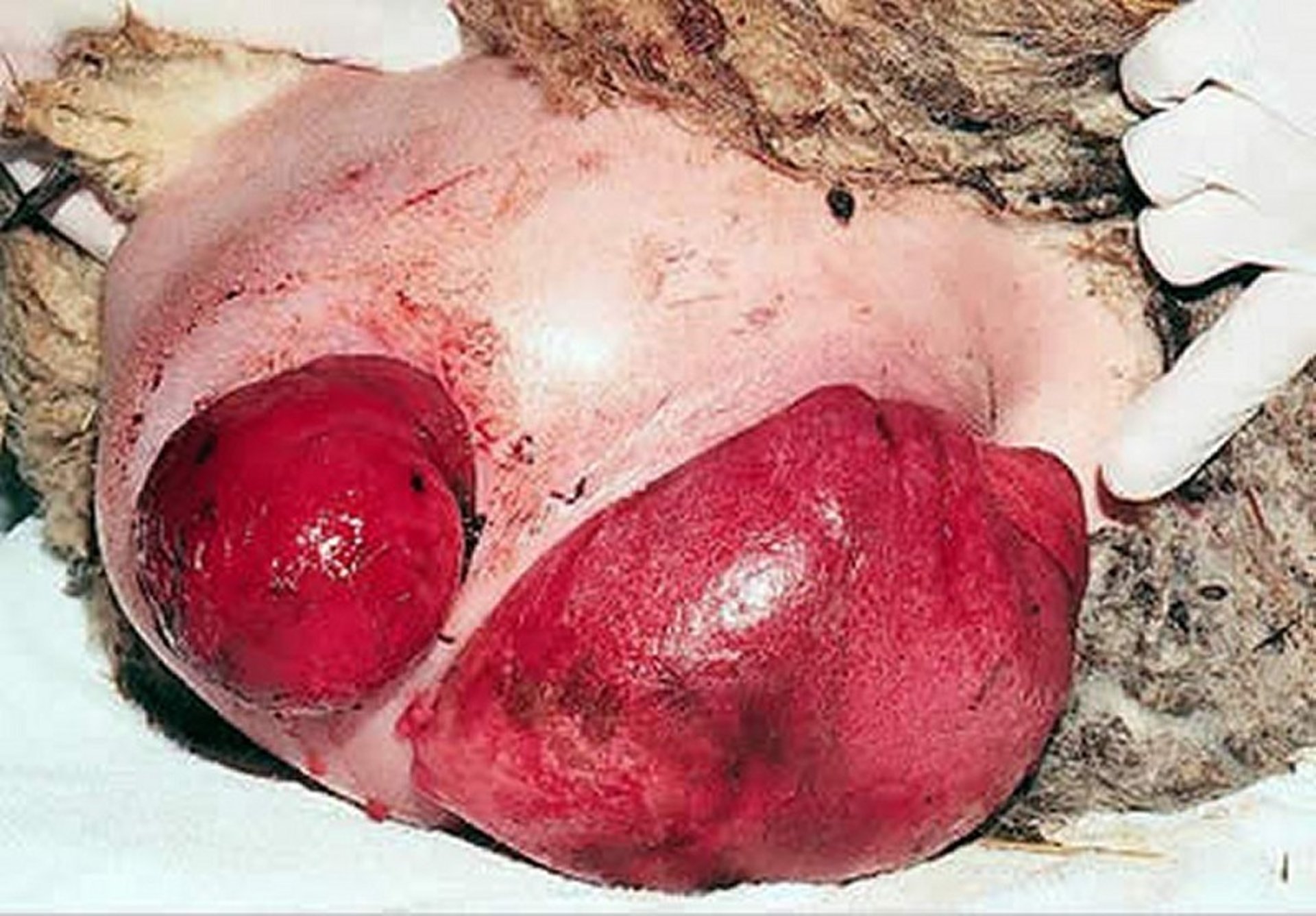
A late-gestation ewe in left lateral recumbency. Both prolapsed caudal vaginal mucosa (right) and rectal prolapse (left) due to persistent straining are present.
Courtesy of Dr. Robert M. Lofstedt.
The bladder or loops of intestine might be contained within the prolapsed vagina. Entrapment of the bladder within the prolapsed vagina can cause occlusion of the urethra. The bladder then fills and enlarges, hindering correction of the vaginal prolapse unless the bladder is drained. In rare cases, the bladder can rupture with potentially fatal consequences.
Vaginal prolapse is categorized as follows:
Grade I: intermittent prolapse, often visible only when the animal is recumbent; vaginal tissues might appear normal (see )
Grade II: continuous acute prolapse of vaginal tissue
Grade III: continuous acute prolapse of the vagina, bladder, and cervix
Grade IV: chronic prolapse of either grade II or III with resultant trauma, infection, or necrosis (see and grade IV images)


Grade I vaginal prolapse in a dairy cow in late gestation. The prolapse was present while the cow was recumbent but resolved when the cow stood up.
Courtesy of Dr. Jennifer Roberts.

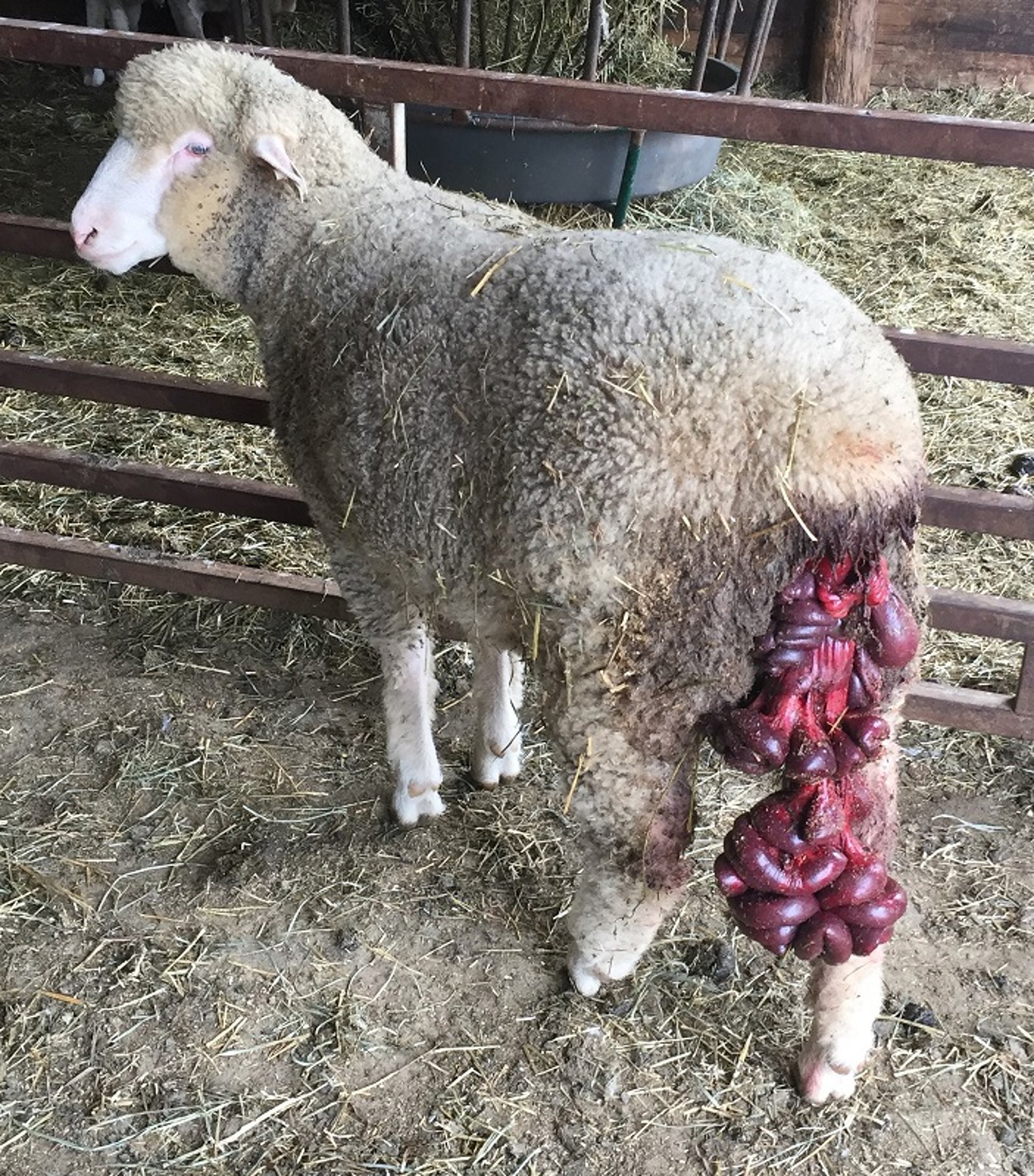
This ewe was previously diagnosed with a grade II vaginal prolapse. Despite placement of a retention suture, the ewe continued to strain, resulting in rupture of the vaginal wall and subsequent evisceration. The resulting trauma elevated the prolapse grade from II to IV. Treatment in this case was humane euthanasia.
Courtesy of Dr. Jennifer Roberts.


This late-gestation, multiparous Holstein cow presented with a grade I vaginal prolapse. The prolapse eventually progressed to grade IV with continuous eversion of the vagina and cervix and necrosis of the vaginal tissue. Although the cow calved normally, she was culled from the herd because of the likelihood of vaginal prolapse recurrence in her next pregnancy.
Courtesy of Dr. Jennifer Roberts.
Although vaginal prolapse is the most common in mature animals in late pregnancy, it can also occur in young, nonpregnant ewes and heifers, especially in fat animals. Predisposing factors include grazing of estrogenic plants (especially Trifolium subterraneum), consumption of feeds contaminated with estrogenic molds, or exogenous administration of estrogenic compounds (usually in the form of growth-promoting implants).
Cervicovaginal prolapse is more common in stabled animals than in pastured animals, suggesting that lack of exercise might be a contributing factor. Vaginal prolapse can also be a problem in cows subjected to repeated superovulation for embryo recovery, because of repeated exposure to supraphysiological estrogen concentrations. Vaginal prolapse can occur also after dystocia due to excessive straining caused by trauma to the tissues of the caudal reproductive tract.
A genetic component in the pathogenesis of cervicovaginal prolapse is likely, because a breed predisposition exists in both cattle (Brahman, Brahman crossbreeds, Hereford) and sheep (Kerry Hill, Romney). In pigs, vaginal prolapse is often associated with estrogenic activity of mycotoxins.
Treatment of Vaginal and Cervical Prolapse in Cattle and Sheep
Epidural anesthetic
Cleaning and lubrication of prolapsed tissue
Manual reduction
Possible Buhner suture placement to prevent recurrence
For replacement of a prolapsed vagina, an epidural anesthetic is first administered. The affected tissues are lavaged, and the bladder emptied, if necessary. Usually, vagina replacement can be achieved by elevating the prolapsed tissue to enable straightening of the urethra and drainage of the bladder; occasionally, however, needle puncture of the bladder through the vaginal wall is necessary. The vagina is well lubricated and replaced and then held in position until it feels warm again.
Retention is achieved after vaginal replacement by insertion of a Buhner suture—a deeply buried, circumferential suture placed around the vestibulum to provide support at the point of initial eversion of the vaginal wall (see ). This purse-string suture should be tightened to allow enough of an opening at the ventral commissure for urination (approximately 3–4 cm, or 2–3 finger widths).


A Buhner suture has been placed circumferentially around the vestibule in this cow. The suture is tied in a bow just below the ventral commissure of the vulva. The purse-string type suture is tightened enough to leave an opening of approximately 3 cm so that the animal can urinate freely. The loop at the dorsal commissure aids in removal of the suture. At the time of removal, the bow is untied and the suture removed by pulling up on the dorsal loop.
Courtesy of Dr. Jennifer Roberts.
The Buhner suture, or variations including a horizontal mattress or shoelace pattern, have largely superseded methods that relied on placement of a retention device within the vagina (which tend to cause discomfort and further straining).
A modification of the Buhner suture to include an exposed, horizontal mattresslike suture has the advantage of remaining in place even when vestibulovaginal tissues have little holding power. The traditional Buhner suture can be prone to tearing through the tissues of the dorsal or lateral vestibular vaginal wall.
The Buhner suture and its modifications are implemented to replicate the support normally provided by the constrictor vestibuli muscles, which are weakened in patients with vaginal prolapse. Animals with Buhner sutures should be monitored closely for signs of parturition so that the sutures can be removed before delivery to prevent extensive laceration of the vagina and vulva.
Pearls & Pitfalls
|
Permanent fixation of the vagina can be achieved by means of the Johnson button technique, whereby sutures are placed via the vagina, through the sacrospinotuberal ligament and gluteal muscles, and then anchored in the vagina and the skin with large, flat disks. Vaginal fixation can also be accomplished by anchoring the cervix to the prepubic tendon or iliopsoas muscles.
Fixation using the Johnson button technique enables parturition to proceed unimpeded by the vaginopexy. Although the cervical os might be edematous and inflamed, cervicovaginal prolapse seldom interrupts pregnancy and does not specifically predispose the animal to dystocia or postpartum uterine prolapse, which has a different etiology.
Vaginal prolapse in sheep can occur simultaneously in many ewes as a herd problem, making surgical treatment impractical. In these cases, commercially available vaginal retention devices (bearing retainers) might be useful. Sheep can lamb successfully with these devices in place.
Permanent fixation techniques (cervicopexy or vaginopexy) have been described in which the cervix or vaginal wall is anchored to other pelvic structures. Such procedures can be useful in individual animals with chronic or recurrent prolapse; however, most cases are resolved by an appropriately placed Buhner suture.
Complications can arise if vaginal prolapse is not treated promptly; these include peritonitis and vaginal wall rupture. The latter can lead to evisceration in the affected animal, requiring humane euthanasia.
In cattle and sheep, vaginal prolapse has a hereditary component and therefore is likely to recur in subsequent pregnancies. Because of the likelihood of recurrence, females with vaginal prolapse should be culled from the herd or flock.
Key Points
Vaginal prolapse is most often diagnosed in late gestation; however, it does not generally impede parturition.
Vaginal prolapse can be caused by factors related to an animal's genetics or conformation.
Because vaginal prolapse is likely to recur in subsequent gestations, culling after delivery and weaning of offspring is recommended.
Prompt diagnosis and replacement of the prolapse incorporating retention sutures is critical for successful management.
For More Information
Noakes DE. Prolapse of the cervix and vagina. In: Noakes DE, Parkinson TJ, England GCW, eds. Veterinary Reproduction and Obstetrics. 10th ed. Saunders Ltd.; 2019:195-201.
Miesner MD, Anderson DE. Management of uterine and vaginal prolapse in the bovine. Vet Clin North Am Food Anim Pract. 2008;24(2):409-419.
Also see pet owner content regarding vaginal overgrowth in dogs.