Abomasal displacement and abomasal volvulus are common disorders of high-producing dairy cattle. Clinical signs include anorexia and decreased milk production. With abomasal volvulus, patient deterioration is rapid. The most important diagnostic finding is a ping upon simultaneous percussion and auscultation of the abdomen. Conservative (medical) treatment for left abomasal displacement can be successful, especially if the diagnosis is made early; however, recurrence is likely. For right abomasal displacement, prompt surgical correction is advised and is always required, because of the high risk for volvulus. Improved management techniques help to decrease the frequency of abomasal displacement in dairy herds.
Displacement and volvulus of the abomasum occur most commonly in dairy cows; they can also occur in dairy bulls and calves. Except for abomasal volvulus, abomasal displacement is rare in beef cattle.
Because the abomasum is suspended loosely from the greater omentum and lesser omentum, it can move from its normal position on the ventral part of the abdomen to the left or right side, or it can rotate while displaced to the right:
Left displaced abomasum (LDA) is displacement of the gas-filled, distended abomasum from the ventral abdominal wall to the left side of the abomasum, trapping it between the rumen and the abdominal wall.
Right displaced abomasum (RDA) is displacement of the gas-filled, distended abomasum from the ventral abdominal wall to the right side of the abomasum, trapping it between the right body wall and the liver.
Abomasal volvulus (AV) is caused by vertical and horizontal rotation of an RDA.
The abomasum can shift from its normal position along the right ventral abdomen to either left or right displacement over a relatively short period, and it can move repeatedly between its normal anatomical position and a displaced position (a condition called "pendulous left displaced abomasum").
AV can develop rapidly or slowly from an RDA. LDA and RDA result in partial ileus; AV leads to complete ileus and abomasal wall ischemia.
Etiology of Abomasal Displacement and Volvulus in Cattle
Although LDA, RDA, and AV are often considered separately, there is evidence of a common underlying etiology; they might be different manifestations of the same or a similar disease process.
The etiology of displaced abomasum and AV is multifactorial. Decreased abomasal emptying by abomasal hypomotility and/or dysfunction of the intrinsic nervous system are thought to play an important role.
Important factors that contribute to LDA, RDA, and AV include abomasal hypomotility associated with hypocalcemia and hypokalemia, as well as concurrent diseases (mastitis, metritis) associated with endotoxemia, low dry matter intake and decreased rumen fill, periparturient changes in the position of intra-abdominal organs, and genetic predisposition, particularly in deep-bodied cows.
Hypomotility is also related to ingestion of high-concentrate, low-roughage diets, which decrease abomasal motility through a poorly defined mechanism that might involve hyperinsulinemia or increased concentrations of volatile fatty acids.
Whether one of the mechanisms of excessive gas accumulation in cattle with abomasal displacement is the reticulum-mediated inflow of ruminal gas into the hypomotile abomasum is debatable, but it seems less likely.
Abrupt changes to high-concentrate diets can result in increased gas production in the abomasum.
Finally, metabolic disturbance leading to hyperketonemia (ketosis) increases the risk of abomasal displacement via an unknown mechanism that might be associated with decreased rumen fill.
A consistent diet with adequate physically effective fiber and maximal dry matter intake in the peripartum period, as well as improved cow comfort and adequate body condition throughout the peripartum period, contribute greatly to the prevention of LDA, RDA, and AV (1).
Approximately 80–85% of abomasal displacements occur within 1 month after parturition; however, they can occur at any time, including during late pregnancy (2). RDA and AV cases are also common in the postparturient period; however, the association with calving is not as strong as with LDA.
For most species, LDA is much more common than RDA (30 LDA:1 RDA). Cases of AV are also more common than RDA (10 LDA:1 AV). AV is thought to be preceded by RDA (3).
Pathogenesis of Abomasal Displacement and Volvulus in Cattle
In left displaced abomasum, as a result of abomasal hypomotility and gas production, the partially gas-distended abomasum becomes displaced, buoying upward along the left abdominal wall lateral to the rumen (see ). The corpus of the abomasum and greater curvature of the abomasum are primarily displaced, causing displacement of the pylorus and duodenum. The omasum, reticulum, and liver are also rotated to varying extents.


A. Normal topography of the left abdominal viscera in a cow. B. Left displacement of the abomasum.
Illustration by Dr. Gheorghe Constantinescu. Adapted, with permission, from DeLahunta and Habel, Applied Veterinary Anatomy, W. B. Saunders, 1986.
The abomasal obstruction in LDA cases is partial, and although the segment contains some gas and fluid, some can still escape, and the distention rarely becomes severe. Because there is minimal interference with blood supply unless the gas distention is marked, the effects of displacement are due entirely to interference with digestion and passage of ingesta, which lead to decreased appetite and dehydration.
Mild metabolic alkalosis with increased serum bicarbonate concentrations, hypochloremia, and hypokalemia is common in LDA. The hypochloremic metabolic alkalosis is due to abomasal hypomotility and partial abomasal outflow obstruction, leading to the continued secretion of hydrochloric acid being sequestered in the abomasum, with reflux into the rumen over time.
Hypokalemia in LDA cases is due to decreased intake of feeds high in potassium, sequestration of potassium in the abomasum, and dehydration. Secondary ketosis is common and can be complicated by the development of hepatic lipidosis (fatty liver disease).
In right displaced abomasum, hypomotility, gas production, and displacement of the partially gas-filled abomasum occur as in LDA. Mild hypochloremic, hypokalemic metabolic alkalosis develops as well. After this dilation phase, rotation of the abomasum can progress to volvulus (AV), which can lead to complete obstruction of abomasal outflow. As much as 50 L of chloride-rich fluid can accumulate in the abomasum and worsen the extent of hypochloremic, hypokalemic metabolic alkalosis.
Volvulus usually occurs in a counterclockwise direction when viewed from the rear and the right side of the animal (see ). The omasum is displaced medially and can be involved in the volvulus, with occlusion of its blood supply (called "omasal-abomasal volvulus") and displacement of the liver and reticulum. In rare cases, the reticulum can be involved in the volvulus (termed "reticular-omasal-abomasal volvulus").

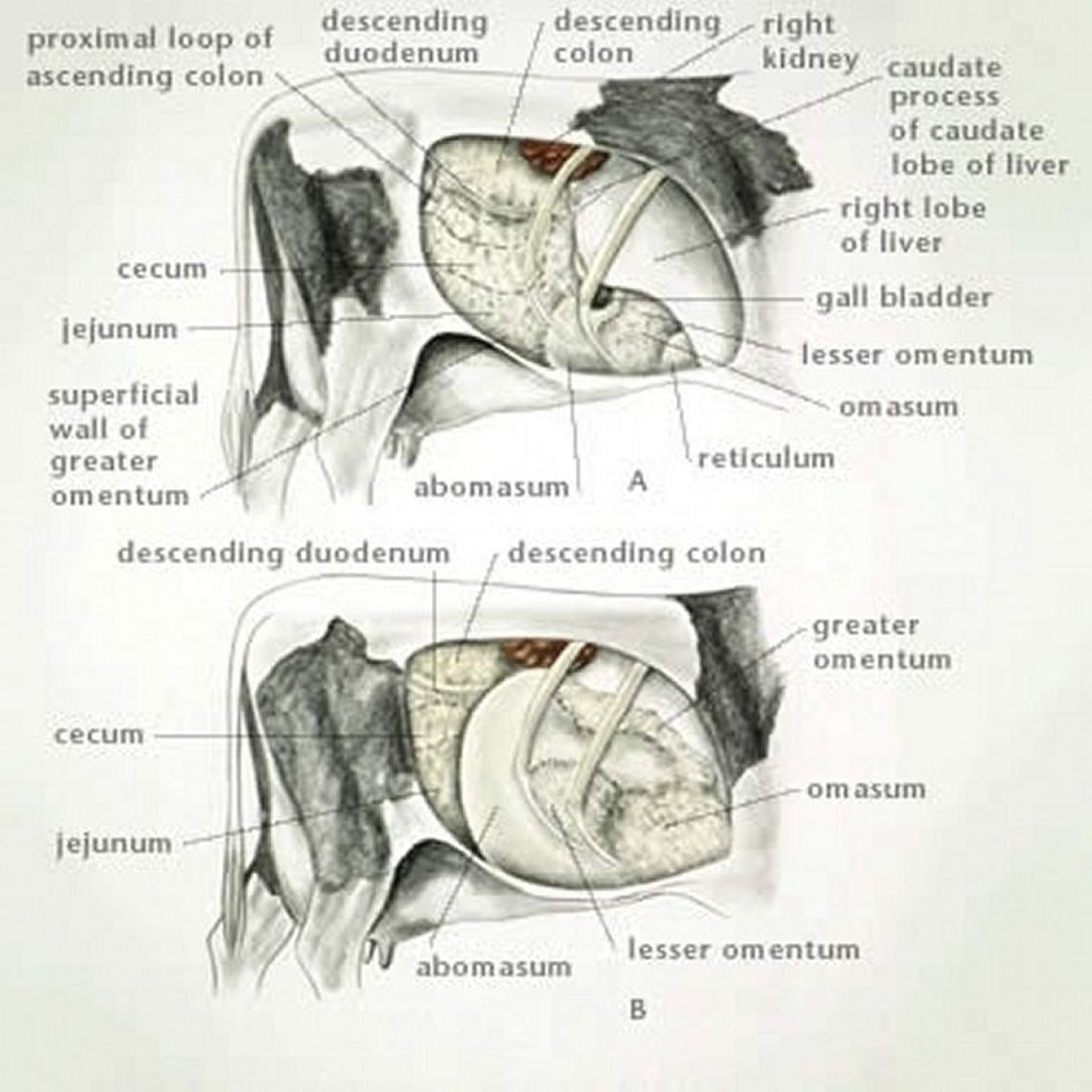
A. Normal topography of the right abdominal viscera in a cow. B. Right displacement of the abomasum with volvulus.
Illustration by Dr. Gheorghe Constantinescu. Adapted, with permission, from DeLahunta and Habel, Applied Veterinary Anatomy, W. B. Saunders, 1986.
The volvulus leads to local circulatory impairment (hemorrhagic strangulating obstruction) of the abomasum, and often the omasum and proximal duodenum become compromised. Eventually, ischemia of the abomasum and proximal duodenum, as well as dehydration and circulatory compromise, develop. As circulatory failure progresses, metabolic acidosis due to hyper-l-lactatemia and azotemia can develop along with the preexisting metabolic alkalosis.
In cattle with AV, a blood l-lactate concentration ≤ 2 mmol/L indicates a positive outcome of surgical correction. Cattle with blood l-lactate concentrations ≥ 6 mmol/L have a high probability of a negative outcome (4, 5). Moreover, l-lactate concentrations are generally higher in cattle with AV than in those with RDA (4).
Pearls & Pitfalls
|
Clinical Findings of Abomasal Displacement and Volvulus in Cattle
The typical history of abomasal displacement includes anorexia (usually, initially as a lack of appetite for grain with a decreased or normal appetite for roughage that progresses to complete anorexia) and a variable decrease in milk production.
Rumen motility might be normal, but it is often decreased in frequency and strength of contraction. Feces usually are decreased in quantity and contain more fluid than normal, but they can be of normal or dry consistency. Hyperketonemia and clinical signs of ketosis can develop before, concurrently with, or secondary to displacement of the abomasum.
In abomasal volvulus, anorexia is complete, milk production is more markedly and progressively decreased, and clinical deterioration is rapid. By contrast, in cases of left or right displaced abomasum, temperature, heart rate, and respiratory rate can be normal. Elevated heart rate is an indicator of poor prognosis in cows with RDA (6, 7).
Unlike simple displacement, AV is accompanied by tachycardia proportional to the severity of the condition. The caudal part of the rib cage on the side of the displacement might appear “sprung,” meaning that the rib cage is pushed laterally.
Hydration appears subjectively normal with LDA, except in some chronic cases; in contrast, dehydration and signs of vascular compromise occur very early with AV. However, early AV can be difficult to distinguish from RDA on the basis of clinical findings.
The area of the ping in early AV is usually larger (extending as far forward as rib 8) than in RDA, and the amount of succussible fluid is greater. The animal is more depressed, and signs of weakness, toxemia, and dehydration develop as the disease progresses. The caudal extent of the abomasum is usually palpable per rectum in AV. In addition, measurement of serum L-lactate concentration can help differentiate between early AV and RDA.
Without treatment, cattle with AV often become recumbent within 48–72 hours after developing volvulus. Death occurs as a result of shock and dehydration and is sudden if the ischemic abomasum ruptures.
The most important physical finding supporting a diagnosis of LDA, RDA, or AV is a ping on simultaneous auscultation and percussion of the abdomen, which should be performed in the area marked by a line from the tuber coxae to the point of the elbow, and from the elbow toward the stifle on both sides of the patient (see ).
Pearls & Pitfalls
|

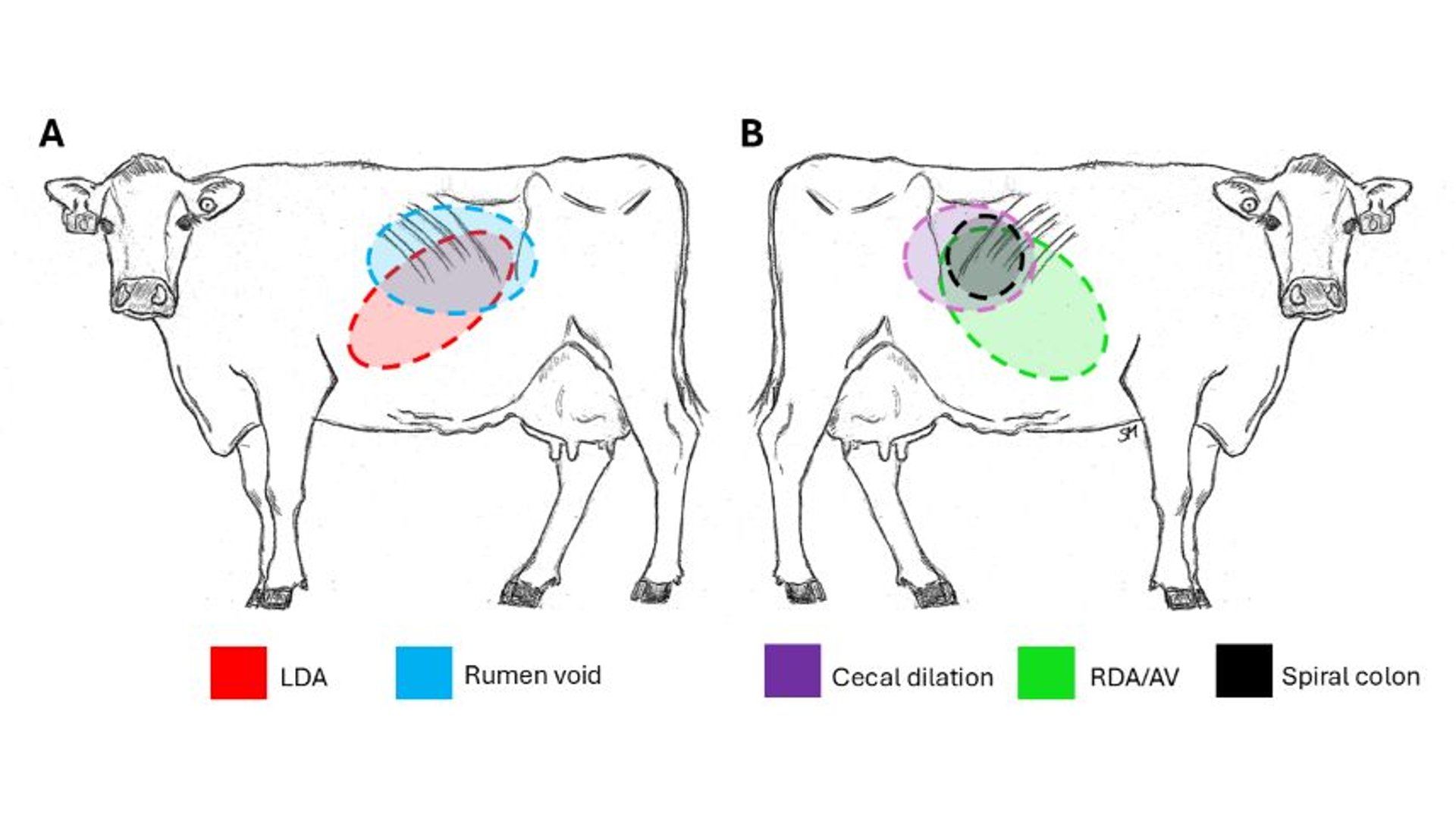
Diagrams showing ping locations in the abomasum of cattle. A. The most typical locations of pings associated with left displaced abomasum (LDA) or rumen void. B. The most typical locations of pings associated with cecal dilatation, right displaced abomasum/abomasal volvulus (RDA/AV), or gas in the spiral colon.
Courtesy of Dr. Sabine Mann.
Ping locations can vary, and landmarks overlap between conditions; therefore, ping location should be interpreted only in conjunction with other physical and ancillary examination findings.
The ping that is characteristic of LDA (refer to ) is most commonly located between ribs 9 and 13 in the middle to upper third of the left abdomen; however, the ping can be more ventral or more caudal, or both.


Pings associated with a rumen gas cap are usually more dorsal, less resonant, and extend more caudally through the left paralumbar fossa. In addition, splashing sounds can be heard during the swinging auscultation of the displaced abomasum. Rectal examination can confirm a gas-filled rumen or a rumen without palpable fiber content that correlates with the rumen ping in these cases.
Pings associated with pneumoperitoneum typically are less resonant, present on both sides of the abdomen, and inconsistent in location on repeated evaluation.
The ping associated with RDA also is most commonly located in the area between ribs 9 and 13 on the right abdomen, where the splashing sounds can be auscultated. Differentiation between various causes of a right-sided ping can be difficult:
A ping cranial to rib 10 usually indicates the presence of RDA or AV because the liver is displaced medially by the distended viscus. Liver displacement can be confirmed via percussion or ultrasonographic examination.
A small, right-sided ping underlying rib 12 or 13 and extending as far forward as rib 10 is common in cows with functional ileus from a number of causes. This ping is most often associated with gas in the ascending colon and resolves with correction of the underlying condition.
Cecal dilatation and rotation are also characterized by a right-sided ping. The ping extends through the dorsal paralumbar fossa in cecal dilatation and usually is located more caudally (well into the paralumbar fossa) in cecal rotation than the ping of RDA/AV.
Another cause of a ping on the right side is volvulus of the duodenal sigmoid flexure. Palpation per rectum is helpful in differentiating an RDA/AV from cecal dilatation or rotation. Other right-sided pings are produced by pneumoperitoneum or gas in the rectum, descending colon, duodenum, or uterus.
Diagnosis of Abomasal Displacement and Volvulus in Cattle
Clinical evaluation
Laboratory testing
Diagnosis of abomasal displacement or volvulus is based on the clinical findings and presence of the characteristic ping on simultaneous auscultation and percussion and by exclusion of other causes of left- or right-sided pings (see above). Spontaneous fluid-splashing or gas-tinkling sounds can be heard on auscultation overlying the area of the ping or on simultaneous ballottement and auscultation of the abdomen (succussion).
The characteristic rectal examination findings with left displaced abomasum include a medially displaced rumen and left kidney. The abomasum is rarely palpable in LDA and only occasionally palpable in RDA, depending on the size of the animal, the extent of dilatation of the abomasum, and the arm length of the examiner. In AV cases, the abomasum can be more frequently palpated during rectal examination because it is severely dilated.
In some LDA cases, abomasal displacement is present intermittently (pendulous LDA), which might be misleading during a physical examination. Melena or signs of peritonitis (eg, fever, tachycardia, localized abdominal pain, pneumoperitoneum) with LDA might indicate a bleeding or perforated abomasal ulcer, respectively.
Ultrasonographic examination can help confirm a diagnosis of LDA, RDA, or AV, especially when the clinical examination is inconclusive; however, it cannot reliably differentiate RDA from AV (8).
When available, laboratory sample evaluation of blood (for hypokalemia, hypochloremia, metabolic alkalosis, hemoconcentration) and rumen fluid (for increased rumen chloride concentration) also supports the diagnosis (8).
Treatment of Abomasal Displacement and Volvulus in Cattle
For LDA, medical or surgical treatment
For RDA and AV, immediate surgical treatment
Generally, both conservative (medical) and surgical treatment options are available for cows with left displaced abomasum. However, surgery is the only possible treatment for cows with abomasal volvulus. Because it cannot be reliably distinguished from AV, right displaced abomasum is also corrected surgically.
A patient with LDA can be medically treated with spasmolytic and analgesic drugs; in addition, rolling a cow through a 180° arc after casting it on its right side corrects most LDAs. Movement during transport of a patient with LDA can sometimes return the abomasum to its normal position. A major disadvantage of all nonsurgical treatment approaches is that recurrence is very likely.
Open (surgical) and closed (percutaneous) techniques can be used to correct abomasal displacements. LDA can be corrected surgically using right- or left-flank omentopexy, right-paramedian abomasopexy, combined left-flank and right-paramedian laparoscopy (a two-step procedure), or left-flank laparoscopy (a one-step procedure). Blind suture techniques (toggle-pin fixation or the “big needle” [blind stitch] method), performed in the right-paramedian area, are percutaneous methods for correcting LDA.
The main disadvantage of the blind stitch technique is uncertainty of the exact location of the suture and development of potentially fatal complications. The reported success rate is less than that of surgical correction by right-flank pyloric omentopexy (9).
With toggle-pin fixation, the typical smell of abomasal gas or pH can be checked to confirm that the pin is in the abomasum, which decreases the likelihood of attaching rumen, small intestine, or omentum, rather than the abomasum, to the body wall and improves the success rate of this technique over the blind stitch approach (10).
Endoscopic methods (one- or two-step procedures) have become routine for correcting LDAs (11).
Both RDA and AV are corrected surgically using right-paralumbar fossa omentopexy. Right-paramedian abomasopexy is typically performed only to correct RDA and AV in cattle unable to stand. The time between onset of the disease and surgery is crucial for treatment success.
Whenever AV is on the list of differential diagnoses, limiting reperfusion injuries is essential to avoid postoperative abomasal atony.
In simple abomasal displacement, fluid and electrolyte abnormalities correct spontaneously, provided that the animal has access to water and a salt block. After correction of displacement in cases of longer duration, providing a balanced electrolyte solution via nasogastric or orogastric tube might be indicated, depending on the degree of electrolyte disturbance and dehydration.
Patients with notable dehydration and metabolic derangements require IV fluid therapy, typically administered as hypertonic saline solution (7.2% NaCl, 4–5 mL/kg, IV, over 5 minutes) (12).
Ancillary treatment of patients with abomasal displacement includes treating any concurrent disease or metabolic disorder (eg, metritis, mastitis, hyperketonemia). Subcutaneous administration of calcium borogluconate or calcium gluconate, or oral administration of calcium products, helps restore normal abomasal motility in many cases. Aggressive treatment of ketosis plays an important role in successful treatment of abomasal displacement.
Occasionally, animals with abomasal displacement or AV have atrial fibrillation, which is thought to be of metabolic origin and due primarily to concurrent hypokalemia and metabolic alkalosis. Correction of the displacement or volvulus almost always results in correction of the atrial fibrillation within 5 days.
The prognosis after correction of simple LDA or RDA is good; patients with AVhave a variable and less favorable prognosis:
In LDA cases, the rate of survival to 60 days is 90% in ambulatory settings (13), and the discharge rate is 80% in referral hospital settings (14, 15). The difference is likely explained by a greater number and severity of comorbidities in hospitalized patients.
In RDA cases, the survival rate is reported as 88% (16), and the rate of return to productivity, as 81% (17).
In AV cases, the survival rate has a wide reported range of 45% (16) to 74% (3, 18), and the rate of return to productive life is 67% (17).
The prognosis differences in surgical cases of LDA and RDA compared with AV can likely be explained by the greater degree of vascular compromise, endotoxemia, metabolic derangement, and postoperative complications.
Prevention of Abomasal Displacement and Volvulus in Cattle
The following measures contribute to effective prophylaxis of LDA, RDA, and AV:
maintaining optimal dry cow and calving management
avoiding rapid dietary changes
maximizing dry matter intake
maintaining adequate physically effective fiber in the diet
providing optimal cow comfort and heat abatement
avoiding postparturient hypocalcemia and hyperketonemia
minimizing and promptly treating concurrent disease
Key Points
Abomasal displacement is a common disease of high-producing dairy cows, with high variation in prevalence rates among herds.
Management and prophylactic measures can effectively decrease disease frequency.
Several treatment options enable correction of the displacement and fixation of the abomasum to the anatomically correct position.
References
Caixeta LS, Herman JA, Johnson GW, McArt JAA. Herd-level monitoring and prevention of displaced abomasum in dairy cattle. Vet Clin North Am Food Anim Pract. 2018;34(1):83-99. doi:10.1016/j.cvfa.2017.10.002
Constable PD, Miller GY, Hoffsis GF, Hull BL, Rings DM. Risk factors for abomasal volvulus and left abomasal displacement in cattle. Am J Vet Res. 1992;53:1184-1192. doi:10.2460/ajvr.1992.53.7.1184
Constable PD, St Jean G, Hull BL, Rings DM, Hoffsis GF. Prognostic value of surgical and postoperative findings in cattle with abomasal volvulus. J Am Vet Med Assoc. 1991;199(7):892-898. doi:10.2460/javma.1991.199.07.892
Boulay G, Francoz D, Doré E, et al. Preoperative cow-side lactatemia measurement predicts negative outcome in Holstein dairy cattle with right abomasal disorders. J Dairy Sci. 2014;97(1):212-221. doi:10.3168/jds.2013-6898
Figueiredo MD, Nydam DV, Perkins GA, Mitchell HM, Divers TJ. Prognostic value of plasma L-lactate concentration measured cow-side with a portable clinical analyzer in Holstein dairy cattle with abomasal disorders. J Vet Intern Med. 2006;20(6):1463-1470. doi:10.1111/j.1939-1676.2006.tb00767.x
Fubini SL, Gröhn YT, Smith DF. Right displacement of the abomasum and abomasal volvulus in dairy cows: 458 cases (1980–1987). J Am Vet Med Assoc. 1991;198(3):460-464. doi:10.2460/javma.1991.198.03.460
Proios I, Grünberg W. Preoperative and surgical predictors of the treatment outcome of dairy cows with right abomasal displacement—a retrospective study of 234 cases. Animals. 2023;13(18):2887. doi:10.3390/ani13182887
Braun U, Nuss K, Reif S, Hilbe M, Gerspach C. Left and right displaced abomasum and abomasal volvulus: comparison of clinical, laboratory and ultrasonographic findings in 1982 dairy cows. Acta Vet Scand. 2022;64(1):40. doi:10.1186/s13028-022-00656-9
Tithof PK, Rebhun WC. Complications of blind-stitch abomasopexy: 20 cases (1980-1985). 1986;189(11):1489-1492. doi:10.2460/javma.1986.189.11.1489
Sterner K, Grymer J, Bartlett P, Miekstyn M. Factors influencing the survival of dairy cows after correction of left displaced abomasum. J Am Vet Med Assoc. 2008;232(10):1521-1529. doi:10.2460/javma.232.10.1521
Newman KD, Harvey D, Roy J-P. Minimally invasive field abomasopexy techniques for correction and fixation of left displacement of the abomasum in dairy cows. Vet Clin North Am Food Anim Pract. 2008;24(2):359-382. doi:10.1016/j.cvfa.2008.02.014
Roussel AJ. Fluid therapy in mature cattle. Vet Clin North Am Food Anim Pract. 2014;30(2):429-439. doi:10.1016/j.cvfa.2014.04.005
Reynen JL, Kelton DF, LeBlanc SJ, Newby NC, Duffield TF. Factors associated with survival in the herd for dairy cows following surgery to correct left displaced abomasum. J Dairy Sci. 2015;98(6):3806-3813. doi:10.3168/jds.2014-9017
Rohn M, Tenhagen B-A, Hofmann W. Survival of dairy cows after surgery to correct abomasal displacement: 1. Clinical and laboratory parameters and overall survival. J Vet Med A Physiol Pathol Clin Med. 2004;51(6):294-299. doi:10.1111/j.1439-0442.2004.00649.x
Schoner T, Zablotski Y, Feist M. Retrospective evaluation of method of treatment, laboratory findings, and concurrent diseases in dairy cattle diagnosed with left displacement of the abomasum during time of hospitalization. Animals. 2022;12(13):1649. doi:10.3390/ani12131649
Tsukano K, Nishi Y, Sasaki N, Suzuki K. Retrospective study on the outcomes and risk factors of right paramedian abomasopexy for right abomasal disorders in 47 dairy cows. J Vet Med Sci. 2021;83(10):1521-1525. doi:10.1292/jvms.21-0123
Meylan M. Prognostic indicators in cattle with right-sided displacement of the abomasum and abomasal volvulus. Schweiz Arch Tierheilkd. Article in German. 1999;141(9):413-418.
Simpson DF, Erb HN, Smith DF. Base excess as a prognostic and diagnostic indicator in cows with abomasal volvulus or right displacement of the abomasum. Am J Vet Res. 1985;46(4):796-797. doi:10.2460/ajvr.1985.46.04.796