Blood collection in guinea pigs takes practice and can be challenging. Shaving the fur and wetting the skin with alcohol can increase visibility of venipuncture sites.
Jugular veins can be used to collect large blood samples in dorsal recumbency; however, a blind approach is often necessary, and the veins are located deep in the short neck. The proximal jugular veins can also be used; the needle is inserted and advanced perpendicular to the skin surface at a palpable notch formed by the clavicle, manubrium, and cervical vertebral column (see ). The jugular vein should be palpable between the ramus of the mandible and the thoracic inlet. It is typically more lateral than expected. The angle of the syringe is typically 45–60°, but a steeper angle may be required if the animal is obese.
Sedation might be required until the clinician and handler are proficient with these techniques.
The cranial vena cava is not recommended for use in pet guinea pigs because there is a high risk of cardiac puncture and death with intrathoracic, pericardial, and pulmonary hemorrhage.


Jugular vein blood collection with a guinea pig in dorsal recumbency with forelimbs restrained caudally. The restrainer's fingertips are positioned at the thoracic inlet to engorge the jugular veins. The phlebotomist should restrain the guinea pig's head in their nondominant hand (left, in this image).
Courtesy of Dr. Miranda Sadar.
The gingival vein (labialis mandibularis vein) is an access route in sedated or anesthetized guinea pigs (see ). Animals are positioned in dorsal recumbency with the inferior lip pulled caudally. A small-gauge needle on a 1-mL syringe is inserted 3–5 mm deep in the mucosa below the gingival-incisor edge, in the caudal direction along midline between the mandibular incisors at an angle of 35–60° (1, 2). The lateral saphenous and lateral metatarsal veins are readily accessible; however, typically only small amounts of blood can be collected. The cephalic veins are small and typically preserved for IV catheter placement (see ).

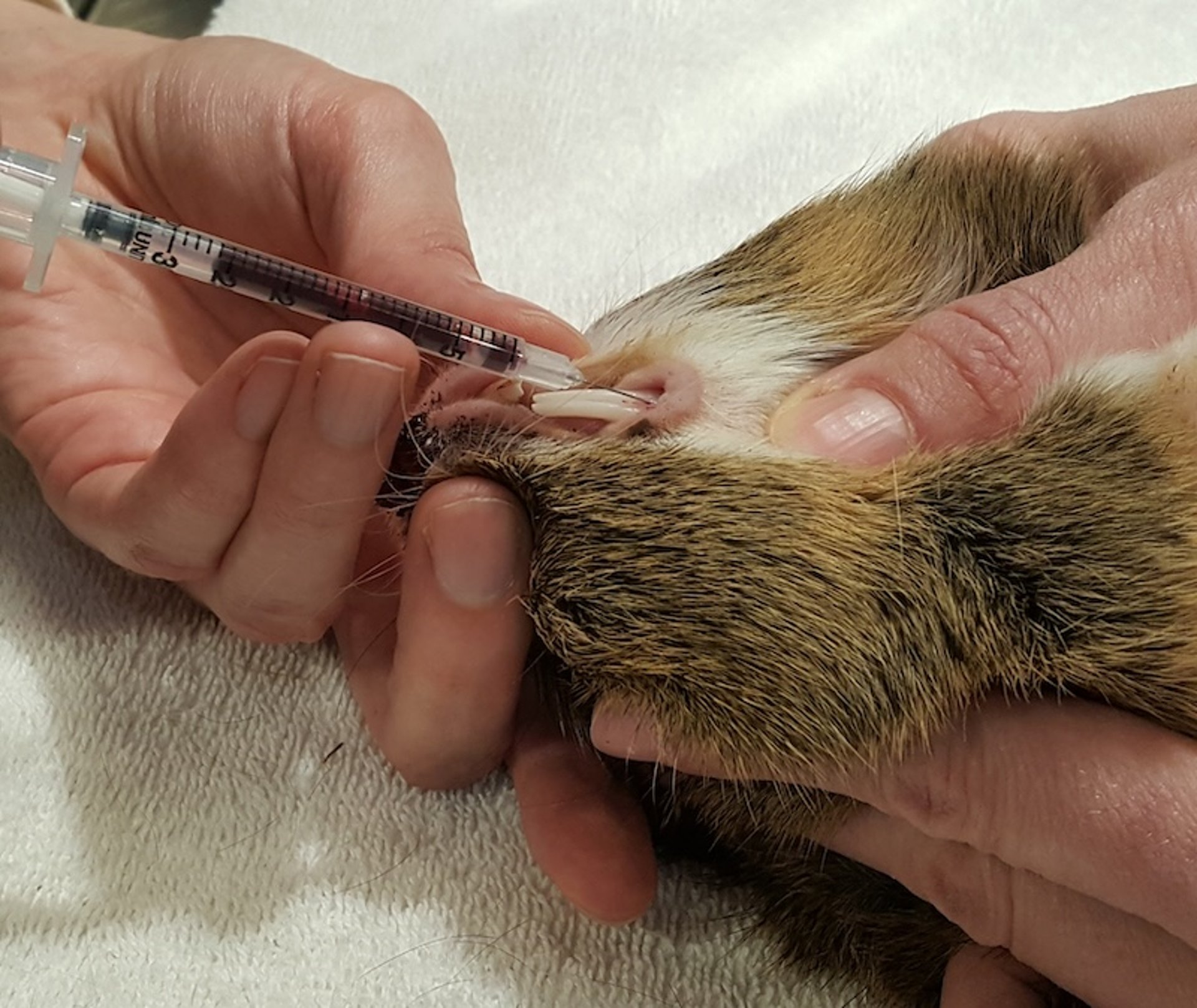
Blood collection from the gingival vein in a guinea pig.
Courtesy of Dr. Miranda Sadar.


IV catheter placed in the cephalic vein of a guinea pig.
Courtesy of Dr. Miranda Sadar.
On the CBC, lymphocytes are the predominant white blood cell in this species. Most are small cells; however, large forms are present as well. Heterophils, the functional counterparts of neutrophils, are the next most common white blood cell. The cytoplasm contains several pale, round, eosinophilic granules, which allows them to be distinguished from eosinophils, which contain larger, more numerous, elongated, rod-shaped granules (3). Toxicity and the presence of band cells (left shift) occur in the presence of inflammation. Monocytes and basophils are morphologically similar to those in small animals. Kurloff cells are large mononuclear cells, possibly of lymphoid origin, that contain a single reticulated eosinophilic cytoplasmic inclusion. They are speculated to be a natural killer cell (4).
On the biochemistry panel in guinea pigs, ALT activity is low in hepatocytes and is not a sensitive or specific marker of hepatocellular injury. Amylase has been shown to have value as a prognostic indicator, with markedly elevated plasma concentrations (1,910–3,985 U/L) being associated with a higher risk of death (5). In addition, BUN concentrations higher than 62 mg/dL have greater odds of mortality than guinea pigs with values lower than this (5).
The subcutaneous space is small and the skin is thick, and because of this, guinea pigs often protest having injections. IM injections are typically administered in the epaxial or quadriceps muscles.IV catheters 24–26 gauge, are typically placed in the cephalic or lateral saphenous veins; however, in the jugular veins, 22 gauge or larger may also be used. An intraosseous catheter may be placed in the femur or tibia using a 22-gauge needle or a 2.5-cm (1-inch) spinal needle (see ).


Intraosseous catheter in the tibia of a guinea pig under anesthesia.
Courtesy of Dr. Miranda Sadar.
Pearls & Pitfalls
|
Urine can be collected through cystocentesis, and the method is similar to that used in small animals. Under sedation or anesthesia, ultrasonography can be used to visualize the urinary bladder and orient the needle for insertion. A 22-gauge needle might be required because of the robust urinary bladder wall. Urethral catheterization is straightforward in both sexes because the urethra is relatively wide. The procedure in males is similar to that in cats and should be performed under sedation or anesthesia. A 5–8 Fr Foley catheter or tube may be used. It must be placed into the urethra and not the intromittent sac. In females, the urethra is relatively short and wide, which allows smaller uroliths to pass without assistance. If urinary catheterization is required, an 8 Fr or larger Foley catheter may be used.
Sedation or anesthesia should be used for proper radiographic positioning and to decrease stress. Positioning for thoracic, abdominal, and skull radiographs is similar to positioning in small animals; however, often survey radiographs of the whole body are taken because of guinea pigs' small size. Several protocols for sedating guinea pigs have been employed, including a combination of SC alfaxalone (5 mg/kg) with midazolam (0.5 mg/kg) (6) or a combination (in this author's experience) of IM dexmedetomidine (0.03 mg/kg) with midazolam (0.3 mg/kg). Ultrasonography is useful for both evaluation of organs and assisting in collection of fine–needle aspirates or fluid. CT is becoming more common in guinea pig medicine and can be performed on sedated animals without the need for general anesthesia.
Oral medications and nutritional support can be administered using small syringes into the side of the mouth. The syringe must be deep enough into the mouth to get past the redundant tissue caudal to the incisors, or the medication will spill out.
Because guinea pigs are hindgut fermenters, there are concerns regarding antimicrobial use. Although all antibiotics can potentially affect the normal gut microbiota, drug classes such as beta lactams, lincosamides, and older macrolides pose a higher risk for development of enteric dysbiosis and antibiotic associated enterotoxemia. Drug classes that pose less risk and that can generally be used safely in guinea pigs include fluoroquinolones, tetracyclines, chloramphenicol, sulfonamide/trimethoprim, and aminoglycosides. For appropriate drugs and dosages in guinea pigs, consult Carpenter's Exotic Animal Formulary or other sources.
Sedation, Anesthesia, and Surgery in Guinea Pigs

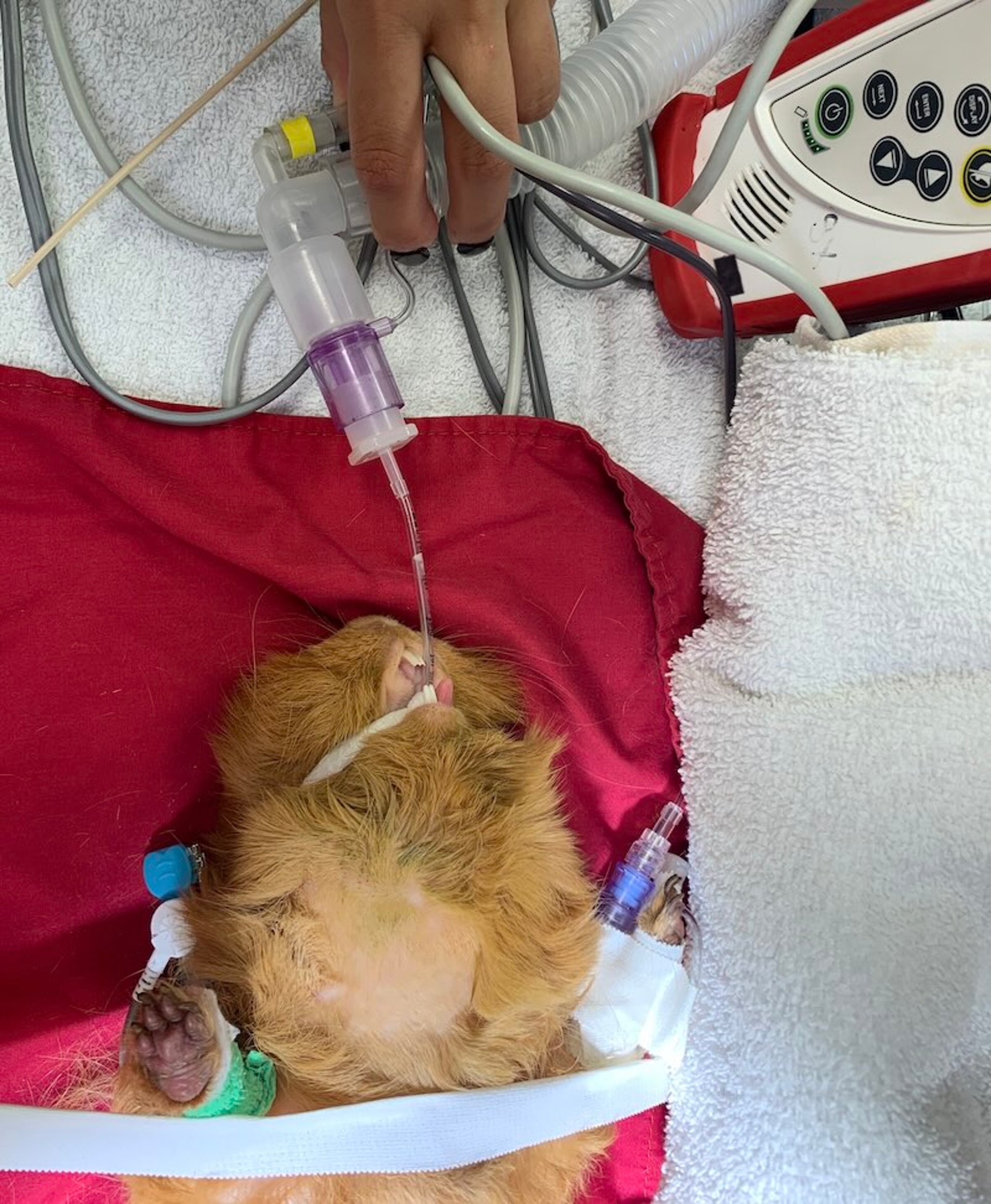
Guinea pig with endotracheal tube held in place with tape around the tube, caudal to the lower incisors, extending around the back of the head.
Courtesy of Dr. Miranda Sadar.
A 1–2 hour fast is recommended before anesthesia because guinea pigs tend to hold food in their mouths and cranial esophagus. Flushing the oral cavity with water and cleaning it with cotton-tipped applicators helps to decrease material in these areas. Sedation can be achieved with a variety of combinations, and Carpenter's Exotic Animal Formulary or other sources can be referenced. After sedation or premedication and preoxygenation, induction of general anesthesia can be performed using isoflurane or sevoflurane. Tracheal intubation may be attempted but is challenging because of the presence of the palatal ostium and often requires direct visualization with an endoscope or other tools. A 1–2 mm internal diameter endotracheal tube may be used for most guinea pigs, with some animals able to have larger tubes. Anesthetic monitoring is similar to monitoring of small animals. (See .)
Flank ovariectomy or ovariohysterectomy is recommended over a ventral midline approach to the female reproductive tract for decreased morbidity secondary to manipulation of the GI tract, straightforward exteriorization of the ovaries, less weight on the incision site, decreased contamination of the surgical site, and smaller incisions. Prophylactic ovariectomy is recommended because of the high incidence of cystic ovarian disease in this species.
Castration is performed via an abdominal or scrotal approach; however, the abdominal approach is reported to have fewer complications (7). Closure of the skin using an intradermal pattern is recommended. (See images of castration, and approaches.)


Abdominal approach to castration in a male guinea pig. The testicle and its associated structures have been exteriorized, and the fat pad can be appreciated in the surgeon's hands. The testicle, epididymis, and vaginal tunic can be visualized at the bottom of the image.
Courtesy of Dr. Miranda Sadar.


Open castration via scrotal approach in a guinea pig.
Courtesy of Dr. Miranda Sadar.
For More Information
Carpenter JW, Harms CA, eds. Carpenter's Exotic Animal Formulary. 6th ed. Saunders; 2023.
References
Rodrigues MV, de Castro SO, de Albuquerque CZ, Mattaraia VGM, Santoro ML. The gingival vein as a minimally traumatic site for multiple blood sampling in guinea pigs and hamsters. PLoS One. 2017;12(5):e0177967. doi:10.1371/journal.pone.0177967
Personett AR, Santangelo KS, Kendall LV, Sadar MJ. Hematologic parameters and blood cultures from the gingival vein compared with the cranial vena cava in guinea pigs. J Am Assoc Lab Anim Sci. 2019;58(6):817-822. doi:10.30802/AALAS-JAALAS-19-000039
Zimmerman K, Moore DM, Smith SA. Hematological assessment in pet guinea pigs (Cavia porcellus): blood sample collection and blood cell identification. Clin Lab Med. 2015;35(3):641-648. doi:10.1016/j.cll.2015.05.012
Rogoff TM, Lipsky PE. Characterization of isolated guinea pig Kupffer cells: accessory cell function in mitogen-induced T lymphocyte activation. J Immunol. 1979;123(5):1920-1927. doi:10.4049/jimmunol.123.5.1920
Souza AR, Ozawa SM, Sadar MJ, et al. Clinical value of amylase and its prognostic accuracy in guinea pigs (Cavia porcellus). J Small Anim Pract. 2025;66(6):382-388. doi:10.1111/jsap.13843
Álvarez ER, Solé LV, de Carellán Mateo AG. Comparison of subcutaneous sedation with alfaxalone or alfaxalone-midazolam in pet guinea pigs (Cavia porcellus) of three different age groups. J American Vet Med Assoc. 2022;260(9):1024-1030. doi:10.2460/javma.21.02.0104
Guilmette J, Langlois I, Helie P, El Warrak Ade O. Comparative study of 2 surgical techniques for castration of guinea pigs (Cavia porcellus). Can J Vet Res. 2015;79(4):323-328. https://pmc.ncbi.nlm.nih.gov/articles/PMC4581678/