Rodents used for research—most commonly mice and rats—are maintained in tightly controlled environments designed to decrease the impact of unwanted variables in animal experiments. Many factors have the potential to influence the animal’s biological response in a laboratory test.
Besides a description of the experiment, research journals often require a description of the research animal's source, microbiological status, and environment (eg, feed, water, temperature, humidity, light exposure) in the discussion of materials and methods.
Environmental conditions, husbandry procedures, and animals must be similar if research data generated from one laboratory is to be judged by reproducibility and thus validation. If variables such as feed, housing, rodent genetic background, and disease-free or microbiological status are not properly controlled, experimental results might be of limited or no use.
Infectious Agents Commonly Tested for in Laboratory Rodents
Agent (common abbreviation) | Description | Species |
|---|---|---|
Fungi | ||
Encephalitozoon cuniculi (E cun) | Sporozoan parasite of rabbits and rodents | Mice, rats |
Bacteria | ||
Clostridium piliforme (C pil) | Agent of Tyzzer disease | Mice, rats |
Filobacterium rodentium (F rodentium) (formerly cilia-associated–respiratory bacillus [CARB]) | Bacterial respiratory pathogen of rodents and rabbits | Mice, rats |
Mycoplasma pulmonis (M pul) | Agent of mouse and rat pulmonary mycoplasmosis | Mice, rats |
Viruses | ||
Ectromelia virus (ECT) (see ) | A mouse poxvirus | Mice |
Hantaan virus (HANT) | A zoonotic hantavirus of rats; two different disease states in humans: hantavirus pulmonary syndrome (HPS) and hemorrhagic fever with renal syndrome (HFRS). | Rats |
Kilham rat virus (KRV) | A rat parvovirus | Rats |
Lactate dehydrogenase–elevating virus (LDEV) | A mouse arterivirus | Mice |
Lymphocytic choriomeningitis virus (LCMV) | A zoonotic arenavirus | Mice, rats |
Minute virus of mice (MVM, MMV) | A mouse parvovirus | Mice |
Mouse cytomegalovirus (MCMV) | A mouse herpesvirus | Mice |
Mouse hepatitis virus (MHV) (see ) | A mouse coronavirus | Mice |
Mouse parvovirus (MPV) | A mouse parvovirus | Mice |
Mouse pneumonitis virus (K-virus) | A mouse papovavirus | Mice |
Mouse thymic virus (MTV) | A mouse herpesvirus | Mice |
Murine norovirus (MNV) | A mouse calicivirus | Mice |
Murine polyomavirus (MPyV) | A mouse polyomavirus | Mice |
Pneumonia virus of mice (PVM) | A rodent pneumovirus | Mice, rats |
Rat theilovirus (RTV) | A rat picornavirus | Rats |
Reovirus type 3 (Reo3) | A rodent reovirus | Mice, rats |
Rodent adenovirus strain 1 (MAdV-1) | Mouse adenovirus, rodent adenovirus strain 1 (FL) | Mice, rats |
Rodent adenovirus strain 2 (MAdV-2) | Mouse adenovirus, rodent adenovirus strain 2 (K87) | Mice |
Sendai virus (SeV) (see ) | A type 1 paramyxovirus | Mice, rats |
Sialodacryoadenitis virus (SDAV) | A rat coronavirus | Rats |
Theiler murine encephalomyelitis virus (TMEV [GDVII]) | Mouse poliovirus, strain GDVII | Mice |
Toolan H-1 virus (TH-1) | A rat parvovirus | Rats |
Parasites | ||
Myobia musculi, Myocoptes musculinus, Radfordia affinis, Radfordia ensifera (fur mites) | Ectoparasites that inhabit fur | Mice, rats |
Syphacia obvelata, Syphacia muris, Aspiculuris tetraptera (pinworms) | Endoparasites that inhabit the cecum and colon | Mice, rats |
Although complete elimination of variables in animal experiments is not possible, many factors that contribute to variation can be substantially minimized or eliminated. One of the most important variables is the effect of infectious agents on research mice and rats.

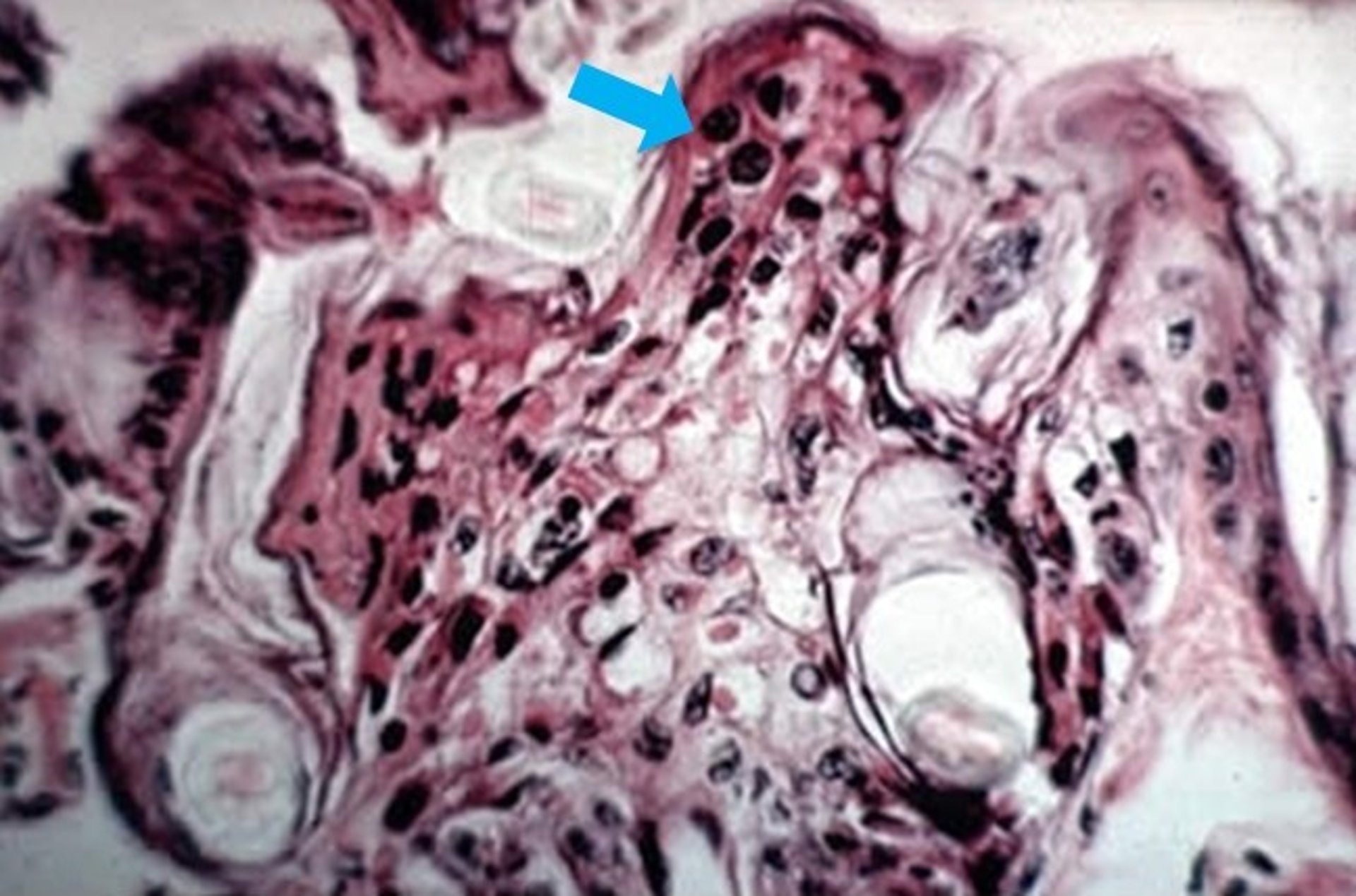
Photomicrograph of skin from a mouse infected with ectromelia virus (mousepox). Note the large intracytoplasmic inclusion bodies (arrow) in epidermal cells. H&E stain; 100X.
Courtesy of RADIL, University of Missouri.


Photomicrograph of intestinal epithelium from a mouse infected with mouse hepatitis virus. Note the syncytia (arrow) at the mucosal surface, which is a consistent feature of this disease. H&E stain; 400X.
Courtesy of RADIL, University of Missouri.


Photomicrograph of lung tissue from a rat infected with Sendai virus. Note the lymphocytic and plasmacytic infiltrate in the peribronchiolar region (peribronchiolar cuffing; arrow) that is characteristic of this infection. H&E stain; 40X.
Courtesy of RADIL, University of Missouri.
Few infectious agents found in laboratory mice and rats today cause overt disease. Distinguishing between infection and disease is critical to interpreting the microbiological status of laboratory animals. Infection indicates the presence of microorganisms, which might be pathogens, opportunists, or commensals (the last two are the most numerous).
Clinical signs do not need to be present for microorganisms to affect research. Animals that appear normal and healthy might be unsuitable as research subjects because of the unobservable but important local or systemic effects of viruses, bacteria, and parasites with which they might be infected.
Knowledge of the varied and unwanted effects of natural pathogens in laboratory rodents has steadily increased since the late 19th century, when animal research began. The historical struggle against pathogens of laboratory rodents is often divided into three periods:
1880–1950: During this period, mice and rats became common research animals. Many of these original stocks harbored a variety of natural, or indigenous, pathogens. Improvements were made in sanitation, nutrition, environmental control, and other aspects of animal husbandry. The result was a great decrease in the range and prevalence of pathogens found in laboratory rodents.
1950–1980: This period was one of gnotobiotic derivation, when cesarean rederivation was used to replace infected stock with uninfected offspring. Full-term fetuses were removed from an infected mother and transferred to a germ-free environment and foster care. This procedure was successful in eliminating many pathogens not transmissible in utero (eg, endoparasites, most bacteria, and some viruses).
1980–present: This period has been one of eradicating indigenous rodent viruses. The decrease in known viruses infecting rodents was accomplished through serological testing of animals for antibodies against specific pathogens. Antibody-positive colonies were subsequently eliminated or cesarean-rederived.
Most modern research animal facilities incorporate some form of health monitoring into their animal care program (see the table ). The well-being of the animal colony is more important than the well-being of an individual animal, effectively making laboratory animal medicine a type of “herd medicine.”
Since the 1980s, health monitoring of rodent colonies has been based on serological testing; however, molecular methods of detection such as PCR assay are rapidly increasing in use.
The widespread use of individually ventilated cage systems for housing mice and rats has greatly decreased the transmission of pathogens between animals housed in the same room. More facilities are now incorporating PCR-based testing of either environmental dust samples or dirty bedding taken from colony animals. This practice eliminates the use of live sentinel animals for health monitoring.
Although costly, health monitoring results in substantial long-term savings, because researchers can use fewer animals and the animals' daily care is not as labor-intensive. Health monitoring also enables laboratory animal veterinarians to check the health status of a colony, inform researchers of their animals’ pathogen status, prevent the entry of pathogens into the facility by screening animals received from unknown sources, and promptly deal with the presence of unexpected infectious agents in the animals.
Undetected infection makes laboratory animals unfit for research and renders experimental data unreliable. It is more cost-effective to prevent the entry of infectious agents into a facility or to detect and eliminate them early than to discard months of research data.
For More Information
Fox JG, Anderson LC, Otto G, Pritchett-Corning KR, Whary MT, eds. Laboratory Animal Medicine. 3rd ed. Academic Press; 2015.
Barthold SW, Imai DM. Pathology of Laboratory Rodents and Rabbits. 5th ed. Wiley; 2025.