Thelazia is a genus of globally distributed nematodes (eyeworms) that infest the eyes of cattle, small ruminants, horses, and many other species. Eyeworms are transmitted by nonbiting dipteran muscid flies as they feed on the lacrimal secretions of animals. Adult nematodes localize in the orbital cavities and associated tissues (eg, nasolacrimal ducts, conjunctival sacs, and excretory ducts of lacrimal glands), causing different degrees of eye disease (eg, lacrimation, ocular discharge, epiphora, conjunctivitis, and even corneal opacity, ulcers, and blindness). Diagnosis is by direct observation of worms. Beyond fly control, levamisole and ivermectins (eg, doramectin) are useful for the treatment of thelaziasis in cattle and horses.
Eyeworm disease (thelaziasis) in large animals is caused by spirurid nematodes (also known as eyeworms), which infest the orbital cavities and associated tissues of several species. These whitish nematodes are transmitted by nonbiting dipteran muscid flies or drosophila fruit flies (intermediate hosts) as they feed on the lacrimal secretions of infected animals (see ). Adults of Thelazia spp localize under the eyelids and the nictitating membrane, as well as in nasolacrimal ducts, conjunctival sacs, and excretory ducts of lacrimal glands, depending on the species targeted.

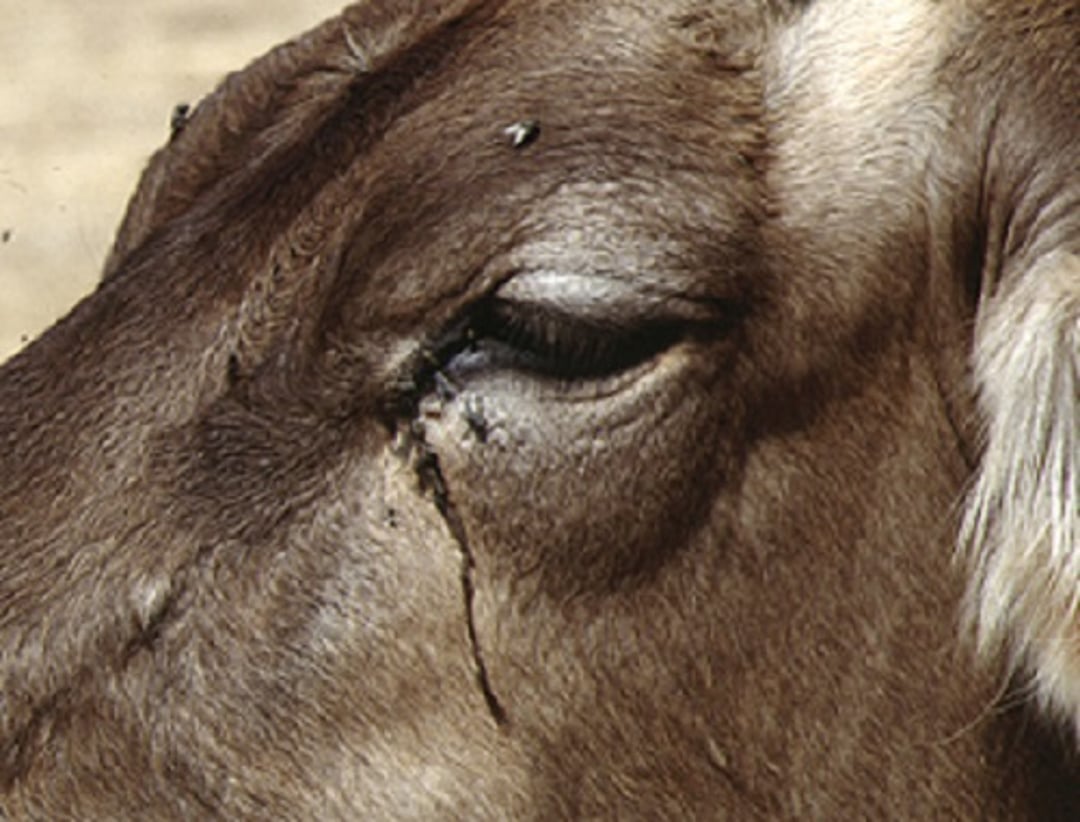
Musca sp face flies feeding on lacrimal secretions of a cow infected with Thelazia gulosa.
Courtesy of Dr. Domenico Otranto.
Thelaziases cause ocular clinical signs of varying severity (eg, lacrimation, ocular discharge, epiphora, conjunctivitis, keratitis, and sometimes corneal opacity or ulcers). Levamisole and ivermectins (eg, doramectin) administered either subcutaneously or intramuscularly, are useful for the treatment of thelaziasis in cattle and horses. Some Thelazia spp can also infect humans.
Etiology and Epidemiology of Eyeworm Disease in Large Animals
Eyeworms (Thelazia spp) are common parasites of horses and cattle worldwide. Horses are infected primarily by T lacrymalis, whereas cattle are infected mainly by T gulosa, T skrjabini, and T rhodesii, particularly in Africa, Asia, and Europe. The prevalence of Thelazia spp in production animals has declined in at least some areas where macrocyclic lactone endectocides, such as ivermectin and doramectin, are in common use. Thelazia spp also infect pigs, sheep, goats, deer, water buffalo, dromedaries, hares, and humans.
Thirteen species of Musca have been incriminated in the transmission of eyeworms in cattle and horses; however, only face flies (eg, M domestica, M autumnalis, and M larvipara) have been demonstrated (see ), in both experimental and natural conditions, to act as vectors in the US, Canada, and Italy. Feeding habits of this fly include a preference for ocular secretions, which are ideal for transmission.

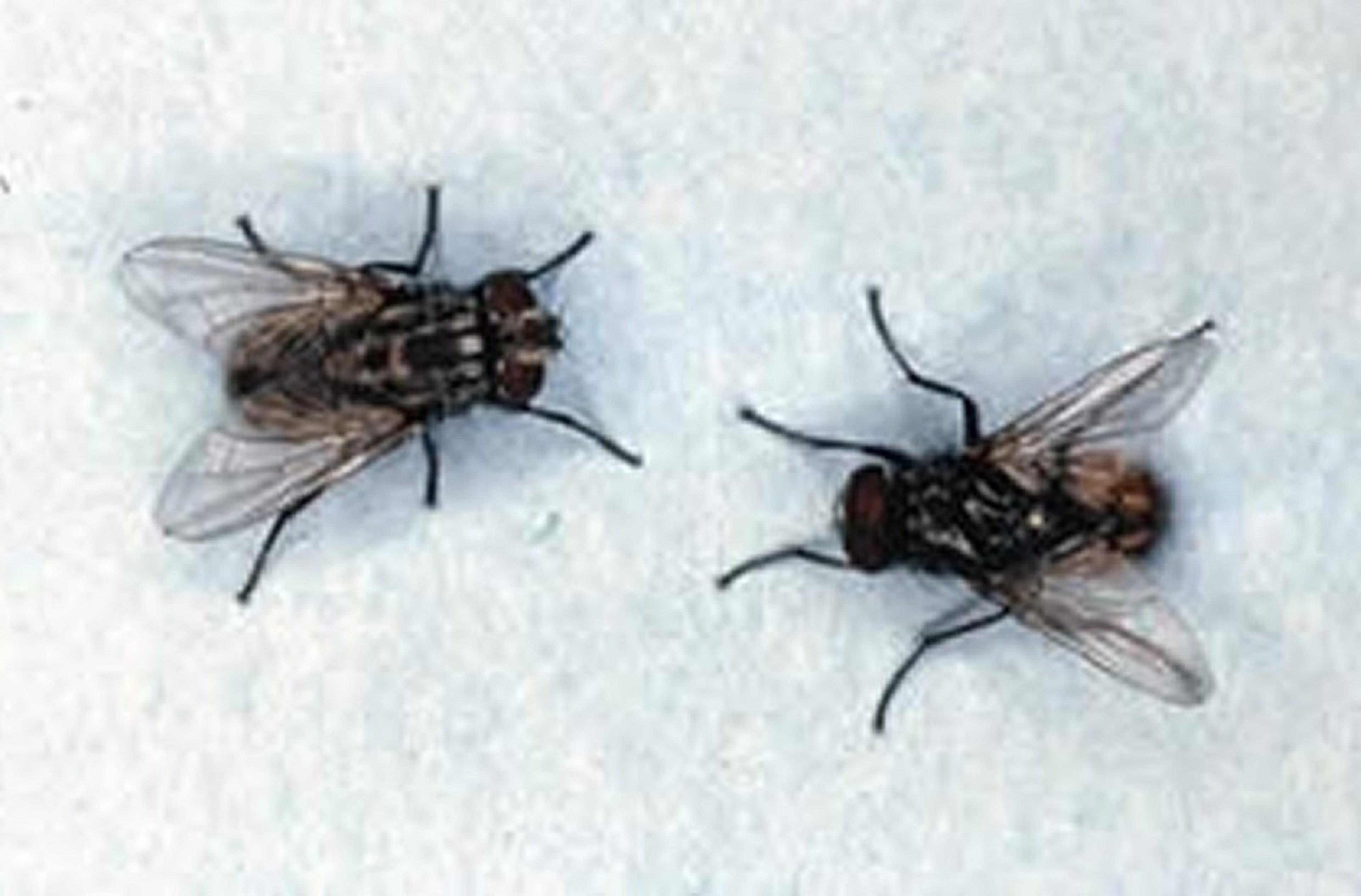
The face fly Musca autumnalis (female on the left, male on the right) is one vector for eyeworm disease in large animals.
Courtesy of Dr. Dietrich Barth.
The life cycle of Thelazia spp is as follows (see ): female worms are ovoviviparous and discharge larvae into the ocular secretions; the larvae are ingested by the fly and become infective in 2–4 weeks. Infective third-stage larvae emerge from the labella (fleshy lobes at the tip of the proboscis) of infected flies and are mechanically deposited in the eye of the host by the fly during feeding. Development of sexually mature worms takes 1–4 weeks in cattle, depending on worm species, and 10–11 weeks for T lacrymalis in horses.


Thelazia gulosa can infect the eyes of cattle, bison, buffalo, and humans (1). Adult worms live under the eyelids and in the ocular tissues (eg, nasolacrimal ducts, conjunctival sacs, and excretory ducts of lacrimal glands) of the host animal (2). After mating, female worms release large numbers of first-stage larvae (3) into the lacrimal secretions of the host. First-stage larvae are then ingested by muscid face flies (4) that feed on eye secretions. In the muscid vectors, T gulosa larvae develop to second-stage and infective third-stage larvae (5), which are eventually released from the fly's proboscis onto the ocular mucosa of a new susceptible host (6).
Courtesy of Professor Jairo Alfonso Mendoza Roldan.
Eyeworm infections can occur year-round; however, clinical signs, particularly in cattle, are usually associated with warm-season activities of the flies. Thelazia spp larvae can overwinter in face flies. Infection rates generally tend to increase with advancing host age.
Pathogenesis of Eyeworm Disease in Large Animals
The lacrimal gland and its ducts are common sites for infestation with the eyeworms T lacrymalis and T gulosa in large animals; the glands of the nictitating membrane and the nasolacrimal ducts are less common sites. T skrjabini is normally found within the lacrimal ducts of the nictitating membrane. Superficial locations on the cornea, in the conjunctival sac, and under the eyelids and nictitating membrane of targeted animals are more typical for T rhodesii; however, T lacrymalis, T skrjabini, and T gulosa are also found in these sites.
Worms are also observed on the periorbital hair or skin during anesthesia or following migration after death of the host. Localized irritation and inflammation are likely due to the serrated cuticle of the worms, especially for T rhodesii. Invasion of the lacrimal gland and excretory ducts can cause inflammation and necrotic exudation. Inflammation of the lacrimal ducts and sac also occurs in horses. Mild to severe conjunctivitis and blepharitis are common. Also, keratitis, including opacity, ulceration, perforation, and permanent fibrosis, sometimes develop in severe cases, particularly with T rhodesii infection in cattle. Human cases of T gulosa infection have been reported in the US; however, T callipaeda is the most common agent of infection in humans worldwide (1).
Clinical Findings and Diagnosis of Eyeworm Disease in Large Animals
From subclinical to conjunctivitis, epiphora, keratitis, corneal clouding, and subconjunctival cysts
Ophthalmic examination
Subclinical infections in horses and cattle appear to be typical of thelaziasis in North America. Infection might be encountered incidentally during surgery or at necropsy examination. However, Thelazia infections in cattle in North America are not always innocuous. They sometimes produce mild conjunctivitis, excessive lacrimation, localized edema, keratitis, corneal clouding, and occasionally, subconjunctival cysts.
In Europe and Asia, thelaziasis is commonly associated with severe clinical signs, including conjunctivitis, photophobia, and keratitis. Characteristically, there is chronic conjunctivitis, with lymphoid hyperplasia and a seromucoid exudate.
A clinically feasible technique for reliable detection of adult eyeworms is lacking. Gross inspection of the eyes might reveal the worms and is generally recommended for T rhodesii, commonly found in the conjunctival sac. However, T gulosa and T skrjabini in cattle, and T lacrymalis in horses, tend to be more invasive and are less apt to occur.
Topical anesthetics allow for tissue manipulation and are useful for detection and recovery of eyeworms.
Microscopic examination of lacrimal fluids for embryonated eggs or larvae can be attempted.
Treatment and Control of Eyeworm Disease in Large Animals
Environmental measures to control flies
Administration of ivermectins and levamisole
Mechanical removal of eyeworms with forceps after instillation of a local anesthetic is useful for treating T rhodesii in cattle. Mechanical removal is also feasible for the more invasive T gulosa or T skrjabini in cattle or for T lacrymalis in horses.
Certain systemic anthelmintics have exhibited activity against eyeworms. In cattle, the following have shown activity against Thelazia spp: levamisole, 5 mg/kg, SC, single administration (2); ivermectin, 0.2 mg/kg, SC or IM, single administration (3); doramectin, 0.2 mg/kg, SC or IM, single administration (4). Pour-on formulations of ivermectin (5) or doramectin (6), applied once to achieve a dosage of 0.5 mg/kg, are also effective. Doramectin has been approved in the US for treatment of adult eyeworms in cattle. Eprinomectin has also been successfully used in dairy farms against T rhodesi and represents the benchmark standard in dairy cows (7).
For T lacrymalis in horses, single doses of the commonly used anthelmintics, including ivermectin, administered via stomach tube at 0.2 mg/kg, have had limited, if any, effect on eyeworms (8).
Fly control measures, directed especially against the face fly, aid in the control of thelaziasis in cattle and horses. Cattle on dry, open pastures have fewer face flies than those on pastures where shade and water are present.
Key Points
Thelaziases (ie, eyeworm infestations) are caused by spirurid nematodes, which live in orbital tissues of large animals and can also infest humans.
Nematodes are transmitted by nonbiting dipteran muscid face flies while the flies feed on the lacrimal secretions of infected animals.
Clinical signs can be of varying severity (eg, ocular discharge, conjunctivitis, keratitis, and even corneal ulcers).
Administration of levamisole and ivermectins is useful for the treatment of thelaziasis in cattle and horses.
For More Information
Otranto D, Wall R. Veterinary Parasitology. 5th ed. Wiley; 2024.
Also see pet owner content regarding eyeworm disease in horses.
References
Bradbury RS, Breen KV, Bonura EM, Hoyt JW, Bishop HS. Case report: conjunctival infestation with Thelazia gulosa: a novel agent of human thelaziasis in the United States. Am J Trop Med Hyg. 2018;98(4):1171-1174. doi:10.4269/ajtmh.17-0870
Deepthi B, Yalavarthi Y. Eye worm infection in a cattle: a case report. Vet World. 2012;5(4):236-237. doi:10.5455/vetworld.2012.236-237 https://veterinaryworld.org/Vol.5/April%202012/Eye%20Worm%20infection%20in%20a%20Cattle.pdf
Soll MD, Carmichael IH, Scherer HR, Gross SJ. The efficacy of ivermectin against Thelazia rhodesii (Desmarest, 1828) in the eyes of cattle. Vet Parasitol. 1992;42(1-2):67-71. doi:10.1016/0304-4017(92)90103-g
Kennedy MJ, Phillips FE. Efficacy of doramectin against eyeworms (Thelazia spp.) in naturally and experimentally infected cattle. Vet Parasitol. 1993;49(1):61-66. doi:10.1016/0304-4017(93)90224-b
Kennedy MJ, Holste JE, Jacobsen JA. The efficacy of ivermectin (pour-on) against the eyeworms, Thelazia gulosa and Thelazia skrjabini in naturally infected cattle. Vet Parasitol. 1994;55(3):263-266. doi:10.1016/0304-4017(93)00644-E
Marley ES, Illyes EF, Keller DS, et al. Efficacy of topically administered doramectin against eyeworms, lungworms, gastrointestinal and nematodes of cattle. Am J Vet Res. 1999;60(6):665-668.
Deak G, Ionică AM, Oros NV, Ghermana CM, Mihalca AD. Thelazia rhodesi in a dairy farm in Romania and successful treatment using eprinomectin. Parasitol Int. 2021;80:102183. doi:10.1016/j.parint.2020.102183
Lyons ET, Drudge JH, Tolliver SC. Apparent inactivity of several antiparasitic compounds against the eyeworm Thelazia lacrymalis in equids. Am J Vet Res. 1981;42(6):1046-1047.