Flea allergy dermatitis is a hypersensitivity disorder in which the affected individual is sensitive to the saliva in the bites of fleas. Diagnosis is based on history and clinical signs. Dogs develop itch and skin lesions on the caudal dorsum and tailhead; cats can develop itch and skin lesions on the head and neck, as well as the dorsum, tailhead, and inguinal region. Prevention and treatment require treatment of the affected pet, of other pets in household, and of the environment.
Flea allergy dermatitis (FAD), or flea bite hypersensitivity, is a hypersensitivity disease caused by the injection of antigens from the salivary glands of fleas as they feed on a host animal.
In dogs, the primary clinical signs of FAD are pruritis and papulocrustous lesions distributed on the lower back, tailhead, and caudal and inner thighs. In cats, the primary signs are pruritis and papular dermatitis with excoriation or overgrooming on the face, neck, and back.
Diagnosis of FAD can be based on history (lack of use or inappropriate use of flea control products), clinical signs, and/or the presence of fleas or flea dirt (flea fecal pellets; see ). Long-term control requires treatment and prevention of flea infestations, along with supportive care for dermatitis.
FAD is the most common dermatological disease of domestic dogs in the southern US. Cats also develop FAD, which is one of the major causes of feline miliary dermatitis, head and neck pruritus, self-induced alopecia, and eosinophilic granuloma complex.
FAD is most prevalent in the summer; however, in warm climates flea infestations can persist throughout the year. In northern temperate regions, the close association of pets and their fleas with human dwellings creates conditions that permit a year-round problem. Environmental temperature extremes, high altitude, and low humidity tend to inhibit flea development.
When feeding, fleas inject saliva that contains a variety of histamine-like compounds, enzymes, and polypeptides that span a wide range of sizes (8–150 kilodaltons, with the most common size < 60 kilodaltons) and induce type I, type IV, and basophil hypersensitivity reactions. Flea-naive dogs exposed intermittently to flea bites develop either immediate reactions (within 15 minutes) or delayed reactions (after 24–48 hours), or both, as well as detectable levels of circulating IgE and IgG antiflea antibodies (1, 2, 3).
Dogs exposed continually to flea bites have low levels of circulating IgE and IgG antiflea antibodies and either do not develop skin reactions or develop them later and to a considerably lesser extent. Therefore, immunological tolerance might develop naturally in dogs that are continually exposed to flea bites.
Although the pathophysiology of FAD in cats is poorly understood, the mechanisms might be similar to those in dogs.
Clinical Findings of Flea Allergy Dermatitis in Dogs and Cats
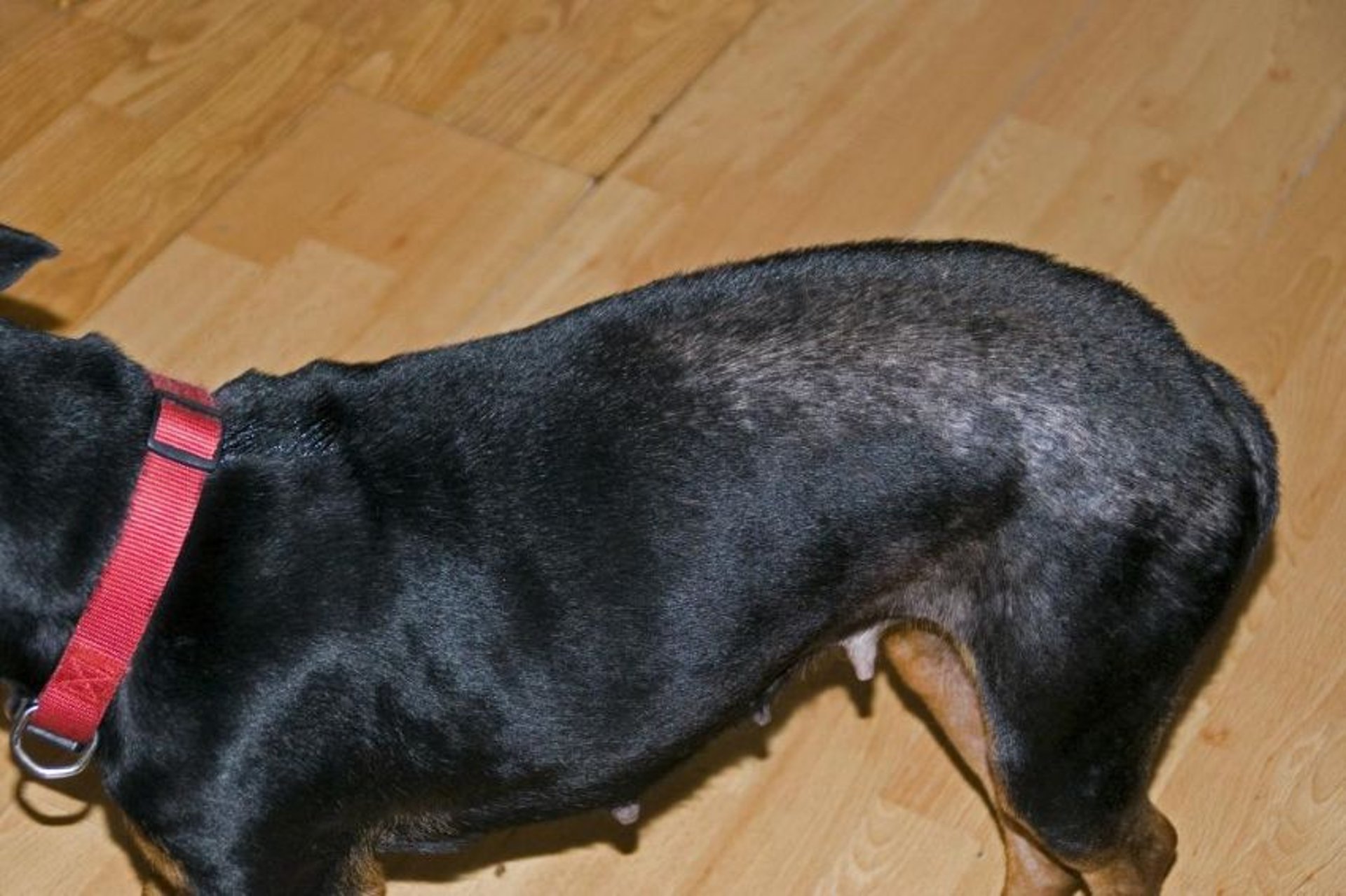
Clinical signs of flea allergy dermatitis in dogs have a more specific pattern than in cats. In dogs, pruritic skin disease occurs on the mid to caudal dorsum, tailhead, and caudal thighs. The most common visible lesions include hair loss (from either barbering—licking, chewing, or scratchingbehavior that results in alopecia—or secondary skin infection) and annular papulocrustous lesions (see ).


Mild flea allergy dermatitis in a dog. Note the thinned hair (due to barbering) on the caudal dorsum and tailhead.
Courtesy of Christina Gentry.
With chronicity, affected areas of the dog's skin can become fully alopecic, hyperpigmented, and lichenified. In long-standing FAD cases, small masses on the dorsum and rump called fibropruritic nodules can develop.
Clinical signs of FAD can involve the entire body, including the face and ears with chronicity and severity of the hypersensitivity (see and FAD images).

Alopecia and erythema is evident over the dorsal tailhead in this adult dog with typical signs of flea allergy dermatitis.
Courtesy of Dr. Michael W. Dryden.

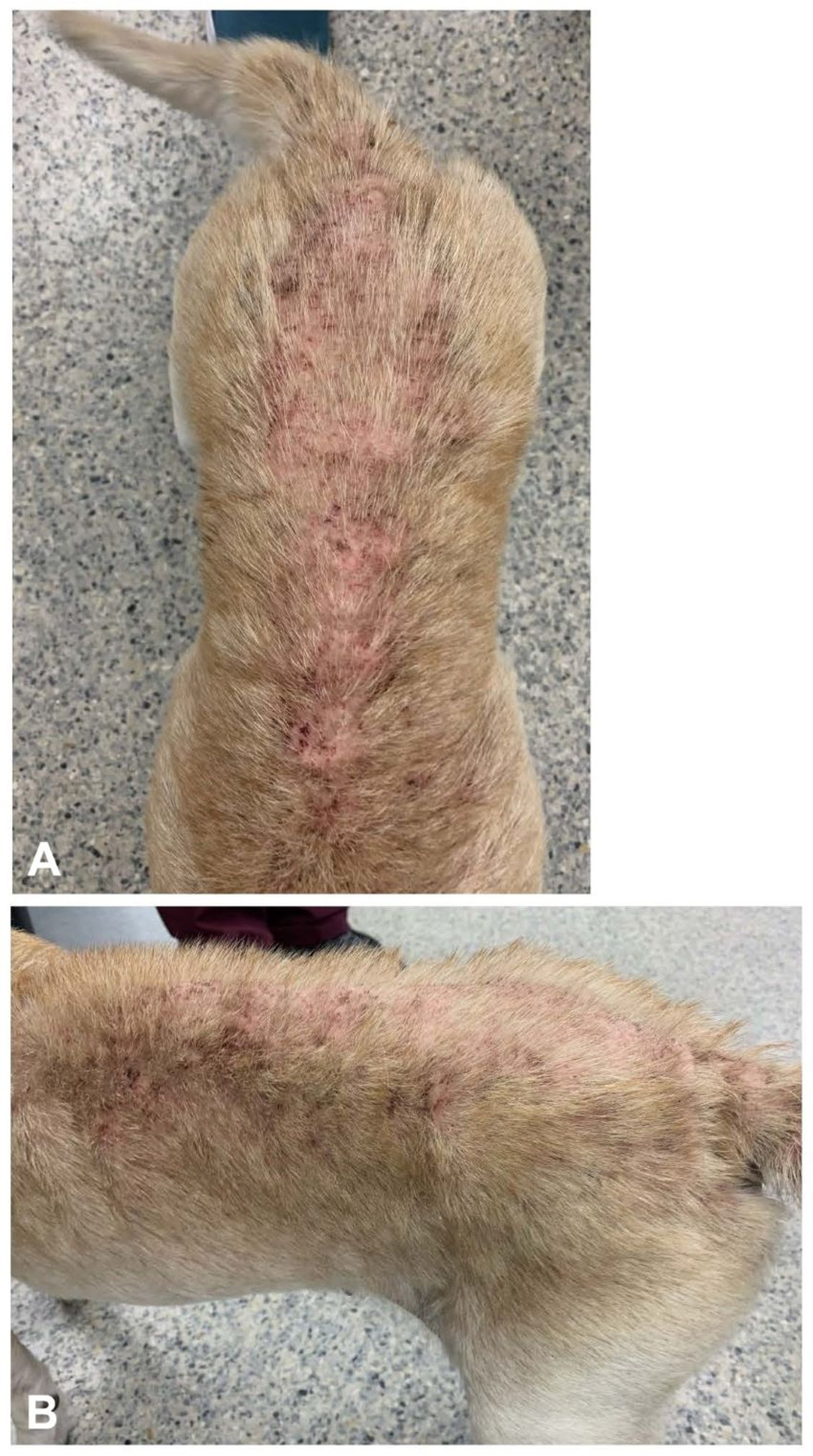
Overhead (A) and lateral (B) views of severe flea allergy dermatitis in a dog. Note the patchy alopecia of the mid to caudal dorsum, which is most severe at the caudal dorsum, with erythema and hemorrhagic crusts.
Courtesy of Christina Gentry.
In cats, clinical signs of FAD vary from minimal to severe, depending on the degree of sensitivity. Crusted papules (miliary dermatitis) are a common sign; however, cats can show any of the four hypersensitivity reaction patterns, which include head and neck pruritus, self-induced alopecia, eosinophilic granuloma complex (indolent ulcers, eosinophilic granulomas, eosinophilic plaques), and miliary dermatitis.
Lesions of the hypersensitivity reaction patterns in cats occur most commonly on the dorsum, tailhead, caudal thighs, inguinal region, head, and neck (see and FAD images).

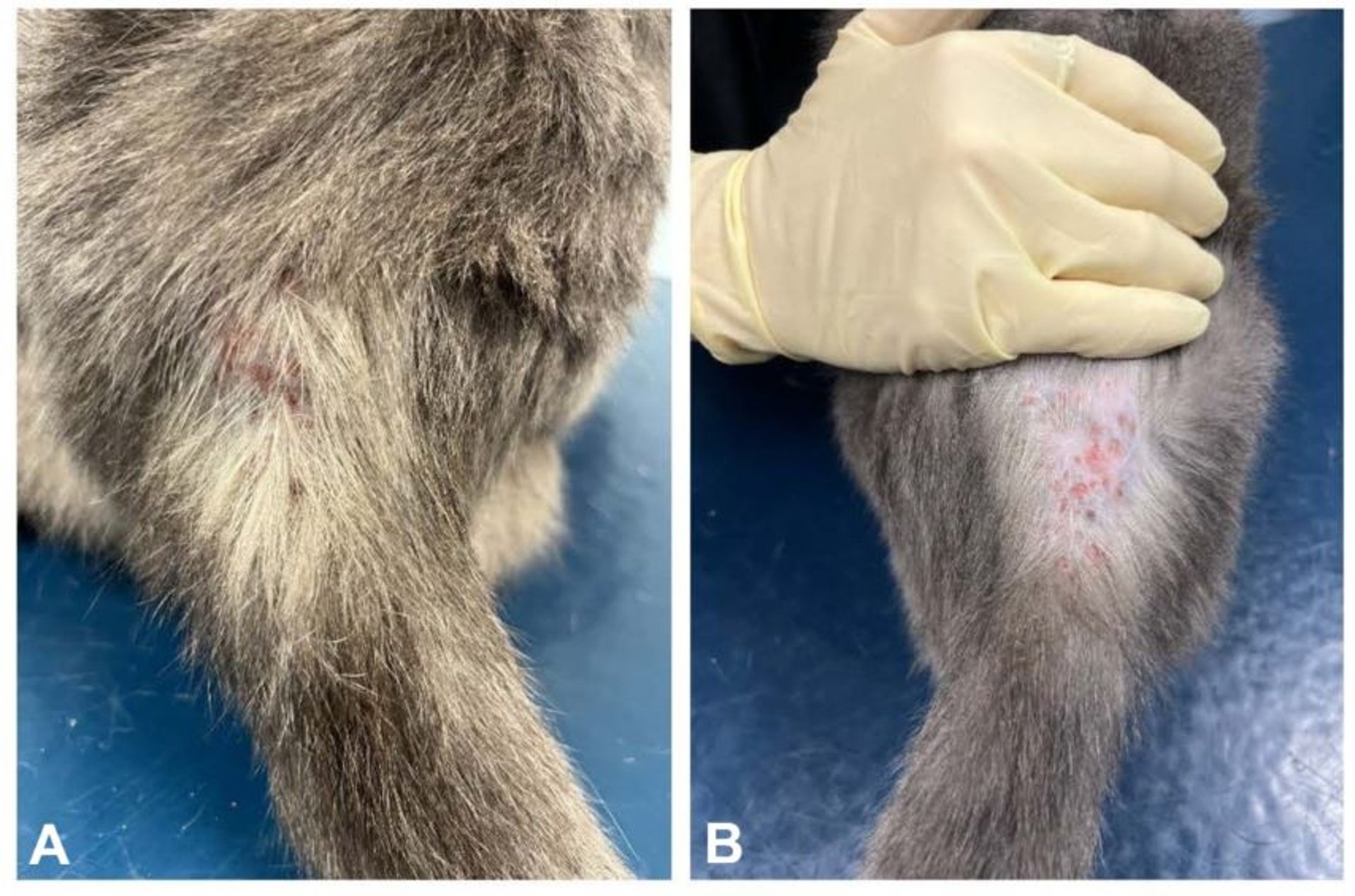
Flea allergy dermatitis in an adult cat. A. The caudal dorsum and tailhead show alopecia due to barbering and eosinophilic plaques. B. The hair is pushed forward in this photograph to show the eosinophilic plaques on the caudal dorsum.
Courtesy of Dr. Christina Gentry.


Flea allergy dermatitis in an adult cat. Self-induced alopecia is evident along the lateral thorax, lateral abdomen, and tailhead. Eosinophilic plaques are present on the lateral thorax.
Courtesy of Dr. Christina Gentry.
In feline FAD cases, alopecia is self-induced and often leads to an unkempt appearance of the coat, pruritus of the head and neck results in excoriations and alopecia, and other hypersensitivity patterns are caused by underlying sensitivity to the saliva in flea bites.
Pruritus from FAD in dogs is moderate to severe and can result from licking, scratching, chewing, biting, rubbing, or scooting of affected areas. This self-trauma can lead to acute moist dermatitis (hot spots) that requires additional treatment. Self-trauma along with the allergic inflammation can lead to superficial and deep bacterial pyoderma, as well as Malassezia dermatitis, which also requires additional treatment.
Dogs with FAD can have concurrent environmental or food-triggered atopic dermatitis or secondary infections (bacterial pyoderma or Malassezia dermatitis) or other ectoparasites that can complicate the clinical picture.
Nonallergic animals might have few clinical signs of FAD other than occasional scratching due to annoyance caused by flea bites. In dogs, signs of flea infestation (pruritus that might lead to alopecia, excoriation, and secondary bacterial infections) are typically present on the ventral abdomen and inguinal region.
Like dogs, cats with FAD can also have an atopic skin syndrome caused by environmental or food allergies, other ectoparasites, dermatophytosis, or secondary skin infections that can complicate the clinical picture.
Diagnosis of Flea Allergy Dermatitis in Dogs and Cats
History and physical examination
Presence of fleas or flea dirt
Response to ectoparasite control
A number of factors must be considered in the diagnosis of flea allergy dermatitis, including history, clinical signs, presence of fleas or flea excrement, and exclusion of other causes of dermatological disease.
History findings supportive of FAD include the following:
lack of consistent use of appropriate flea control for the patient or housemates
access to other animals that might not be on flea control (eg, at grooming salons or dog parks)
access to outdoor environments where stray or wild animals might reside (porches, decks, crawl spaces, outbuildings, barns, etc)
conducive climate
Visual observation of fleas or flea dirt, with matching clinical signs, supports a FAD diagnosis.
Most FAD cases occur in late summer, corresponding to the peak of flea populations. It can occur in animals of any age, and there are no sex or breed predispositions (1).
Extremely hypersensitive animals, especially cats, can be virtually free of fleas because of excessive self-grooming. In these patients, it is usually difficult to find evidence of fleas, thus making it harder to convince owners of a problem. Response to ectoparasite control can be used in such cases as a diagnostic test.
Demonstration to the owner of the presence of fleas or flea excrement is helpful. Slowly parting the hair against the normal lay often reveals flea excrement or rapidly moving fleas. Flea excrement is reddish black, cylindrical, and pellet- or comma-shaped. Placed in water or on a damp paper towel and crushed, the excrement dissolves, producing a reddish-brown color.
Use of a fine-tooth flea comb (32 teeth/inch) facilitates finding of fleas and their excrement. Examination of the pet’s bedding for eggs, larvae, and excrement is also useful; however, such investigation is not practical outside of house call practices.
Intradermal skin testing and serological testing of IgE directed against flea-specific salivary antigens have limited sensitivity and specificity for diagnosis of FAD and are no longer recommended. See Atopic Dermatitis in Dogs for additional information on allergy testing.
Pearls & Pitfalls
|
In patients with suspected FAD, secondary bacterial and Malassezia infections can be present and should be identified via cytological testing of the skin. These infections should be treated promptly because they are an additional cause of pruritus in animals with FAD.
The concurrent presence of ectoparasites can be investigated by superficial and deep skin scrapings. If there are cost constraints, flea preventatives (such as isoxazoline insecticides) that also treat and prevent mites can be used instead of skin scrapings (4).
In dogs, differential diagnoses for FAD include atopic dermatitis that is environmental or food triggered, sarcoptic or demodectic mange, and other ectoparasites.
In cats, the four hypersensitivity reaction patterns can occur with other conditions caused by external parasites (cheyletiellosis, trombiculosis, notoedric mange, and pediculosis), with dermatophytosis, with feline atopic skin syndrome caused by environmental allergy or food allergy, and with secondary skin infections.
Treatment and Control of Flea Allergy Dermatitis in Dogs and Cats
Elimination of existing pet flea infestations
Elimination of biomass at the home premises
Prevention of future infestations
Supportive care
Also see Ectoparasiticides Used in Small Animals.
The first step in managing flea allergy dermatitis is to eliminate existing pet flea infestations, which also eliminates or at least markedly decreases clinical signs of FAD (see Fleas in Dogs and Cats).
Supportive care for pruritus and skin infection might be necessary in FAD cases. With severe disease, PCV or CBC can confirm an anemia diagnosis, and supportive care should be based on the severity of the anemia.
Supportive medical treatment must be instituted to control pruritus and secondary skin disease in hypersensitive animals:
Systemic glucocorticoids are often used to control inflammation and associated pruritus. Short-acting prednisone (for dogs) or prednisolone (for cats) can be administered initially at a dosage of 0.5–1 mg/kg, PO, every 24 hours for 7–14 days, then tapered using alternate-day therapy for 7–14 days until the lowest dose possible that still controls the pruritus is given (5). As soon as flea control is accomplished, the glucocorticoid can be discontinued.
One study showed that oclacitinib at the labeled dosing of 0.4–0.6 mg/kg, PO, every 12 hours for 14 days substantially decreased pruritus in flea-infested dogs (6). If itch control is needed for longer periods of time, it is reasonable to continue oclacitinib administration at 0.4–0.6 mg/kg, PO, every 24 hours until FAD and itch are resolved (7).
Anti-inflammatories should never be used as a substitute for flea control, but they can improve the patient's quality of life during flea treatment.
Secondary bacterial skin infections can be associated with FAD. Cytological testing of the skin should be used to determine whether bacterial pyoderma or Malassezia dermatitis is present. If possible, a single topical antiseptic should be applied to treat both acute moist dermatitis and localized superficial pyoderma (8).
Along with topical antiseptics, systemic empirical first-line antimicrobials should be considered for treating widespread superficial pyoderma and deep pyoderma.
Bacterial culture and susceptibility testing should guide the choice of systemic antimicrobials for FAD patients that have extensive antimicrobial history or that fail to respond to first-line treatments (8).
Key Points
Many dog and cat owners expect treatment for fleas to immediately eliminate flea infestations. However, the existing biomass residing within the premises means that complete elimination often takes up to 3 months.
Effective long-term flea control necessitates preventing fleas from reproducing by consistently using ectoparasite control in all household animals.
Once an infestation is eradicated, most pet owners stop administering flea products. Lifelong flea control is required to prevent reinfestation.
For More Information
CAPC Guidelines: Fleas. Companion Animal Parasite Council.
Noli C. Flea biology, allergy and control. In: Noli C, Colombo S, eds. Feline Dermatology. Springer Nature; 2020:437-449.
Also see pet owner content regarding fleas of dogs and cats.
References
Lam A, Yu A. Overview of flea allergy dermatitis. Compend Contin Educ Vet. 2009;31(5):E1-10.
Dryden MW, Rust, MK. The cat flea: biology, ecology and control. Vet Parasitol. 1994;52(1-2):1-19. doi:10.1016/0304-4017(94)90031-0
Laffort-Dassot C, Carlotti D-N, Pin D, Jasmin P. Diagnosis of flea allergy dermatitis: comparison of intradermal testing with flea allergens and a FcɛRI α-based IgE assay in response to flea control. Vet Dermatol. 2004;15(5):321-330. doi:10.1111/j.1365-3164.2004.00394.x
Miller J, Simpson A, Bloom P, et al. 2023 AAHA Management of allergic skin diseases in dogs and cats guidelines. J Am Anim Hosp Assoc. 2023;59(6):255-284. doi:10.5326/JAAHA-MS-7396
Scheidt VJ. Flea allergy dermatitis. Vet Clin North Am Small Anim Pract. 1988;18(5):1023-1042. doi:10.1016/s0195-5616(88)50105-5
Gonzales AJ, Aleo M, Mahabir S, Messamore J, Stegemann M. Oclacitinib (APOQUEL®) is a selective Janus kinase 1 inhibitor with efficacy in a canine model of flea allergic dermatitis. J Vet Pharmacol Ther. 2024;47(6):447-453. doi:10.1111/jvp.13462
Cosgrove SB, Wren JA, Cleaver DM, et al. Efficacy and safety of oclacitinib for the control of pruritus and associated skin lesions in dogs with canine allergic dermatitis. Vet Dermatol. 2013;24(5):479-e114. doi:10.1111/vde.12047
Loeffler A, Cain CL, Ferrer L, et al. Antimicrobial use guidelines for canine pyoderma by the International Society for Companion Animal Infectious Diseases (ISCAID). Vet Dermatol. 2025;36(3):234-282. doi:10.1111/vde.13342