In dogs and cats, patellar luxation is a developmental orthopedic disorder characterized by displacement of the patella, either medially or laterally, from the trochlear groove of the femur. The disorder is caused by abnormal development of the surrounding musculoskeletal structures.
Patellar luxation is often associated with multiple deformities of the hindlimb, involving the hip joint, femur, and tibia:
Medial patellar luxation is commonly associated with a decreased coxofemoral angle (coxa vara), lateral bowing of the distal femur (distal femoral varus), internal rotation of the tibia, a shallow trochlear groove, and hypoplasia of the medial femoral condyle.
Lateral patellar luxation is typically associated with opposite deformities, such as coxa valga, medial femoral bowing (femoral valgus), and external tibial rotation.
In general, medial patellar luxation is more common in cats, in small- and miniature-breed dogs, and in large-breed dogs. Lateral patellar luxation is much less common than medial patellar luxation; lateral patellar luxation is more prevalent in large-breed dogs.
Clinical signs of patellar luxation vary, depending on the severity. Animals of any age can be affected; however, clinical signs generally start showing before the age of 1 year.
The main clinical sign of patellar luxation is lameness. Characteristically, affected animals have intermittent non–weight-bearing lamenessof the affected hindlimb that resolves within a few steps (often described as a "skipping" gait). On palpation of the stifle joint, the patella can be felt to be displaced medially or laterally during flexion and extension, depending on the type and degree of luxation.
Patellar luxation can be classified by grade according to the level of severity:
Grade 1: Clinical signs are mild and infrequent, or animals can be subclinically affected, and the patella can be manually luxated, but it spontaneously returns to the trochlear groove.
Grade 2: The patella luxates spontaneously or with manipulation but can remain luxated temporarily; it can be returned to the trochlear groove manually or by extension of the limb. Affected animals might show intermittent weight-bearing lameness or skipping lameness.
Grade 3: The patella is luxated most of the time but can be manually reduced; however, it reluxates easily. Lameness is consistent, and bone deformities are evident.
Grade 4: The patella is permanently luxated and cannot be manually reduced. Lameness and limb deformations are severe. Affected dogs might walk with flexed stifle joints and crouched hindlimbs.
Radiography of dogs and cats with patellar luxation reveals various degrees of limb changes based on the direction and grade of the luxation.
With medial patellar luxation, possible radiographic findings include distal femoral varus, femoral rotational deformity, medial displacement of the tibial tuberosity, and medial rotation of the tibia (see ).

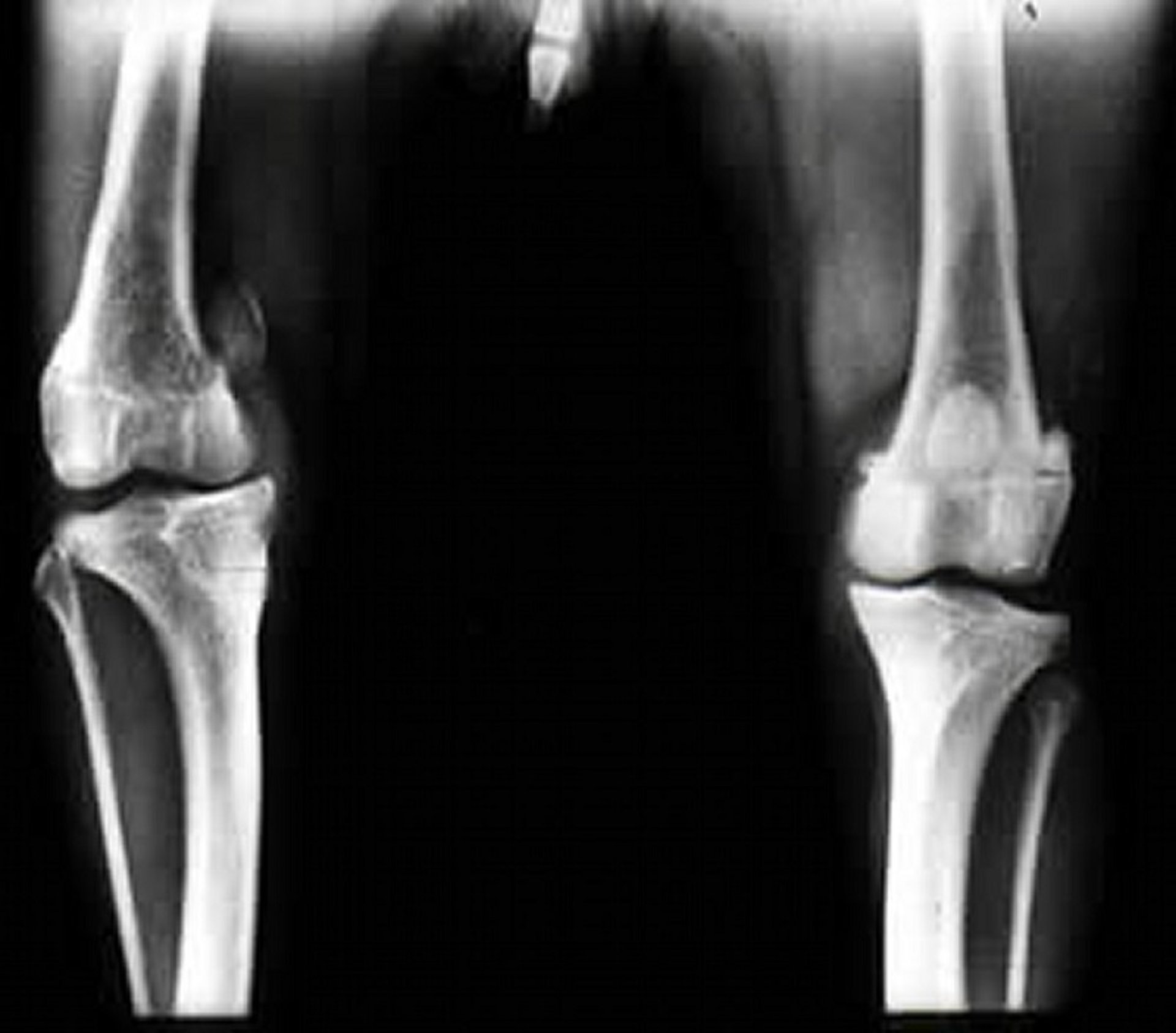
Craniocaudal radiographic view of the stifle joints of a dog with right-sided medial patellar luxation. Note the displacement of the patella and internal rotation of the tibia, with increased medial soft tissue fibrosis.
Courtesy of Dr. Ronald Green.
With lateral patellar luxation, possible radiographic findings include displacement of the patella lateral to the femoral condylar groove, coxa valga, medial femoral bowing (femoral valgus), and external tibial rotation.
The trochlear groove is frequently shallow or flattened, contributing to patellar instability.
With medial patellar luxation, additional deformities can include hypoplasia of the medial femoral condyle and coxa vara. Skeletal changes increase in severity with the grade of luxation.
Treatment for patellar luxation depends largely on the severity of the condition and clinical signs.
Conservative treatment of patellar luxation (eg, includes weight management, controlled exercise, physical therapy, and analgesia provided by anti-inflammatory medications) aims to decrease inflammation and improve comfort but does not correct the underlying anatomical abnormalities, so progression of the luxation can still occur over time. Conservative treatment is generally reserved for dogs with mild clinical signs (grade 1 and some grade 2 cases with minimal or no lameness), older patients, or patients for whom surgery is not feasible.
Surgical intervention is typically recommended for dogs with moderate to severe patellar luxation (grades 2–4), dogs experiencing marked lameness, or dogs with progressive worsening of clinical signs. Osseous surgical techniques for medial or lateral patellar luxation in dogs include tibial tuberosity transposition (TTT) and femoral trochleoplasty (trochlear groove deepening).
TTT realigns the quadriceps mechanism to improve patellar tracking. Trochleoplasty helps to stabilize the patella within the groove. These procedures are often combined with soft tissue techniques to balance the forces around the patella. Soft tissue surgery techniques for treatment of medial patellar luxation include medial retinacular release and lateral capsular imbrication. Soft tissue surgery techniques for treatment of lateral patellar luxation include lateral desmotomy and medial capsular imbrication.
In severe patellar luxation cases with marked bone deformities, corrective osteotomy of the femur or tibia might be necessary to restore normal limb alignment. The choice of surgery depends on the grade of luxation, the presence of skeletal deformities, and the overall condition of the dog.
Additional surgical options are available for the treatment of patellar luxation in dogs, especially when traditional techniques are insufficient or contraindicated:
An ultrahigh-molecular-weight polyethylene (UHMWPE) implant is available as a sulcal ridge prosthesis. The implant is fixed to the medial trochlear ridge of the femur to prevent medial displacement of the patella without the need for trochleoplasty. It preserves the articular cartilage, which is particularly useful in small dogs with shallow trochlear grooves.
The patellar groove replacement (PGR) system, a metal prosthesis that replaces the entire trochlear groove, is indicated in cases of severe trochlear dysplasia, cartilage erosion, or previous failed surgeries.
These techniques are relatively novel and are typically reserved for select cases; however, early outcomes suggest they can improve patellar tracking and decrease lameness when conventional approaches are not feasible (1, 2).
Surgical treatment of patellar luxation in cats shares many similarities with that in dogs; however, there are also some important differences. As in dogs, surgical correction in cats typically (but less commonly than in dogs) involves procedures to realign the extensor mechanism (eg, TTT) and to deepen the femoral trochlear groove (eg, trochleoplasty). Combined soft tissue balancing techniques (medial release and lateral capsular imbrication) are also sometimes needed. Some cases require partial parasagittal patellectomy.
The prognosis for recovery from patellar luxation is good in mild or moderately affected dogs and cats. Concurrent cranial cruciate ligament and medial meniscal injuries should be identified and treated.
Key Points
Patellar luxation in dogs and cats is a developmental orthopedic disorder characterized by medial or lateral displacement of the patella from the femoral trochlear groove, often associated with multiple limb deformities, such as coxa vara, femoral valgus or varus, tibial rotation abnormalities, and a shallow trochlear groove.
Clinical signs vary widely, from mild or absent signs to persistent lameness and an intermittent skipping gait.
Luxations are graded from 1 to 4 on the basis of severity and reducibility.
Treatment depends on severity. Conservative management is reserved for mild cases; moderate to severe cases require surgery.
For More Information
Brooks W. Medial luxating patella in dogs. Vet Partner. 2006. Revised June 19, 2024.
Loughlin CA, Kerwin SC, Hosgood G, et al. Clinical signs and results of treatment in cats with patellar luxation: 42 cases (1992–2002). J Am Vet Med Assoc. 2006;228(9):370-1375.
Rezende CMF, Tôrres RCS, Nepomuceno AC, Lara JS, Varón JAC. Patellar luxation in small animals. In: Kaoud HAE, ed. Canine Medicine—Recent Topics and Advanced Research. 2016:chap. 8.
Patellar Luxations. American College of Veterinary Surgeons.
Also see pet owner content regarding kneecap displacement in dogs and cats.
References
Dokic Z, Lorinson D, Weigel JP, Vezzoni A. Patellar groove replacement in patellar luxation with severe femoro-patellar osteoarthritis. Vet Comp Orthop Traumatol. 2015;28(2):124-130. doi:10.3415/VCOT-14-07-0106
Nicetto T, Longo F. Trochlear ridge prostheses for reshaping femoral trochlear ridges in dogs with patellar luxation. Vet Comp Orthop Traumatol. 2024;37(2):98-106. doi:10.1055/s-0043-1776331