Feline hypokalemic polymyopathy is a generalized metabolic muscle-weakness disorder in cats secondary to hypokalemia.
Most cats develop this polymyopathy secondary to chronic kidney disease and the subsequent loss of potassium through urination. However, feline hypokalemic polymyopathy has been associated with hyperthyroidism, dietary potassium deficiency, hyperaldosteronism, excessive fluid administration, chronic vomiting or diarrhea, and the use of potassium-wasting diuretics.
Feline hypokalemic polymyopathy has been reported in cats receiving ophthalmic dorzolamide (1) and in Burmese kittens with episodic hypokalemic myopathy (2).
Extracellular hypokalemia causes muscle cell membrane hyperpolarization and secondary excessive permeability to sodium. This makes the muscle cell membrane refractory to depolarization and subsequent contraction.
Clinical signs of feline hypokalemic polymyopathy are typically acute in onset and include the following:
generalized weakness
ventroflexion of the neck (see )
stiff, stilted gait
anorexia
muscle pain
Severe hypokalemia can result in respiratory paralysis and rhabdomyolysis.
Historically, diagnosis has relied on demonstration of hypokalemia. Serum biochemical analysis in cats with hypokalemic polymyopathy typically reveals low potassium concentrations—a median potassium concentration of 2.45 mmol/L (2.45 mEq/L) was reported in one study (3)—and possibly increased creatinine concentration and CK activity (4). PCR assay provides a straightforward means of diagnosis in Burmese and related breeds with familial episodic hypokalemic polymyopathy.
Abdominal ultrasonography is recommended to evaluate for an underlying adrenal tumor that may be causing hyperaldosteronism. Hyperaldosteronism is definitively diagnosed by measuring serum aldosterone concentration in a properly hydrated patient.

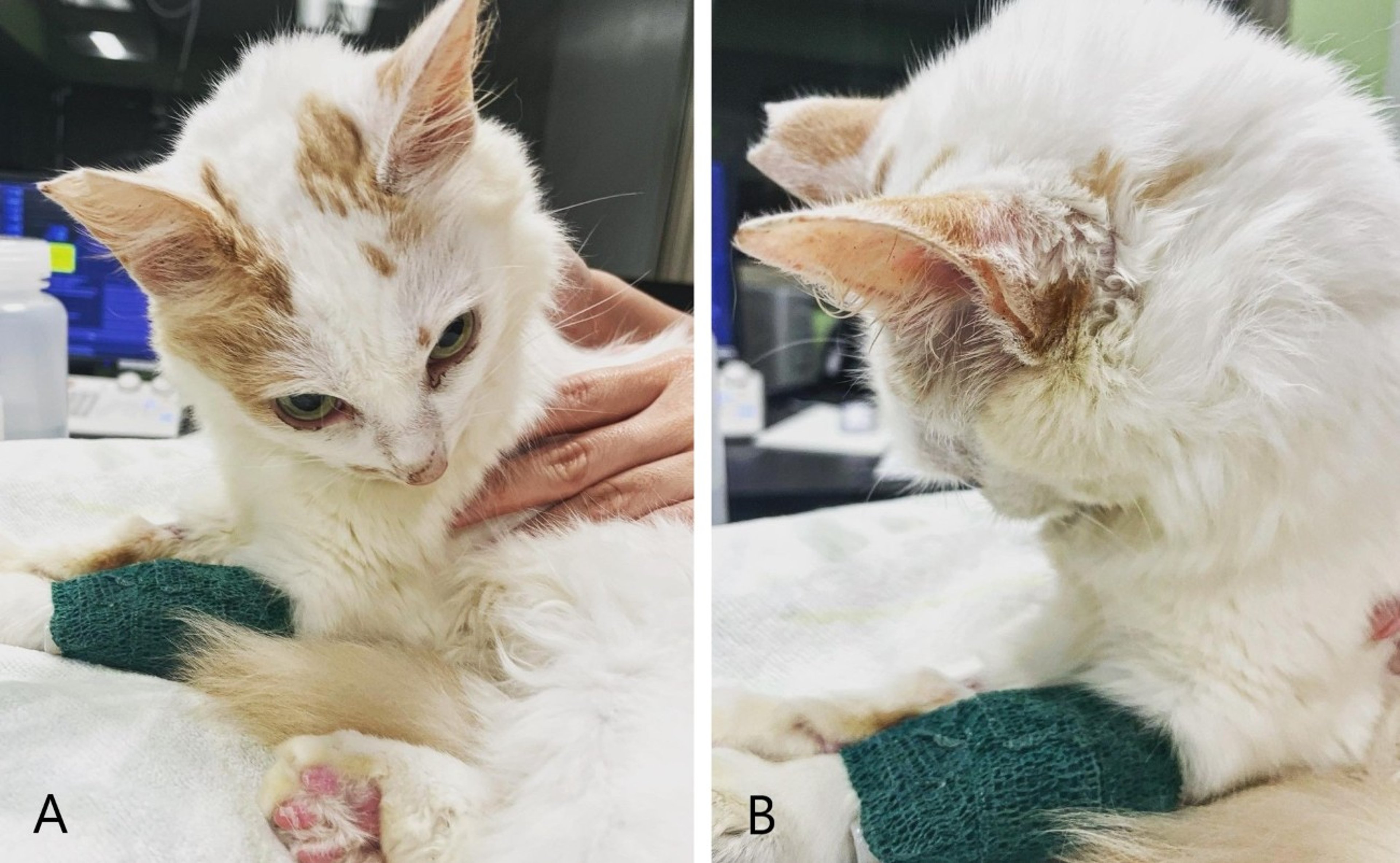
Front (A) and side (B) views of a 1-year-old cat with cervical ventroflexion secondary to hypokalemia. The cat was receiving brinzolamide ophthalmic solution. Clinical signs resolved with oral and IV potassium supplementation.
Courtesy of Baye Williamson, DVM, DACVIM (Neurology).
Treatment of feline hypokalemic polymyopathy is potassium supplementation (5–8 mEq/cat, PO, every 24 hours or divided every 12 hours) (5). Normal potassium concentrations are typically achieved in 1–3 days.
In cats with profound hypokalemia, potassium can be administered parenterally (0.5 mEq/kg/h, IV) (5); electrolytes should be checked every 4 hours, and supplementation can be decreased once potassium concentration returns to normal.
Once normokalemia is achieved, most cats with conditions that cause hypokalemia will require long-term potassium supplementation (2 mEq/cat, PO, every 12 hours) (5). Treatment of the underlying cause, such as managing hyperthyroidism or lowering the diuretic dose, may also be required.
The prognosis for cats with feline hypokalemic polymyopathy is excellent when the condition is diagnosed and treated early.
For other metabolic myopathies in small animals (dogs and cats), see the Overview for this chapter.
For More Information
Ash RA, Harvey AM, Tasker S. Primary hyperaldosteronism in the cat: a series of 13 cases. J Feline Med Surg. 2005;7(3):173-182.
Lo AJ, Holt DE, Brown DC, Schlicksup MD, Orsher RJ, Agnello KA. Treatment of aldosterone-secreting adrenocortical tumors in cats by unilateral adrenalectomy: 10 cases (2002–2012). J Vet Intern Med. 2014;28(1):137-143.
Also see pet owner content regarding hypokalemic polymyopathy in cats.
References
Czepiel TM, Wasserman NT. Hypokalemia associated with topical administration of dorzolamide 2% ophthalmic solution in cats. Vet Ophthalmol. 2021;24(1):12-19. doi:10.1111/vop.12773
Malik R, Musca FJ, Gunew MN, et al. Periodic hypokalaemic polymyopathy in Burmese and closely related cats: a review including the latest genetic data. J Feline Med Surg. 2015;17(5):417-426. doi:10.1177/1098612X15581135
Tamura S, Nakamoto Y, Tamura Y. Reversible positioning head tilt observed in 14 cats with hypokalaemic myopathy. J Feline Med Surg. 2023;25(6):1098612X231175761. doi:10.1177/1098612X231175761
Karpozilou A, De Stefani A, Liatis T. Cervical ventroflexion in cats: 86 cases (2003-2024). J Feline Med Surg. 2025;27(7):1098612X251348328. doi:10.1177/1098612X251348328
DiBartola SP, de Morais HA. Disorders of potassium: hypokalemia and hyperkalemia. In: DiBartola SP, ed. Fluid, Electrolyte, and Acid-Base Disorders in Small Animal Practice. 4th ed. Elsevier Saunders; 2012:92-119. doi:10.1016/B978-1-4377-0654-3.00012-3