Muscular dystrophy is a type of degenerative and/or developmental myopathy affecting dogs and cats.
The most common forms of muscular dystrophy in both humans and animals are associated with deficiencies of the protein dystrophin, which is located on the X chromosome. X-linked dystrophin-deficient muscular dystrophies in dogs and cats are thought to be the analogues of Duchenne and Becker muscular dystrophies in humans, respectively, and have been described in numerous dog and cat breeds. Specific genetic mutations have been identified in Golden Retrievers, German Shorthaired Pointers, Cavalier King Charles Spaniels, Japanese Spitz dogs, Rottweilers, and Brittanys, among others (1). Muscular dystrophy is best described in the Golden Retriever (2).
The predominant clinical sign in dogs is progressive muscular atrophy, whereas muscular hypertrophy is the hallmark of X-linked muscular dystrophy in cats. Both atrophy and hypertrophy can occur in both species, and all muscles are not uniformly affected (see ).Partial trismus and a "bunny-hopping" gait have been observed in male dogs as young as 6 weeks old.
Other common clinical signs of muscular dystrophy in dogs and cats include the following:
exercise intolerance
stilted gait
plantigrade stance
dysphagia (see and )
dysphonia
kyphosis that progresses to lordosis
hypertrophy of the muscles at the base of the tongue
There are a variety of muscular dystrophies with variable disease progression. Juvenile-onset cases may be more severe, whereas adult-onset cases may have a milder disease course. In Golden Retrievers, clinical signs typically progress over 3–6 months, after which time the disease progresses more slowly. Marked increases in serum CK activity are detected within a few weeks after birth.

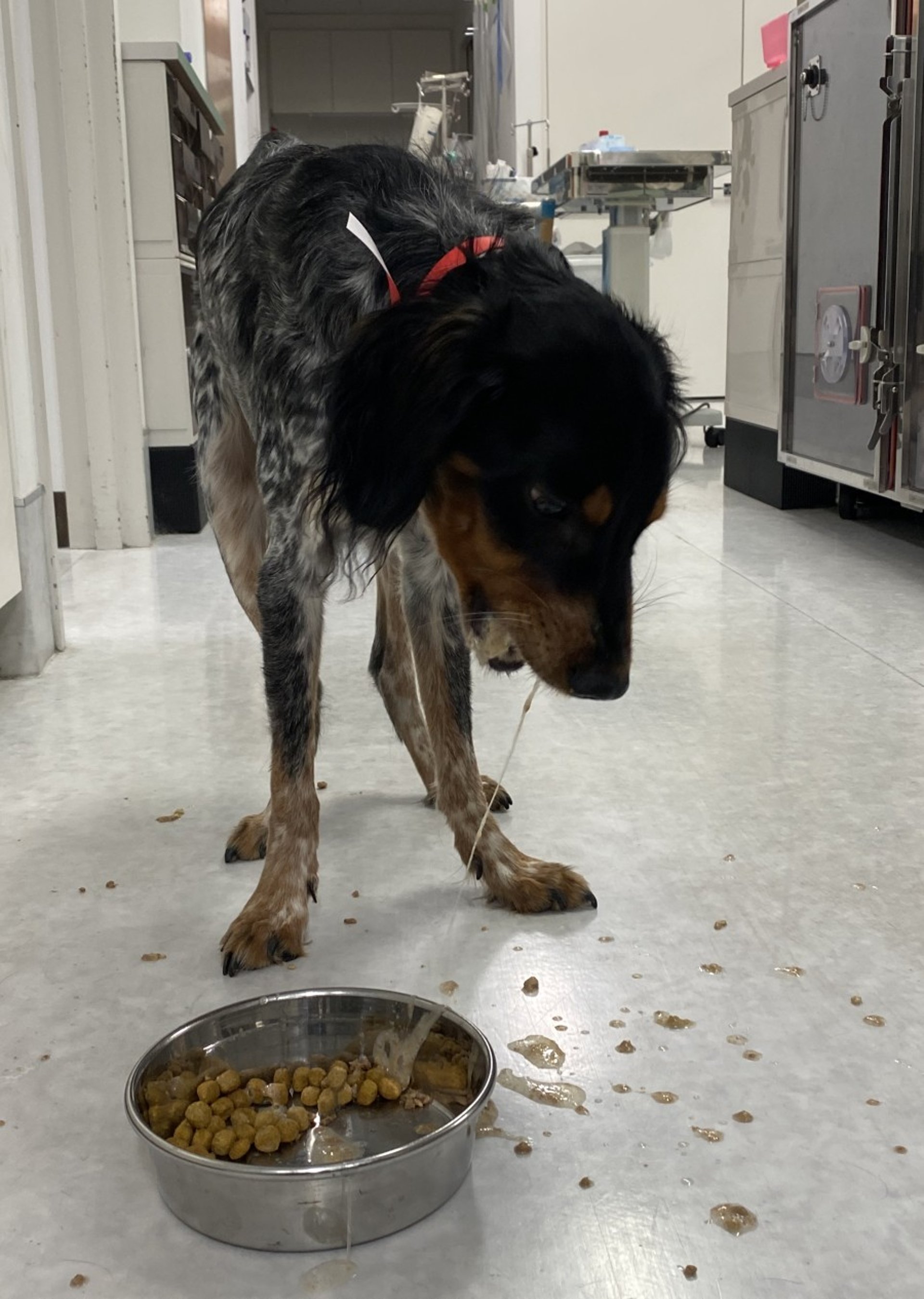
A juvenile male Brittany exhibiting dysphagia (difficulty swallowing food, water, or saliva) while eating, a clinical sign of dystrophin-deficient muscular dystrophy. The dog was examined because of failure to grow, progressive exercise intolerance, and dysphagia.
Case report: Stevens R, Kanazono S, Petesch S, Guo LT, Shelton GD. Dystrophin-deficient muscular dystrophy in two male juvenile Brittanys. J Am Anim Hosp Assoc. 2022;58(6):292-296. doi:10.5326/JAAHA-MS-7255
Courtesy of Shinichi Kanazono, DVM, DACVIM (Neurology).


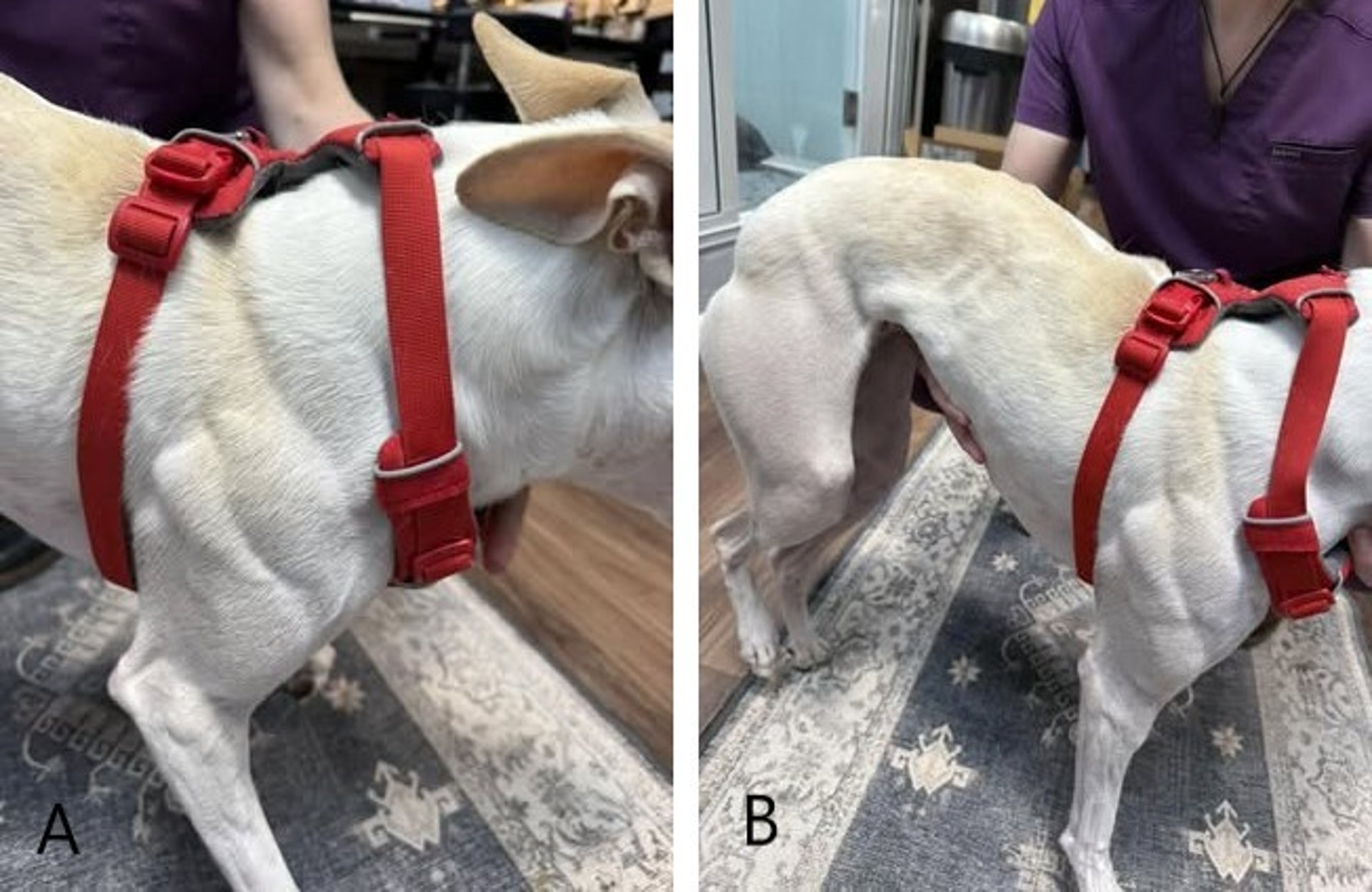
Dog suspected of having muscular dystrophy; however, a definitive diagnosis was not established. (A) Muscular hypertrophy of the thoracic limbs. (B) Comparison of thoracic and pelvic limbs demonstrating more pronounced muscular hypertrophy of the thoracic limbs relative to the pelvic limbs.
Courtesy of Carrie Jurney, DVM, DACVIM (Neurology).
Feline X-linked muscular dystrophy is much more variable. Clinical signs in affected cats include the characteristic "bunny-hopping" gait in the first few months of life; however, they can also appear clinically unaffected or only mildly affected until approximately 2 years old. Cats demonstrate a progressive stiffness in their gait and muscle hypertrophy. Stress can lead to open-mouthed breathing or syncopal episodes as a result of a combination of cardiac and respiratory muscle involvement.
Diagnosis of muscular dystrophy is based on the following:
signalment
characteristic clinical signs
marked serum CK activity elevation (often > 10,000 U/L)
abnormal electromyographic findings
muscle biopsy results
Consistent radiographic abnormalities have been identified in Golden Retrievers with X-linked muscular dystrophy. Thoracic radiographic images show diaphragmatic asymmetry, which may accompany a hiatal hernia. Pelvic radiographs show the pelvis is tilted vertically, narrowed, and elongated.
There is no definitive treatment for any of the muscular dystrophies. Some patients have an unexplained response to glucocorticoid treatment. A favorable response to prednisone, 1–2 mg/kg, PO, every 24 hours, has been reported (3, 4); however, the improvement is short-term. Duration of treatment is unknown but is unlikely lifelong, as a sustained response to steroids does not occur.
Overall, the prognosis for dogs and cats with muscular dystrophies is guarded to poor, and disease severity varies.
For other degenerative and/or developmental myopathies in dogs and cats, see the Overview for this chapter.
For More Information
American Kennel Club: Golden Retriever DNA tests.
CombiBreed: Muscular Dystrophy (MD) – Corgi [DNA test].
Embark: Muscular Dystrophy [DNA test].
EVG: Muscular dystrophy (MD) - CKCS [DNA test].
Also see pet owner content regarding muscular dystrophy in dogs and muscular dystrophy in cats.
References
Shelton GD, Minor KM, Friedenberg SG, Cullen JN, Guo LT, Mickelson JR. Current classification of canine muscular dystrophies and identification of new variants. Genes. 2023;14(8):1557. doi:10.3390/genes14081557
Kornegay JN. The golden retriever model of Duchenne muscular dystrophy. Skelet Muscle. 2017;7(1):9. doi:10.1186/s13395-017-0124-z
Liu JM, Okamura CS, Bogan DJ, Bogan JR, Childers MK, Kornegay JN. Effects of prednisone in canine muscular dystrophy. Muscle Nerve. 2004;30(6):767-773. doi:10.1002/mus.20154
Wuebbles RD, Sarathy A, Kornegay JN, Burkin DJ. Levels of α7 integrin and laminin-α2 are increased following prednisone treatment in the mdx mouse and GRMD dog models of Duchenne muscular dystrophy. Dis Model Mech. 2013 Sep;6(5):1175-1184. doi:10.1242/dmm.012211