Avian lice (suborder Mallophaga) have a life cycle of approximately 3 weeks and normally feed on feathers or bits of dead skin. Lice can live for several months on the host but remain alive for only approximately 1 week off the host. Humans and other mammals can temporarily harbor avian lice.
The most common and economically important louse for both chickens and turkeys is the chicken body louse (Menacanthus stramineus). This louse is found in intensive commercial flocks and in small backyard or hobby flocks alike.
Adult chicken body lice are 3–3.5 mm long, and eggs are glued to the base of feathers. Menacanthus stramineus is found primarily on the host’s skin in the vent, breast, or thigh areas. Chicken body lice feed on feathers and also feed on blood by chewing on pin feathers.
Several other louse species can infest domestic poultry (see ). Comparatively little is known about these species, because they are rarely observed infesting commercial flocks, and it is unlikely that they are of major economic importance. Possible exceptions are the Menoponidae lice (Menacanthus spp, Menopon gallinae), which can feed on blood.

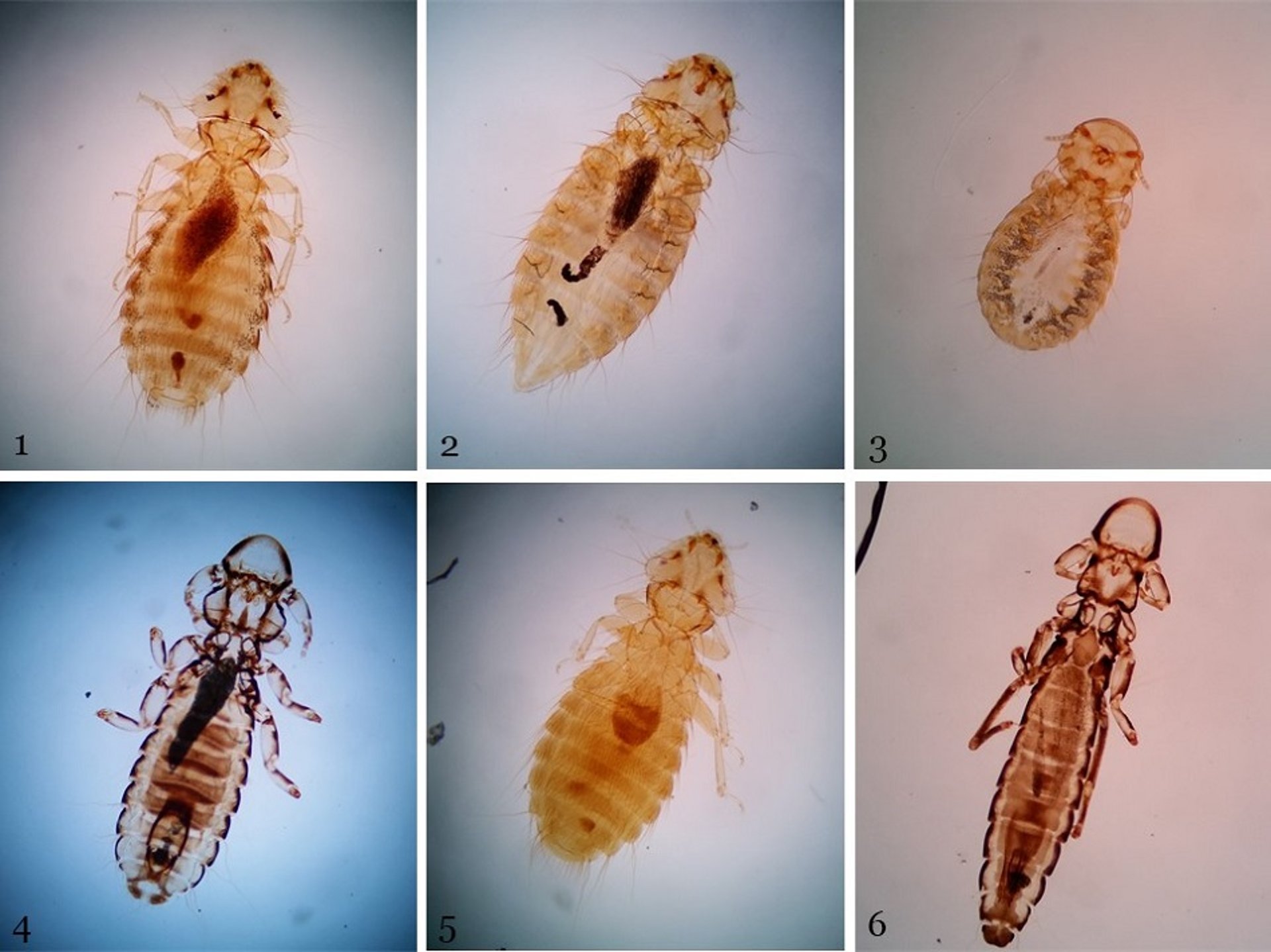
Photomicrographs showing examples of poultry lice, cleared and slide-mounted under light microscopy: 1. chicken body louse; 2. shaft louse; 3. fluff louse; 4. chicken head louse; 5. Menacanthus cornutus; 6. chicken wing louse (images not to scale). Adult lice range in size from 1.5 to 3.5 mm long.
Courtesy of Dr. Amy Murillo.
Chickens are less commonly infested with the shaft louse (Menopon gallinae; on feather shafts), the chicken wing louse (Lipeurus caponis; mainly on the primary wing feathers), the chicken head louse (Cuclotogaster heterographus; mainly on the head and neck), the fluff louse (Goniocotes gallinae; very small, in the fluff of feathers), the large chicken louse (Goniodes gigas), the brown chicken louse (Goniodes dissimilis), Menacanthus cornutus, the small body louse (Uchida pallidula), or Oxylipeurus dentatus.
Turkeys can also be infested with the large turkey louse (Chelopistes meleagridis) and the slender turkey louse (Oxylipeurus polytrapezius).
Because lice transfer from one bird species to another when hosts are in close contact, other domestic and caged birds can be infested with Mallophaga species that are usually host specific. Lice also sometimes reach new bird hosts by using louse flies (Hippoboscidae) for transportation. Some lice of geese and swans are vectors of filarial nematodes.
Heavy populations of the chicken body louse (Menacanthus stramineus) decrease reproductive potential in males, egg production in females, and weight gain in growing chickens. Areas of skin irritation are also sites for secondary bacterial infections. Other louse species are not highly pathogenic to mature birds but could be fatal to chicks. Examination of birds, particularly around the vent and under the wings, reveals eggs or moving lice on the skin or feathers.
Lice are usually introduced to a farm through infested equipment (eg, crates or egg flats) or by galliform birds. Lice are best controlled on caged chickens or turkeys by spraying with approved insecticides. For more information, see the list of pesticides for treating poultry arthropods registered by state jurisdiction. Eggs are not killed, so insecticidal treatment should be repeated after 10 days.
Birds on the floor are more easily treated by scattering insecticidal dust on the litter or by providing dust boxes containing sand and an insecticidal dust, such asfood-grade diatomaceous earth. Chickens provided with dust boxes (such as plastic cement-mixing bins) filled with washed play sand (approximately 50 pounds) and food-grade diatomaceous earth (approximately 6 cups) have been found to markedly decrease their louse burden by dust bathing in the treated material (1, 2).
Note that diatomaceous earth should be applied in well-ventilated areas only, and the applicator should wear a dust mask.
Pearls & Pitfalls
|
For More Information
Chicken Lice. Veterinary Entomology.
Medical and Veterinary Entomology. 3rd ed. Academic Press; 2019:79-106.
Axtell RC. Arthropod pests of poultry. In: Williams RE, Hall RD, Broce AB, Scholl PJ, eds. Livestock Entomology. Wiley-Interscience; 1985:269-295.
References
Martin CD, Mullens BA. Housing and dustbathing effects on northern fowl mites (Ornithonyssus sylviarum) and chicken body lice (Menacanthus stramineus) on hens. Med Vet Entomol. 2012;26(3):323-333. doi:10.1111/j.1365-2915.2011.00997.x
Murillo AC, Mullens BA. 2016. Diversity and prevalence of ectoparasites on backyard chicken flocks in California. J Med Entomol. 2016;53(3):707. doi:10.1093/jme/tjv243