The most economically important of the many external parasites of poultry are mites of the following families: Dermanyssidae and Macronyssidae (poultry red mite, northern fowl mite, and tropical fowl mite), and Trombiculidae (turkey chigger).
Poultry Red Mite
The poultry red mite, or chicken mite (Dermanyssus gallinae), infests chickens, turkeys, pigeons, canaries, and various wild birds worldwide. These blood-feeding mites also bite humans; however, they cannot survive on humans or infest them.
Although rare in modern commercial caged laying operations, poultry red mites are found in cage-free environments including breeder or broiler flocks.
Poultry red mites are nocturnal feeders that hide during the day under bird droppings, on roosts, in nest boxes, and in cracks and crevices of the chicken house, where they deposit eggs (see ).


A perch heavily infested with poultry red mites.
Courtesy of Dr. Amy Murillo.
Populations of poultry red mites develop rapidly during the warmer months and more slowly in cold weather. The life cycle can be completed in only 1 week. A poultry house can remain infested for up to 9 months after affected birds are removed.
Transmission of the poultry red mite, as well as of the northern fowl mite and the tropical fowl mite, is by mite dispersion or by contact with infested birds, animals, or inanimate objects. In the integrated poultry industry, mites are usually dispersed on inanimate objects such as egg flats, crates, or coops or via personnel going from house to house or farm to farm.
Heavy infestations of either poultry red mites or northern fowl mites (see ) decrease reproductive potential in males, egg production in females, weight gain in young birds, and feed conversion efficiency. They can also cause anemia and death.

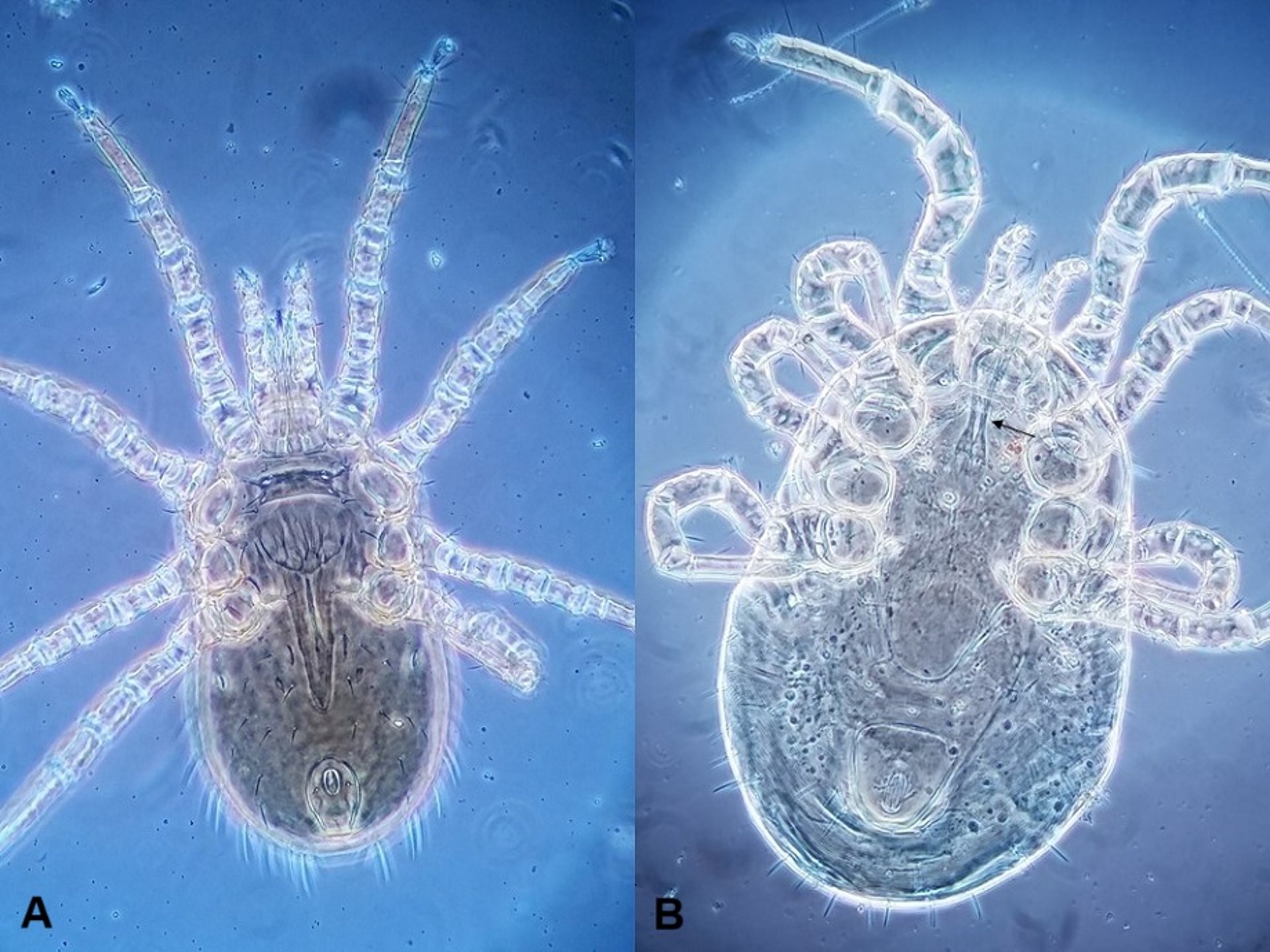
Photomicrographs showing northern fowl mite (A) and poultry red mite (B) adult females, cleared and slide-mounted under phase-contrast microscopy. The adult female poultry red mite is slightly larger (approximately 1.5 mm) than the adult female northern fowl mite (approximately 0.6 mm), and it has very long chelicerae (arrow).
Courtesy of Dr. Amy Murillo.
Poultry red mites can be found in chicken houses during the day, particularly in nest boxes, in cracks, where roost poles touch supports, or on birds at night. These mites are rarely observed on birds during the day, because they feed on poultry only at night and then leave the host during daylight.
The role of poultry red mites as vectors of other pathogens in nature needs study. However, experimental transmission of eastern, western, and Venezuelan equine encephalitis viruses, fowlpox virus, and the bacteria Salmonella enteritidis, Pasteurella multocida, Coxiella burnetii, and Borrelia anserina has been demonstrated (1).
Obtaining mite-free birds and using good sanitation practices are important to prevent a buildup of mite populations. After poultry have been infested, control can be achieved by spraying or dusting the birds and litter or by targeting the inside of the house and all hiding places for poultry red mites (eg, behind nest boxes, in cracks and crevices) with a high-pressure sprayer. For more information, see the list of pesticides for treating poultry arthropods registered by state jurisdiction.
Inert dusts such as food-grade diatomaceous earth and pure synthetic amorphous silicas can be effective. Chickens provided with dust boxes (such as plastic cement-mixing bins) filled with washed play sand (approximately 50 pounds) and food-grade diatomaceous earth (approximately 6 cups) have been found to markedly decrease their northern fowl mite burden by dust bathing in the treated material (2, 3). Note that diatomaceous earth should be applied in well-ventilated areas only, and the applicator should wear a dust mask.
Pearls & Pitfalls
|
Northern Fowl Mite
The northern fowl mite (Ornithonyssus sylviarum; see ), is the most important parasite of layers and breeding chickens in the US, and it is a serious pest of chickens throughout the temperate zones of other countries. On turkeys, it is second in importance only to the turkey chigger in areas where the turkey chigger is found.
Pearls & Pitfalls
|

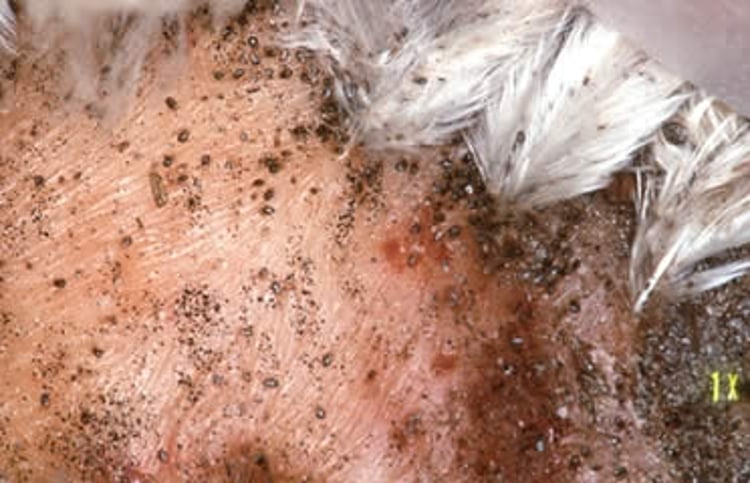
Ornithonyssus sylviarum mites and excrement on the vent area of a broiler breeder hen.
Courtesy of Dr. Jean Sander.
O sylviarum has been reported from many species of birds and from rats, mice, and humans; however, fertile populations are reported only on birds.
Northern fowl mites are obligate blood-feeding parasites that can complete their life cycle in 5–12 days. Off the host, these mites can live up to 4 weeks, depending on temperature and relative humidity.
Northern fowl mites are typically found by parting feathers in the vent area, which might have thick, crusty skin, severe scabbing, and soiled feathers (see ). Eggs are laid in the fluffy feathers, and the feeding stages (protonymphs and adults) travel to the skin surface to feed on blood.


Northern fowl mites infesting the vent region feathers of a chicken.
Courtesy of Dr. Amy Murillo.
In heavy infestations, northern fowl mites can be found on eggs or other parts of the chicken's body. Even moderate infestations (> 100 mites/bird) can cause decreased egg production and decreased feed conversion efficiency in laying hens.
Prevention of mite introduction to a flock is the best means of control, because eradication is very difficult. Any acaricidal spray treatments must be applied with sufficient force to penetrate the feathers in the vent area. Resistance to pyrethrins and pyrethroids is widespread, and few other chemical treatments are available for use on birds.
Dust-bathing boxes with sand and acaricidal materials, such as inert dusts (eg, food-grade diatomaceous earth), are very effective for bird self-treatment of mites. For more information, see the list of pesticides for treating poultry arthropods registered by state jurisdiction.
In July 2025, the FDA approved a drinking-water parasiticide—oral fluralaner solution—with zero days withdrawal in egg-laying chickens.
Western equine encephalitis, St. Louis encephalitis, and Newcastle disease viruses, as well as fowlpox virus, have been isolated from these mites. However, the mites are not important vectors of these viruses. Clinical findings and control are similar to those for poultry red mites.
Tropical Fowl Mite
The tropical fowl mite (Ornithonyssus bursa) is distributed throughout warmer regions of the world, and in the US it has been reported in Hawaii, Texas, Florida, Illinois, Indiana, Maryland, and New York. It closely resembles the northern fowl mite in its biology and habits, but it lays a greater proportion of its eggs in the nest.
O bursa hosts include chickens, turkeys, ducks, pigeons, sparrows, starlings, mynah birds, and humans. Western equine encephalitis virus has been recovered from this mite; however, there is no evidence that it transmits the virus.
Clinical findings and control are similar to those for poultry red mites.
Scaly Leg Mite of Poultry
The scaly leg mite (Knemidocoptes mutans) is a microscopic, spherical, sarcoptic mite that usually tunnels into the tissue under the scales of the bird's legs. It is rare in modern poultry facilities but not uncommon in backyard flocks.
K mutans can be identified via skin scrapings under microscopy and is found primarily on older birds, where irritation and exudation cause the legs to become thickened, encrusted, and unsightly (see ). Scales on the feet and legs become raised, resulting in lameness. Birds stop feeding, and death can result after several months.

Scaly leg mite infestation of a chicken. Mites burrow into the skin under the epidermal scales, causing irritation, inflammation, and encrustations.
Courtesy of Dr. Amy Murillo.
K mutans occasionally attacks the bird's comb and wattles. The entire life cycle is in the skin; transmission is by contact. Infections can be latent for long periods until stress triggers a mite population increase.
For control, affected birds should be culled or isolated, and houses should be cleaned and sprayed frequently, as recommended for poultry red mites.
Common Chigger of Poultry
The common chigger (Trombicula alfreddugesi) and other chigger species (harvest mites, red bugs) infest birds and will bite humans and other mammals, feeding on partially digested skin cells and lymph.
Birds heavily parasitized by the common chigger become droopy, refuse to eat, and can die from starvation and exhaustion. Larvae can be found either singly or in clusters on the ventral portion of affected birds.
On the range, control is aided by keeping the grass cut short and dusting with acaricides.
Turkey Chigger
The larvae of the turkey chigger (Neoschongastia americana) are parasitic on numerous birds. Across the southern US, they are the major pest of turkeys ranged on heavy clay soils in the summer.
Turkey chiggers feed in groups of as many as 100 mites per lesion for 8–15 days. Each individual turkey can have 25–30 lesions. One lesion 3 mm in diameter can cause substantial downgrading at market time. To prevent downgrading, turkeys must be protected for at least 4 weeks before marketing.
Acaricidal sprays or dusts on turkey ranges control chiggers. For more information, see the list of pesticides for treating poultry arthropods registered by state jurisdiction. A preventive measure now used in many turkey-growing areas includes a shift from range to confinement rearing, or use of sheds to provide shade.
Cyst Mite of Poultry
The fowl cyst mite (Laminosioptes cysticola) is a small cosmopolitan parasite of chickens, turkeys, and pigeons that is usually diagnosed by observation of white to yellowish, caseocalcareous nodules approximately 1–3 mm in diameter in the subcutis, muscle, lungs, and abdominal viscera.
Careful examination of the skin and subcutis of birds under a dissecting microscope frequently reveals the mites.
Destroying affected birds has been the best control for this parasite, but ivermectin might be effective. Note, however, that the use of ivermectin is extralabel drug use (ELDU), so it must be prescribed by a veterinarian and must have documented approval from the US Food Animal Residue Avoidance Databank (FARAD). The established toxic dose of ivermectin in poultry is 5.4 mg/kg.
Depluming Mite of Poultry
The depluming mite (Neocnemidocoptes gallinae) is found worldwide. It burrows into the epidermis at the base of feather shafts, causing intense irritation, feather pulling, and loss in chickens, pheasants, pigeons, and geese in spring and summer. Hyperkeratosis, skin lesions, and digit necrosis can result from the mite's burrowing.
Birds infested with depluming mites should be isolated and treated with ivermectin or with acaricidal materials. Note, however that the use of ivermectin is ELDU, so it must be prescribed by a veterinarian and must have documented approval from the US Food Animal Residue Avoidance Databank (FARAD). The established toxic dose of ivermectin in poultry is 5.4 mg/kg. For more information about acaricidal treatment, see the list of pesticides for treating poultry arthropods registered by state jurisdiction.
Feather Mite of Poultry
Most feather mites belong to the families Analgidae, Pterolichidae, or Proctophyllodidae. Surface feather mites feed mainly on feather oils, debris, fungi, and skin scales. More than 25 species, including Megninia cubitalis, Megninia ginglymura, and Pterolichus obtusus, are found on domestic poultry.
Feather mites are rare on modern poultry ranches, but there are exceptions. Outbreaks of Allopsoroptoides galli in commercial layer facilities in Brazil have been reported (4). These infestations caused dermatitis and substantial decreases in hen body weights and egg production.
Quill mites (Syringophilidae and Gaudoglyphidae) live in quills and feed on quill tissue or fluids obtained by piercing the calamus wall. Syringophilus bipectinatus is found in chicken and turkey feather quills worldwide. Columbiphilus polonica, Dermoglyphus elongatus, and Gaudoglyphus minor live in chicken quills in Europe.
Feather mites do little economic damage; however, they can decrease egg production by causing malnutrition, feather loss, and dermatitis. Affected birds should be dusted with acaricides (for more information, see the list of pesticides for treating poultry arthropods registered by state jurisdiction), orivermectin can be administered orally or topically. Note, however, that the use of ivermectin is ELDU, so it must be prescribed by a veterinarian and must have documented approval from the US Food Animal Residue Avoidance Databank (FARAD). The established toxic dose of ivermectin in poultry is 5.4 mg/kg.
For More Information
Chicken Mite. Veterinary Entomology.
Northern Fowl Mite. Veterinary Entomology.
Also see pet owner content regarding parasites in birds.
References
Valiente Moro C, De Luna CJ, Tod A, Guy JH, Sparagano OAE, Zenner L. The poultry red mite (Dermanyssus gallinae): a potential vector of pathogenic agents. Exp Appl Acarol. 2009;48(1-2):93-104. doi:10.1007/s10493-009-9248-0
Martin CD, Mullens BA. Housing and dustbathing effects on northern fowl mites (Ornithonyssus sylviarum) and chicken body lice (Menacanthus stramineus) on hens. Med Vet Entomol. 2012;26(3):323-333. doi:10.1111/j.1365-2915.2011.00997.x
Murillo AC, Mullens BA. 2016. Diversity and prevalence of ectoparasites on backyard chicken flocks in California. J Med Entomol. 2016;53(3):707. doi:10.1093/jme/tjv243
Mironov SV. Allopsoroptoides galli n. g., n. sp., a new genus and species of feather mites (Acari: Analgoidea: Psoroptoididae) causing mange in commercially raised domestic chicken in Brazil. Syst Parasitol. 2013;85(3):201-212. doi:10.1007/s11230-013-9422-y