Clonorchiasis is a parasitic disease that requires two intermediate hosts. Humans and animals can become infected by consuming improperly prepared, raw or preserved flesh of fish, the second intermediate host. Disease is associated with migration of the fluke to the biliary system.
Etiology and Pathogenesis of Clonorchiasis
Clonorchiasis is a parasitic zoonosis caused by the trematode Clonorchis sinensis, that is prevalent primarily in Asian countries, including South Korea, China, northern Vietnam, and eastern Russia. It is an important foodborne infection, with 18–35 million people estimated to be infected worldwide, and it is classified as a human carcinogen for cholangiocarcinoma. C sinensis flukes cause appreciable illness and severe harm to aquaculture, an important source of food and jobs in resource-limited nations (1, 2, 3).
C sinensis has three hosts in its life cycle (1, 4):
First intermediate host: freshwater snails
Second intermediate host: freshwater and brackish-water fish and, occasionally, shrimp
Definitive host or reservoir: humans and fish-eating mammals
Ten freshwater snail species, favoring slow-moving, cool waters, can act as first intermediate hosts for C sinensis. In South Korea, 40 freshwater fish species are second intermediate hosts. In China, 102 fish species and 4 shrimp species are suitable hosts. In Russia's Amur River, 7 fish species serve as hosts. Besides humans, possible reservoir hosts include cats, dogs, pigs, and other fish-eating mammals. Experimental infections have shown that rats, hamsters, rabbits, and mice can also serve as hosts (1, 5).
The life cycle of C sinensis (see ) begins with adult flukes in the bile ducts of definitive hosts. These parasites release eggs in the feces, which can contaminate water and be ingested by snails. Miracidia (the first larval stage) go through different larval stages to become cercariae (free-swimming larvae). Snails then release the cercariae, which infect freshwater fish and shrimp. Humans and other fish-eating mammals can become infected by consuming raw, undercooked, wine-soaked, dried, salted, or pickled fish, as well as freshwater shrimp—which often contain encysted metacercariae, the resting or mature stage.

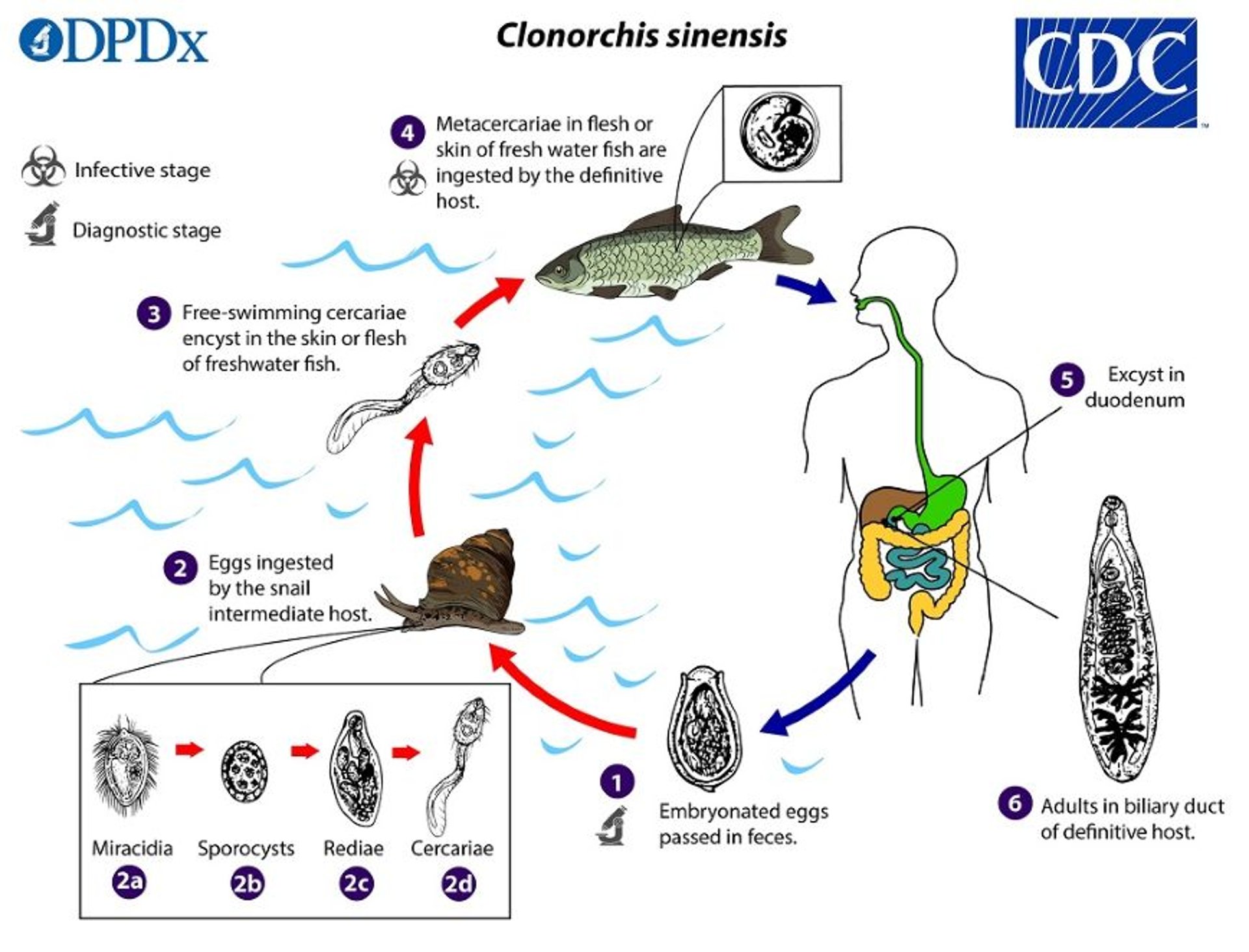
The life cycle of Clonorchis sinensis, the fluke that causes clonorchiasis. Embyronated eggs pass through the biliary ducts and into the feces to be ingested by snail intermediate hosts. Eggs release miracidia, which go through several developmental stages (sporocyst, redia, and cercaria). The cercariae, once released from the snail into the water, penetrate the flesh of freshwater fish, where they encyst as metacercariae. Humans become infected by ingesting undercooked, salted, pickled, or smoked freshwater fish. Metacercariae excyst in the human's duodenum and ascend the biliary tract, where they mature over approximately 1 month into adult flukes (measuring 10–25 × 3–5 mm).
Developed by the CDC. This diagram is available for no charge at https://www.cdc.gov/dpdx/clonorchiasis. (Reference to specific commercial products, manufacturers, companies, or trademarks does not constitute their endorsement or recommendation by the US Government, Department of Health and Human Services, or Centers for Disease Control and Prevention.)
C sinensis metacercariae are released in the duodenum and migrate to the host’s common bile duct, where they mature into adults in approximately 1 month. Adults can live for ≥ 25 years and grow to the size of approximately 10–25 × 3–5 mm (3, 4).
Practices that contribute to the transmission of C sinensis include poor sanitation and open defecation, the use of contaminated water in fish culture, and the consumption of undercooked, infected fish. Animals that defecate widely can accelerate egg transfer into ponds or rivers and worsen epidemics (1, 3).
Clinical Findings of Clonorchiasis
Acute clonorchiasis is usually subclinical; however, severe infection (in which several thousand flatworms are present) can cause fever and pain when the worms obstruct the gallbladder (3).
Diagnosis of Clonorchiasis
Parasitological, immunological, and molecular laboratory testing
Parasitological, immunological, and molecular techniques are available for laboratory testing to detect C sinensis (3).
Control of Clonorchiasis
Avoiding consumption of raw or preserved fish in endemic areas
Controlling intermediate hosts, especially in fish farming operations
To decrease the risk of clonorchiasis and decrease endemicity, the following veterinary public health measures can be helpful:
Feeding raw freshwater fish to animals should be avoided in endemic areas.
Domestic animals should be treated with praziquantel.
Snail control is important in areas where fish are farmed.
Sanitation should be improved by promoting latrines, decreasing fecal contamination of aquaculture systems, and providing a safe drinking-water supply. The use of domestic animal manure as fertilizer for crop production should be decreased.
Adequate cooking of freshwater fish and safe food-handling practices should be promoted. Metacercariae-tainted fish should be barred from markets.
Contaminated ponds and the distribution of infected freshwater fish and snails in endemic areas should be monitored.
Currently, no commercial vaccines are available against C sinensis in fish or other hosts; however, research is underway to develop them (1, 3, 6, 7, 8).
Key Points
Clonorchiasis is a foodborne parasitic zoonosis that is prevalent primarily in Asian countries.
Clonorchis sinensis causes appreciable illness and severe harm to aquaculture in resource-limited nations.
C sinensis has three hosts in its life cycle: freshwater snails; freshwater and brackish-water fish and, occasionally, shrimp; and humans and fish-eating mammals.
Poor sanitation and open defecation, along with the use of contaminated water in fish culture, contribute to the transmission of C sinensis.
For More Information
Foodborne Parasitic Infections: Clonorchiasis and Opisthorchiasis. WHO, Food and Agricultural Organization of the United Nations, and WOAH; 2021.
Clonorchiasis. CDC.
References
Tang Z-L, Huang Y, Yu X-B. Current status and perspectives of Clonorchis sinensis and clonorchiasis: epidemiology, pathogenesis, omics, prevention and control. Infect Dis Poverty. 2016;5:71. doi:10.1186/s40249-016-0166-1
Sohn W-M. Fish-borne zoonotic trematode metacercariae in the Republic of Korea. Korean J Parasitol. 2009;47(suppl):S103-S113. doi:10.3347/kjp.2009.47.S.S103
WHO, Food and Agriculture Organization of the United Nations, WOAH. Foodborne parasitic infections: clonorchiasis and opisthorchiasis. 2023. https://rr-asia.woah.org/app/uploads/2023/05/cb1208en_clonorchiasis_opisthorchiasis_rebranded.pdf
CDC. Clonorchiasis. November 13, 2024. Accessed October 12, 2026. https://www.cdc.gov/dpdx/clonorchiasis
Lin R-Q, Tang J-D, Zhou D-H, et al. Prevalence of Clonorchis sinensis infection in dogs and cats in subtropical southern China. Parasit Vectors. 2011;4:180. doi:10.1186/1756-3305-4-180
Zhang J, Cao J, Cao L, Zhang C, Gong L, Kang X. Current knowledge on the prevalence and detection techniques of Clonorchis sinensis in China. Front Vet Sci. 2025;12:1618633. doi:10.3389/fvets.2025.1618633
Hung NM, Dung DT, Lan Anh NT, et al. 2015. Current status of fish-borne zoonotic trematode infections in Gia Vien district, Ninh Binh province, Vietnam. Parasit Vectors. 2015;8:21. https://link.springer.com/article/10.1186/s13071-015-0643-6
WHO. Neglected tropical diseases: clonorchiasis. August 15, 2025. Accessed October 12, 2026. https://www.who.int/news-room/questions-and-answers/item/neglected-tropical-diseases-clonorchiasis