Abnormalities of the Testis and Epididymis
Cryptorchidism is a failure of one or both testicles to descend into the scrotum. Cryptorchidism occurs in all domestic animals; it is common in stallions and boars and is the most common disorder of sexual development in dogs (13%) (1).
Cryptorchidism is caused by a combination of genetic, epigenetic, and environmental factors.
Bilateral cryptorchidism results in sterility. Unilateral cryptorchidism is more common, and the male is usually fertile because of sperm production from the normally descended testicle. The undescended testicle can be located anywhere from just caudal of the kidney to within the inguinal canal and can be identified by transrectal or transabdominal ultrasonographic evaluation.
Abdominal testicles produce male hormones, and cryptorchid animals show normal secondary sex characteristics and mating behavior. Cryptorchidectomy is recommended for all companion animals because of the suspected inherited nature of the condition and predisposition to testicular neoplasia (seminomas, interstitial cell tumors).
Pearls & Pitfalls
|
Testicular hypoplasia has been described in several domestic species and is associated with chromosomal abnormalities in some cases. Increased prevalence of the condition is reported in cattle herds with higher levels of inbreeding (2). Affected males are subfertile and should be removed from the breeding population. A hereditary component is suspected in South American camelids (3).
Anorchism is the complete absence of development of one or both testes. Unilateral anorchism, also referred to as monorchidism, has been described in horses and camelids (3, 4). In camelids, the kidney ipsilateral to the missing testis is also absent.
Partial or complete segmental aplasia of the structures originating from the mesonephric duct (epididymis, ductus deferens, ampullae, and seminal vesicles) has been described in bulls. Bilateral epididymal hypoplasia has been described in azoospermic stallions (5).In camelids, segmental aplasia of the epididymis is often associated with epididymal and rete testis cysts (3).
See images of abdominal testes in a and a ; ; ; ectopic testes in a and an ; ; ; ; and .


Transrectal ultrasonographic (top) and laparoscopic (bottom) views of an abdominal testis in a stallion.
Transrectal ultrasonographic (top) and laparoscopic (bottom) views of an abdominal testis in a stallion.
Courtesy of Dr. Ahmed Tibary.

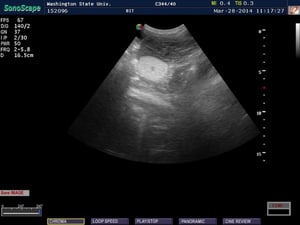
Transabdominal ultrasonogram of an abdominal testis in a pot-bellied pig.
Transabdominal ultrasonogram of an abdominal testis in a pot-bellied pig.
Courtesy of Dr. Ahmed Tibary.

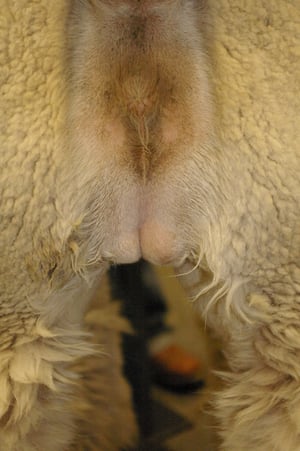
Testicular hypoplasia in an alpaca.
Testicular hypoplasia in an alpaca.
Courtesy of Dr. Ahmed Tibary.
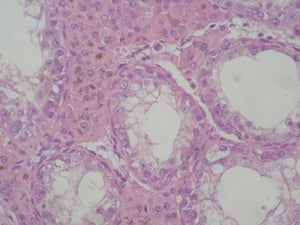
Histological image showing complete lack of spermatogenesis in the seminiferous tubules and normal interstitial (Leydig) cells. H&E stain.
Histological image showing complete lack of spermatogenesis in the seminiferous tubules and normal interstitial (Leydig
Courtesy of Dr. Ahmed Tibary.

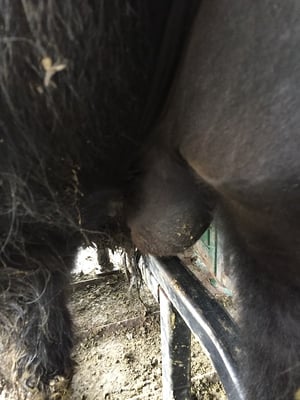
Ectopic testis in a bull. The testis was located subcutaneously in the inguinal area.
Ectopic testis in a bull. The testis was located subcutaneously in the inguinal area.
Courtesy of Dr. Ahmed Tibary.
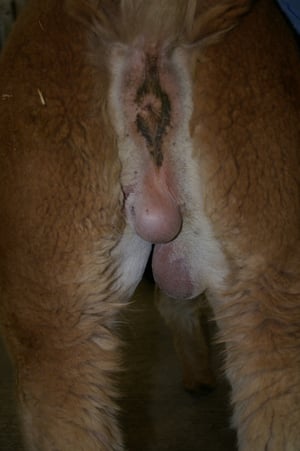
Ectopic testis in an alpaca.
Ectopic testis in an alpaca.
Courtesy of Dr. Ahmed Tibary.

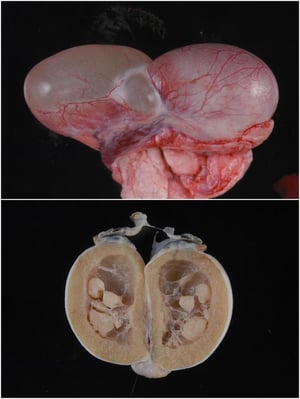
Epididymal (top) and rete testis (bottom) cysts in an alpaca.
Epididymal (top) and rete testis (bottom) cysts in an alpaca.
Courtesy of Dr. Ahmed Tibary.

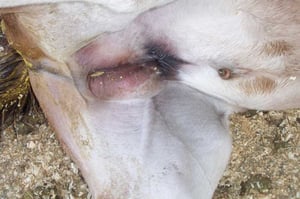
Inguinal hernia in a day-old Arabian colt.
Inguinal hernia in a day-old Arabian colt.
Courtesy of Dr. Ahmed Tibary.


Ultrasonographic appearance of rete testis cysts (black arrows) and spermatocele in a ram with segmental epididymal aplasia. The spermatocele appears as dilation and fluid accumulation in the head of the epididymis. BE, body of the epididymis; HE, head of the epididymis; RT, rete testis; T, testis.
Ultrasonographic appearance of rete testis cysts (black arrows) and spermatocele in a ram with segmental epididymal apl
Courtesy of Dr. Ahmed Tibary.


Testis of a 4-year-old Jersey bull with segmental aplasia of the epididymis and testicular hypoplasia. The length of the testis pictured here is approximately 5 cm, whereas a normal bull at this age has a testicular length of 15–20 cm. Note the aplastic body of the epididymis that fails to connect the head and tail of the epididymis (arrow).
Testis of a 4-year-old Jersey bull with segmental aplasia of the epididymis and testicular hypoplasia. The length of th
Courtesy of Dr. Ahmed Tibary.
Transrectal ultrasonographic (top) and laparoscopic (bottom) views of an abdominal testis in a stallion.
Transrectal ultrasonographic (top) and laparoscopic (bottom) views of an abdominal testis in a stallion.
Courtesy of Dr. Ahmed Tibary.
Transabdominal ultrasonogram of an abdominal testis in a pot-bellied pig.
Transabdominal ultrasonogram of an abdominal testis in a pot-bellied pig.
Courtesy of Dr. Ahmed Tibary.
Testicular hypoplasia in an alpaca.
Testicular hypoplasia in an alpaca.
Courtesy of Dr. Ahmed Tibary.
Histological image showing complete lack of spermatogenesis in the seminiferous tubules and normal interstitial (Leydig) cells. H&E stain.
Histological image showing complete lack of spermatogenesis in the seminiferous tubules and normal interstitial (Leydig
Courtesy of Dr. Ahmed Tibary.
Ectopic testis in a bull. The testis was located subcutaneously in the inguinal area.
Ectopic testis in a bull. The testis was located subcutaneously in the inguinal area.
Courtesy of Dr. Ahmed Tibary.
Ectopic testis in an alpaca.
Ectopic testis in an alpaca.
Courtesy of Dr. Ahmed Tibary.
Epididymal (top) and rete testis (bottom) cysts in an alpaca.
Epididymal (top) and rete testis (bottom) cysts in an alpaca.
Courtesy of Dr. Ahmed Tibary.
Inguinal hernia in a day-old Arabian colt.
Inguinal hernia in a day-old Arabian colt.
Courtesy of Dr. Ahmed Tibary.
Ultrasonographic appearance of rete testis cysts (black arrows) and spermatocele in a ram with segmental epididymal aplasia. The spermatocele appears as dilation and fluid accumulation in the head of the epididymis. BE, body of the epididymis; HE, head of the epididymis; RT, rete testis; T, testis.
Ultrasonographic appearance of rete testis cysts (black arrows) and spermatocele in a ram with segmental epididymal apl
Courtesy of Dr. Ahmed Tibary.
Testis of a 4-year-old Jersey bull with segmental aplasia of the epididymis and testicular hypoplasia. The length of the testis pictured here is approximately 5 cm, whereas a normal bull at this age has a testicular length of 15–20 cm. Note the aplastic body of the epididymis that fails to connect the head and tail of the epididymis (arrow).
Testis of a 4-year-old Jersey bull with segmental aplasia of the epididymis and testicular hypoplasia. The length of th
Courtesy of Dr. Ahmed Tibary.
Abnormalities of the Penis and Prepuce
Persistent penile frenulum is not uncommon. (See .) Affected bulls are unable to protrude the penis from the sheath and, in most cases, cannot achieve intromission. Attachment can be minimal (eg, 0.5 cm), or the preputial mucosa can be attached the full length of the ventral raphe of the free part of the penis. Genetic association is suspected in some breeds.

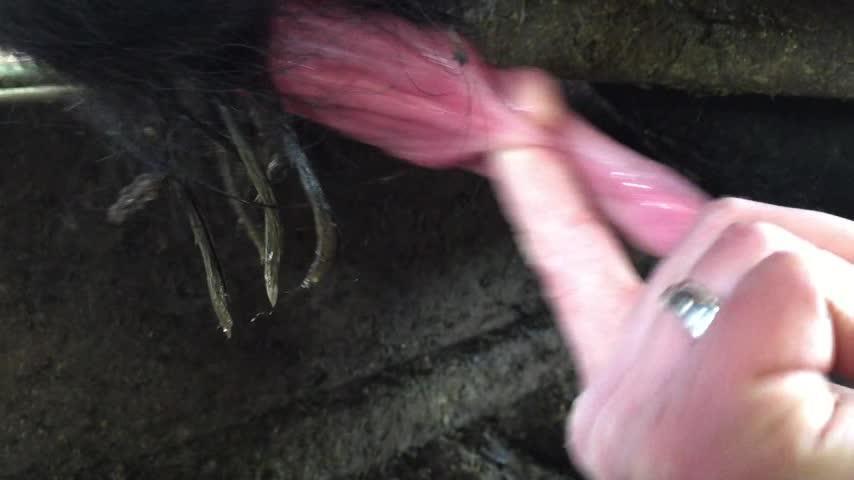
Surgical correction should not be performed in bulls intended for seed stock breeding due to the potential genetic association. Many male foals appear to have a persistent frenulum at birth; however, the condition resolves within a few days. If the condition persists, correction should not be attempted until the foal is at least 1 month old.
Preputial prolapse occurs because of a weak or absent preputial retractor muscle in polled breeds. The condition is exacerbated when these breeds are crossed with Brahman cattle.
Congenital short penis has been described in bulls and associated with short retractor penis muscles (6), which prevent full erection. Bulls might breed satisfactorily in the first season, but copulation becomes impossible as their body size increases.
Short retractor penis muscle can occur congenitally or after injury to the penis or prepuce. Affected bulls have normal libido; however, during attempted service, the penis is only partially protruded from the sheath and the ejaculatory thrust does not occur. Failure of erection in bulls could be a congenital condition but is generally a sequela of trauma and/or hematoma of the penis.
Congenital vascular shunts have been described in bulls with partial erection or erection failure (7).
Hypospadias and epispadias are rare congenital defects that result in an abnormal opening of the urethra due to failure or incomplete closure of the embryonic urethral groove. They are differentiated by the location of the defect. Hypospadias is located on the ventral aspect of the penis and caudal to the end of the penis. Epispadias is associated with bladder exstrophy and occurs on the dorsal aspect of the urethra.
For More Information
Maxwell H. Inability to breed due to injury or abnormality of the external genitalia of bulls. In: Hopper RM. ed. Bovine Reproduction. Wiley-Blackwell; 2021:155-172.
Griffin B, White S, Root Kustritz MV. Disorders of sexual development and common reproductive pathologies. In: White S. ed. High‐Quality, High‐Volume Spay and Neuter and Other Shelter Surgeries. Wiley-Blackwell; 2020:27-51.
Raudsepp T. Genetics of equine reproductive diseases. Vet Clin North Am Equine Pract. 2020;36(2):395-409.
Arroyo E, Tibary A. Cryptorchidism in stallions. Clin Theriogenology. 2023;15:31-51.
References
Squillacioti C, De Luca A, Liguori G, et al. Urocortinergic system in the testes of normal and cryptorchid dogs. Ann Anat. 2016;207:91-96. doi:10.1016/j.aanat.2016.05.004
Salvador DF, Salvador SC. Testicular hypoplasia in cattle: causes and consequences. Ciência Animal. 2021;31(1):67-79. https://www.cabidigitallibrary.org/doi/full/10.5555/20210342193
Sghiri A, Waqas MS, Ciccarelli M, Anouassi A, Tibary A. Advances in the diagnosis of reproductive disorders in male camelids. Animals (Basel). 2025;15(19):2931. doi:10.3390/ani15192931
Clements PE, Coomer RPC, McKane SA, Gorvy D, Bladon B, Mair T. Clinical findings in 10 horses diagnosed with monorchidism following exploratory laparotomy or standing laparoscopic surgery. Equine Vet Educ. 2020;32(8):431-436. doi:10.1111/eve.13074
Blanchard TL, Woods JA, Brinsko SP. Theriogenology question of the month: azoospermia attributable to bilateral epididymal hypoplasia. J Am Vet Med Assoc. 2000;217(6):825-826. doi:10.2460/javma.2000.217.825
Ladds PW. Congenital abnormalities of the genitalia of cattle, sheep, goats, and pigs. Vet Clin North Am Food Anim Pract. 1993;9(1):127-144. doi:10.1016/s0749-0720(15)30677-0
Wolfe DF. Review: Abnormalities of the bull – occurrence, diagnosis and treatment of abnormalities of the bull, including structural soundness. Animal. 2018;12(s1):s148-s157. doi:10.1017/S1751731118000939