Contagious agalactia is a disease, caused primarily by Mycoplasma agalactiae, that affects sheep and goats. The most common clinical signs are mastitis, conjunctivitis, and arthritis; however, these signs are rarely all observed in a single animal. Diagnosis depends on laboratory testing, especially in chronically infected herds. Vaccine efficacy varies, and animals should not be vaccinated during an outbreak.
Contagious agalactia (CA) is a syndrome that affects mainly small ruminants worldwide. Mycoplasma agalactiae is the primary disease-causing agent in both sheep and goats; however, Mycoplasma mycoides capri and, depending on the geographical area, Mycoplasma capricolum capricolum and Mycoplasma putrefaciens have been implicated in the disease in goats and sporadically isolated in sheep.
Mastitis, conjunctivitis, and arthritis, rarely observed in a single animal or even in the same herd, are the typical signs associated with CA, and mastitis and sporadic episodes of mammary gland atrophy are frequent in animals in chronically infected herds (see ). Respiratory signs and reproductive disorders, including abortions, also can occur.


Atrophy of the left mammary gland in a goat.
Courtesy of Dr. Christian de la Fe Rodríguez.
Diagnosis of CA is complex in endemic areas and always depends on laboratory testing. PCR assay, culture of patient samples, or both are the most suitable tools for diagnosis, and serological testing can be used for unvaccinated herds.
Antimicrobial therapy is an alternative to culling infected animals when a CA outbreak occurs; however, antimicrobials cannot achieve a bacteriological cure. The efficacy of available vaccines varies, and they cannot prevent new infections. Use of vaccines during a clinical outbreak is not recommended, because their use can worsen symptoms.
Etiology and Epidemiology of Contagious Agalactia in Small Ruminants
Dairy and meat sheep and goats are susceptible to infection by Mycoplasma agalactiae. Contagious agalactia is more complex in goats because of the presence of four causative agents. Thus, mixed infections are common at the herd or individual level in goats. Molecular studies have revealed a high amount of genetic and antigenic variability between M agalactiae isolates. Genetic diversity is higher in caprine isolates, even those recovered in closed herds or regions.
CA is a worldwide disease considered endemic in many countries surrounding the Mediterranean Sea—in particular Portugal, Spain, Greece, Italy, France, Turkey, Israel, and North Africa, as well as in many parts of the Middle East, Asia, and North and South America. Sporadic cases have been reported in the US.
CA-causing mycoplasmas persist lifelong in infected animals, even after treatment, making these animals permanent carriers. Seronegative subclinical carriers are also common in chronically infected herds. Both types of carriers are reservoirs for new mycoplasma infections within the herd. Animals of both sexes and all ages can be subclinical carriers; thus, because of animal movements, these subclinical carriers are also the main source of infection for new herds.
Recurrence of CA is common after a period of stress in animals that have recovered from the disease. Goats are commonly auricular subclinical carriers (see ). Mycoplasma spp are recovered from the ears of animals that have had systemic infection.


In goats that are auricular subclinical carriers of contagious agalactia, disease-causing mycoplasmas are recovered from the ears, as pictured here.
Courtesy of Dr. Christian de la Fe Rodríguez.
Many mycoplasma carriers are seronegative. Introducing such carriers into a susceptible flock can initially cause high rates of morbidity and mortality. Once the organism is established in a herd, young ruminants become infected mainly while suckling colostrum and milk. Adults are infected mainly via milking machines or via direct contact with aerosolized body fluids from infected animals.
Other routes of transmission are possible but rare. Venereal transmission is suggested by the presence of M agalactiae or M mycoides capri in semen or by the presence of genital lesions in both sexes.
M agalactiae and M mycoides capri have been detected in wild ruminants, such as the Spanish ibex, chamois, and alpine ibex. In markhor, the screw-horned goat of Pakistan, pneumonia caused by M capricolum capricolum has been described. Clinical signs of CA in wildlife are linked to contact with domestic species.
Antibodies against M capricolum capricolum and M mycoides capri have been detected in South American camelids; however, whether these organisms cause disease in camelids is not clear.
Clinical Findings and Lesions of Contagious Agalactia in Small Ruminants
There are two different clinical pictures of contagious agalactia. Clinical outbreaks are commonly characterized by a short incubation period (weeks) and can be followed by either acute disease with fever and occasionally death or, more often, subacute disease characterized by mastitis, arthritis, and infectious keratoconjunctivitis. These signs are rarely all present in the same animal or even the same herd.
CA infection begins as interstitial mastitis, producing a hot, swollen, and painful udder, and is followed by a sudden drop in the quantity and quality of milk production. The milk can appear discolored and granular, separating into watery and solid phases, or it can take on a thick, yellow consistency with clots obstructing the teat duct. After several days, the affected udder shrinks because of damage to secretory tissue. Abscesses within the udder and enlargement of the retromammary lymph nodes can also occur. In some cases, atrophy and fibrosis lead to permanent loss of milk production.
Unilateral or bilateral arthritis can occur both in adults and in young animals, and these individuals have difficulty keeping up with the flock. Lagging behind can be the first clinical finding of CA in affected herds, mainly in meat animals. Affected animals might limp or sit on their carpal or tarsal joints because of discomfort. The joints are hot, swollen, and painful.
Conjunctivitis presents as a discharge of clear ocular exudates, followed by corneal opacity, keratitis, purulent exudation, and occasionally ulceration and panophthalmitis. Severe cases can result in irreversible blindness, especially when another bacterium, such as Moraxella ovis, is present. Abortion caused by mycoplasmas in the bloodstream, as well as respiratory disease in kids, also can occur.
Herds that are chronically infected with CA represent the epidemiologically dominant variant in many countries where the disease is endemic. Subclinical mastitis in animals continually affected by atrophy or sporadic arthritis, or a continuous presence of mycoplasmas in bulk tank milk, leads to permanent loss of milk production.
A CA-infected udder is grossly atrophic on one or both sides. Microscopically, the chronic inflammatory reaction in the stroma shows increased fibrosis and a decreased number of glandular acini. Infected joint capsules are edematous, and the synovium can contain clumps of fibrin. Articular surfaces might be eroded and occasionally ankylosed.
In early stages of keratitis, the cornea is edematous and infiltrated with leukocytes; later, abundant purulent exudate infiltrates both the cornea and the ciliary body. In addition, the presence of mild chronic conditions in some organs of chronically infected animals has been described. Colonization of nervous tissue by mycoplasmas has also been described; however, neurological signs of CA have rarely been reported.
Diagnosis of Contagious Agalactia in Small Ruminants
Clinical evaluation (useful for clinical outbreaks)
Laboratory testing, especially PCR assay and culture
At herd level:
Continual monitoring of bulk tank milk samples
Detection of subclinical carriers
Serological testing (if vaccination is not used)
Preferred samples from living animals to help confirm a diagnosis of contagious agalactia include milk and udder secretions (see ), joint fluid from arthritic cases, and eye swabs from ocular disease cases. Isolation of mycoplasmas from the blood during the brief circulating stage of the disease is rarely successful.

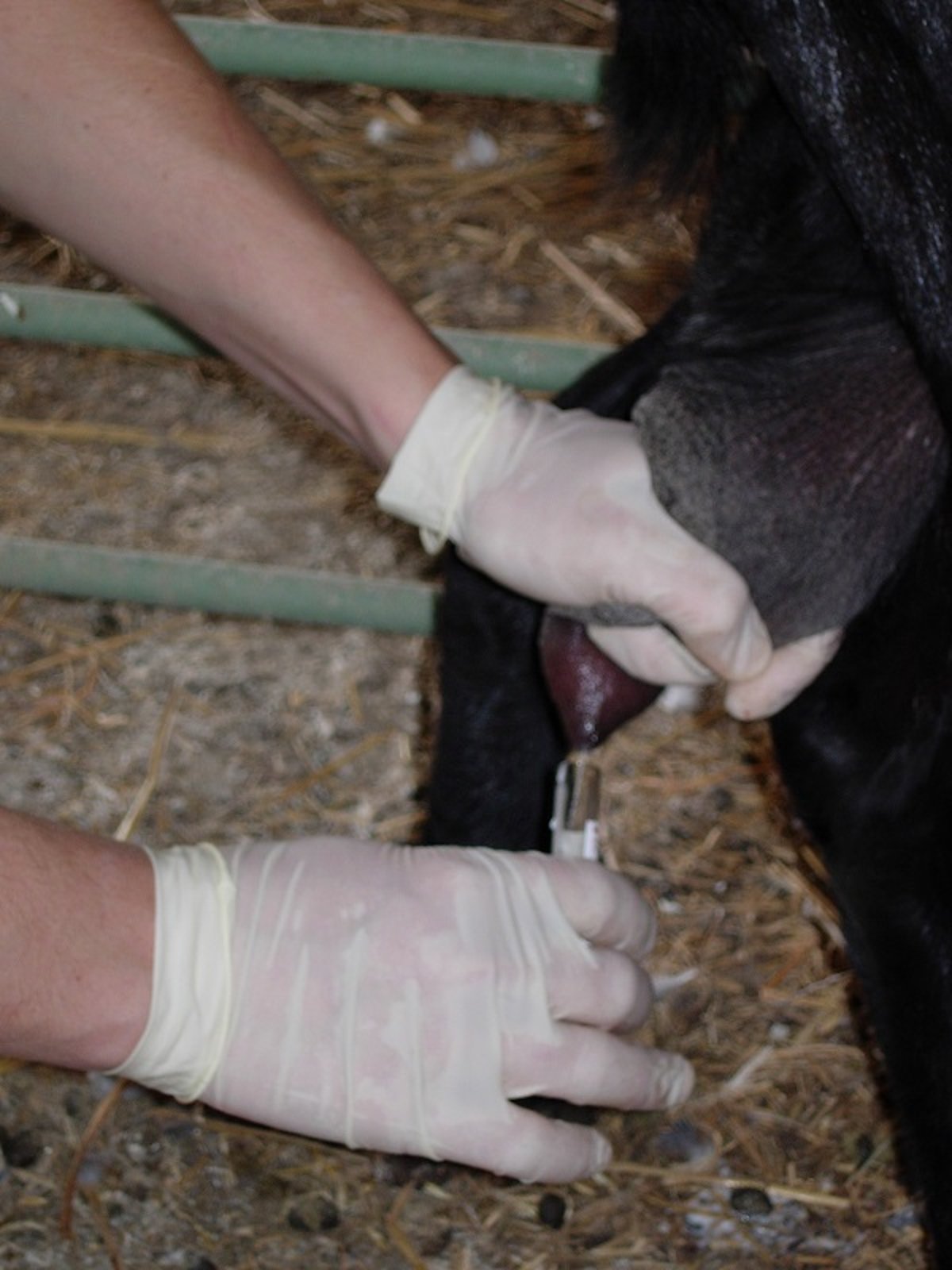
Milk and udder secretions being collected from a goat.
Courtesy of Dr. Christian de la Fe Rodríguez.
Postmortem tissue and fluid specimens from CA-affected animals should include udder and associated lymph nodes, joint fluid, lung tissue (at the interface between diseased and healthy tissue), and pleural or pericardial fluid. Samples should be kept moist and cool and sent promptly to a diagnostic laboratory. Microbial culture or PCR assay, which also can be performed directly on clinical samples within hours after they are collected, can help confirm the diagnosis.
In chronically infected herds where CA is endemic, bulk tank milk samples should be continually monitored for intermittent excretion of mycoplasmas, and mastitis samples or auricular/nasal swabs should be collected to detect the presence of carriers. The ear canal of goats is a rich source of both pathogenic and nonpathogenic mycoplasmas, so specific diagnostic testing should be conducted.
Detection of serum antibodies by ELISA provides rapid diagnosis of CA. However, ELISA might not be very sensitive in chronically affected herds and flocks, so its use for individual diagnosis is not recommended. Indirect ELISA for Mycoplasma agalactiae is commercially available and has been used routinely in control programs to screen herds.
Pearls & Pitfalls
|
Immunoblotting can be used to confirm suspect ELISA results and can distinguish antibodies that developed in response to field infection from those that developed after vaccination. However, this option is complex and time-consuming for routine diagnosis.
Serological tests are not commercially available for M mycoides capri, M capricolum capricolum, or M putrefaciens. Culture or PCR tests, which can be performed directly on clinical sampleswithin hours after they have been collected, can confirm the presence of these species (see ).


Typical morphology of Mycoplasma mycoides capri colonies in solid culture media.
Courtesy of Dr. Christian de la Fe Rodríguez.
A number of other mycoplasmas are commonly isolated from small ruminants, such as Mycoplasma arginini; Mycoplasma ovipneumoniae, the causative agent of atypical pneumonia; Mycoplasma conjunctivae, a common cause of keratoconjunctivitis; or the nonpathogenic mycoplasmas M auris, M cottewii, and M yeatsii.
Other bacteria that cause mastitis are mainly staphylococci, streptococci, enterobacteria, and Corynebacterium spp.
Small ruminant lentiviruses should also be considered in cases of arthritis in adults.
Treatment, Control, and Prevention of Contagious Agalactia in Small Ruminants
Antimicrobials for control of outbreaks
Vaccination
Regular laboratory monitoring of flocks/herds
Culling affected animals
Antimicrobials that inhibit cell wall synthesis (eg, penicillins) are not effective against contagious agalactia. In vitro tests have shown increased antimicrobial resistance of Mycoplasma agalactiae, M mycoides capri, and M capricolum capricolum, and a minimal inhibitory concentration test of recovered bacteria is highly recommended, when possible.
Pearls & Pitfalls
|
Fluoroquinolones (enrofloxacin, marbofloxacin), macrolides (tylosin, erythromycin), tetracyclines (doxycycline, tetracycline), or lincosamides (lincomycin) are used to treat CA.Antimicrobials are usually administered at a recommended rate between 2 and 10 mg/kg, IM or SC, every 24 hours for 3–5 days (1). The intramammary route can also be used, if available, for mastitis (single dose). These drugs can improve clinical signs, particularly if administered early in the disease; however, their use can promote carrier animals. M agalactiae is genetically resistant to erythromycin.
In the US, treating CA with some of these drugs is considered extralabel drug use, and some of these drugs (eg, fluoroquinolones) are not permitted to be used in food-producing animals.
In endemic areas, inactivated vaccines against M agalactiae are used with mixed success, and published data on their effectiveness is scarce. Some of these vaccines have provided protection against disease. However, they do not prevent infection by or transmission of mycoplasmas. In general, the duration of immunity, particularly that conferred by the formalinized, inactivated vaccines used in Europe, is short, and ongoing inoculations are recommended.
Vaccines containing two or three causative agents of CA are also available. Attenuated vaccines have been used in Europe but are currently not approved. National programs to control CA have been established in France and Spain.
Regular laboratory monitoring of flocks/herds helps to prevent the transmission or introduction of CA, and testing can be done on serum and/or milk (including bulk tank milk) via serological tests, culture, or PCR assay. Carriers can also be detected.
Culling or isolating animals infected with CA is generally advised. When this is not possible, hygienic measures, such as improved the milking routine and pasteurizing milk or colostrum before feeding it to young animals, should be implemented. Replacement animals should not be introduced; if they must be, they should be tested to prevent the entry of carriers, using culture or PCR assay on ear, milk, or nasal samples. Artificial insemination can protect against the entry of infectious agents associated with reproductive acts.
Zoonotic Risk of Contagious Agalactia in Small Ruminants
There is no evidence that contagious agalactia is transmitted to humans. Only one case of sepsis and meningoencephalitis in a human has been associated with infection by M capricolum capricolum after contact with small ruminants or consumption of food products from goats (2).
Key Points
Contagious agalactia (CA) is a multifactorial disease, caused mainly by Mycoplasma agalactiae, a variable bacterium with complex epidemiology.
The presence of subclinical carriers is an important problem in effective CA control. Auricular carriers are common in chronically infected goat herds.
Direct detection by means of microbial culture, PCR assay, or both is necessary to confirm the diagnosis of CA. Serological testing is useful at a herd level but is of questionable efficacy in endemic areas.
Antimicrobials and vaccines can mitigate CA morbidity, but they do not eliminate or prevent infection at the individual or herd level.
Culling animals is the only way to guarantee immediate CA-free status.
For More Information
Center for Food Security and Public Health, Iowa State University. Contagious agalactia (Caprine Mycoplasmosis) factsheet. October 2018.
References
CIMAvet. Spanish Agency of Medicines and Medical Devices (AEMPS), accessed October 28, 2025. https://cimavet.aemps.es/cimavet/publico
Heller M, Schwarz R, Noe G, et al. First human case of severe septicaemia associated with Mycoplasma capricolum subsp. capricolum infection. JMM Case Rep. 2015;2(5). doi:10.1099/jmmcr.0.000101