Copper toxicosis occurs in many species in association with chronic disease, most commonly as a result of progressive hepatic accumulation. In sheep, clinical signs appear abruptly and represent acute hemolytic crisis. In dogs, copper-associated disease reflects chronic hepatitis. Diagnosis requires copper quantitation in the liver in dogs and in the liver and kidneys in sheep, with concurrent histopathological lesions. Treatment is often unrewarding, making prevention of the accumulation critical.
Acute and chronic copper toxicosis occur worldwide and affect multiple animal species. Sheep are the most susceptible; however, toxicosis has also been reported in cattle, goats, camelids, pigs, and dogs.
In dogs (most notably Bedlington Terriers), an inherited defect in hepatic copper metabolism similar to Wilson disease in humans results in excessive hepatic copper accumulation. Chronic copper toxicosis has also been documented in Labrador Retrievers, West Highland White Terriers, Skye Terriers, Keeshonds, American Cocker Spaniels, and Doberman Pinschers.
Acute copper toxicosis in dogs typically follows accidental ingestion or administration of excessive quantities of soluble copper sources, including those present in mineral supplements and other sources meant for intentional feeding.
Oral bioavailability of copper is strongly dependent on the chemical form. Metallic or elemental copper (wire, tubing, scrap metal) is relatively insoluble and less readily absorbed. Smaller copper particles have more surface area, which can increase the amount of copper available for absorption compared with larger copper fragments.
Copper homeostasis is influenced by numerous dietary and metabolic factors that affect intestinal absorption, hepatic storage, and biliary excretion. For example, decreased dietary concentrations of molybdenum and sulfur, in particular, can cause decreased copper excretion and hepatic retention.
In sheep, primary chronic copper toxicosis occurs most commonly in animals exposed to excessive dietary copper concentrations over prolonged periods. Copper accumulates subclinically within hepatic lysosomes until hepatic storage capacity is exceeded and progressive hepatocellular injury develops.
With hepatocyte necrosis and loss of sequestration, copper is released in massive amounts into the bloodstream. The resulting increase in circulating copper causes lipid peroxidation and intravascular hemolysis in sheep. Stressors such as transportation, handling, adverse weather, pregnancy, lactation, strenuous exercise, or nutritional deterioration can precipitate massive release of stored copper, triggering a hemolytic crisis in animals with chronic copper toxicosis.
Secondary copper accumulation in sheep can occur with a variety of hepatopathies because hepatocellular loss and cholestasis impair hepatic sequestration and biliary excretion. The phenomenon has been documented with chronic ingestion of pyrrolizidine alkaloid-containing plants by sheep (1); however, it has the potential to occur in any species.
Dogs with chronic hepatitis can accumulate excessive hepatic copper, and copper-associated hepatopathy is an important contributor to chronic liver disease (2). Genetic susceptibility has been described in multiple breeds, including the autosomal recessive COMMD1 exon 2 deletion in Bedlington Terriers and the ATP7B variant in Labrador Retrievers, both of which ultimately decrease copper excretion (2, 3).
Retrospective data show that hepatic copper concentrations in dogs have increased over time, including in breeds with or without genetic predisposition. This trend suggests an environmental component potentially including changes in commercial diet formulations and the use of more bioavailable copper sources in dog foods (4, 5). Excess hepatic copper can then result from increased intake, impaired biliary excretion, secondary accumulation in chronic liver disease, or a combination of these factors.
Pearls & Pitfalls
|
Regardless of cause, when hepatic copper concentrations exceed the safe storage capacity of the liver in dogs, free copper promotes oxidative stress and hepatocyte injury (6).
In ruminants, chronic copper toxicosis reflects cumulative exposure and is driven primarily by dietary mineral balance rather than by a specific toxic dose. Commonly cited dietary copper concentrations should be interpreted as rough risk ranges because disease can occur at lower concentrations if the diet favors retention.
A dietary copper:molybdenum ratio of 10:1 is considered tolerable for sheep; 6:1 is ideal (7).
Clinical Findings of Copper Toxicosis
Animals with acute copper toxicosis typically show signs of severe gastroenteritis with anorexia, abdominal pain, diarrhea, dehydration, and shock. Hemolysis and hemoglobinuria (which causes characteristic reddish-brown urine, described as "port wine urine") might follow within several days in animals that survive the initial exposure.
In contrast, chronic copper toxicosis in ruminants remains subclinical until hepatic copper release causes a sudden hemolytic crisis. The hemolytic crisis is characterized by depression, weakness, recumbency, rumen stasis, pale mucous membranes, hemoglobinuria, and jaundice.
Increased liver enzyme activities might be detected days before the onset of hemolytic crisis, and laboratory abnormalities during the crisis can include methemoglobinemia, hemoglobinemia, declining PCV, and decreased blood glutathione concentration.
Camelids can develop severe hepatic necrosis without a prominent hemolytic crisis (8).
The prognosis for animals with copper toxicosis is poor once clinical signs develop. Case fatality rates are high, and morbidity rates are typically low. Losses can continue for weeks after dietary correction because animals with excessive hepatic copper stores are still at risk.
In grazing species, chronic hepatic injury due to copper toxicosis can be a cause of secondary (hepatogenous) photosensitization.
Dogs with copper toxicosis can develop progressive hepatitis and cirrhosis.
Lesions of Copper Toxicosis
Acute copper toxicosis produces severe gastroenteritis, with erosions and ulcerations in the abomasum of ruminants.
In sheep, chronic copper toxicosis is characterized grossly by hemoglobinuria; marked icterus; characteristic swollen, dark, blue-black to red-black kidneys (described as "gunmetal kidneys"); and an enlarged, friable liver. Cattle often do not develop the characteristic dark kidneys that occur in sheep.
Histopathological lesions include hepatic lesions that typically include centrilobular necrosis with portal fibrosis, bile duct proliferation, and lymphocytic inflammation, accompanied by hemoglobinuric nephrosis and renal tubular injury (7) (see , , , and images).


Photomicrograph of liver tissue from a 2-year-old sheep with copper toxicosis. Note the central veins (stars) and numerous hepatocytes with cytoplasmic vacuolar change evident as small clear spaces. Magnification 40X.
Courtesy of Dr. Trevor Arunsiripate.

Photomicrograph of liver tissue from a 2-year-old sheep with copper toxicosis. Note the severe vacuolar changes affecting hepatocytes (black arrows), as well as bile plugs from severe cholestasis (yellow arrows). Rare, light-green copper pigment is also evident (black arrowhead). Magnification 400X.
Courtesy of Dr. Trevor Arunsiripate.
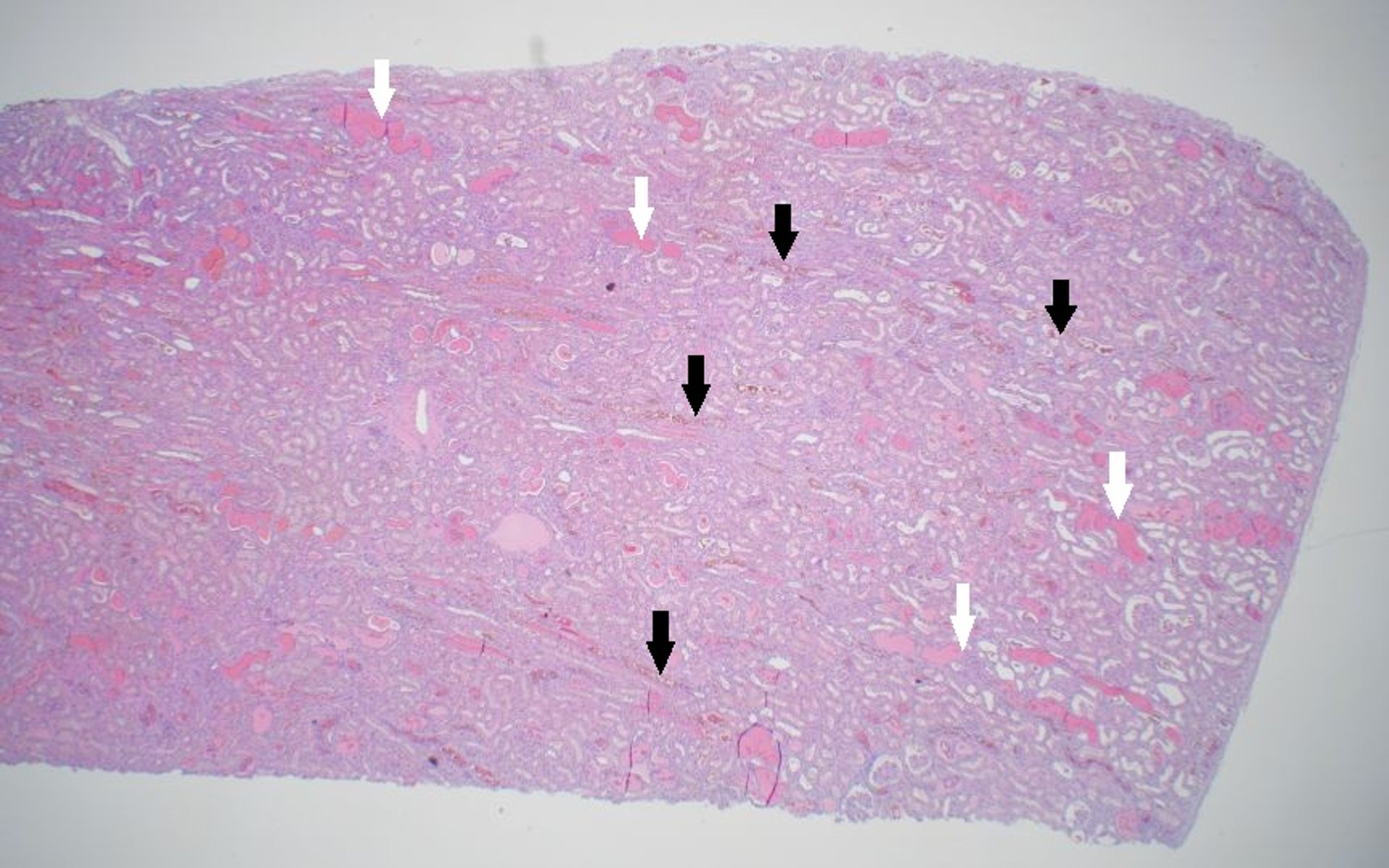
Photomicrograph of kidney tissue from a 2-year-old sheep with copper toxicosis. Note the dark-red pigmented granular material filling the lumina of tubules multifocally (black arrows). Other tubules contain homogenous eosinophilic fluid (white arrows). Magnification 40X.
Courtesy of Dr. Trevor Arunsiripate.

Photomicrograph of kidney tissue from a 2-year-old sheep with copper toxicosis. Renal tubular lumina contain dark-red granular pigmented material that represents hemoglobin casts (black arrows).Tubules affected by hemoglobin casts have necrotic epithelia resulting in attenuation of cells along the basement membrane (white arrows). Other tubules are lined by epithelia with hydropic degeneration characterized by abundant, lightly eosinophilic, lacy cytoplasm (yellow arrows). G, glomerulus. Magnification 200X.
Courtesy of Dr. Trevor Arunsiripate.
In dogs, copper-associated disease manifests as chronic hepatitis rather than a hemolytic crisis. Copper accumulates within centrilobular hepatocytes, progressing to necrosis, inflammation, fibrosis, and eventual cirrhosis (9).
Diagnosis of Copper Toxicosis
In sheep, postmortem analysis of liver and kidney copper concentrations with supportive gross and histopathological lesions
For outbreaks, testing of ration components
In dogs, liver histological evaluation and quantitative hepatic copper analysis
In sheep, diagnosis of copper toxicosis typically follows the hemolytic crisis in which antemortem weakness, icterus, and hemoglobinuria are accompanied by characteristic necropsy findings. Confirmatory diagnosis requires histopathological evidence of hepatic necrosis and hemoglobinuric nephrosis, as well as copper quantitation in both liver and kidney.
Because the pathogenesis of copper toxicosis requires copper release from the liver, hepatic copper concentrations can be near normal in terminal cases. Renal copper concentrations then provide evidence for systemic copper release and resultant hemolysis.
Pearls & Pitfalls
|
Serum copper concentrations are transient and can provide some usable information during the hemolytic phase; however, serum analysis should not be used to determine body status or prognosis in surviving members of the flock. In suspected feed-related outbreaks of copper toxicosis, analysis of the ration, mineral supplements, and water for copper concentrations and copper-molybdenum balance are essential for case investigation.
In dogs, diagnosis of copper-associated hepatopathy is based primarily on liver biopsy, combined with quantitative copper analysis performed on fresh tissue and with concurrent histological evaluation. Copper-specific stains (eg, rhodanine) are often used to demonstrate copper accumulation in hepatocellular cytoplasmic granules.
The American College of Veterinary Internal Medicine (ACVIM) consensus statement bases its definition of copper-associated hepatitis on the combination of histological evidence of chronic hepatitis, supportive evidence from copper staining, and hepatic copper concentrations > 1,000 mcg/g dry weight (6). There is potential lobe-to-lobe variability and a potential gray zone between approximately 600 and 1,000 mcg/g that requires case interpretation as a whole.
Importantly, in advanced cases of copper-associated hepatopathy, extensive fibrosis and decreased hepatocyte mass can confound quantitative copper measurements. This effect emphasizes the need to interpret copper concentration in conjunction with histopathological findings rather than as an isolated value.
Treatment and Control of Copper Toxicosis
Preventing oversupplementation of susceptible animals
In flocks, eliminating supplementation and encouraging copper elimination via dietary modulation
In dogs, managing chronic liver disease
Prevention is the primary strategy of copper toxicosis control in sheep. After liver damage and hemolytic crisis, the prognosis is poor, and treatment is often unrewarding. In acute exposures, supportive care including fluid therapy, management of GI damage, and shock control are indicated.
Chelation with ammonium tetrathiomolybdate has been recognized as one of the most effective therapies to decrease copper absorption and enhance copper elimination in sheep; however, availability of ammonium tetrathiomolybdate might be limited (7). In flock outbreaks, altering the dietary copper:molybdenum ratio by decreasing copper supplementation and increasing oral molybdenum and thiosulfate can help antagonize further absorption.
Dietary modulation in sheep is preferred over individual treatment of copper toxicosis in order to eliminate the stress associated with handling, which can precipitate copper release from the liver. Prevention relies on avoiding excessive copper supplementation by using mineral packs and feeds formulated specifically for sheep, because other livestock feeds often contain enough copper to be problematic.
In dogs, management of copper toxicosis relies on dietary copper restriction and potential chelation with D-penicillamine. Therapeutic success in these patients reflects management of chronic liver disease rather than reversal of the syndrome. Genetic testing might be available for breeds with a genetic predisposition, potentially enabling targeted dietary management.
Key Points
Chronic copper accumulation is often subclinical until sudden hepatic release causes acute hemolytic crisis.
Regardless of species, diagnosis requires copper quantification in tissue.
Prevention is key because treatment is often unsuccessful after hepatic damage has occurred.
For More Information
Webster CRL, Center SA, Cullen JM, et al. ACVIM consensus statement on the diagnosis and treatment of chronic hepatitis in dogs. J Vet Intern Med. 2019;33(3):1173-1200.
Also see pet owner content regarding copper poisoning.
References
Seaman JT. Pyrrolizidine alkaloid poisoning of sheep in New South Wales. Aust Vet J. 1987;64(6):164-167. doi:10.1111/j.1751-0813.1987.tb09674.x
Langlois DK, Nagler BSM, Smedley RC, Yang YT, Yuzbasiyan-Gurkan V. ATP7A, ATP7B, and RETN genotypes in Labrador Retrievers with and without copper-associated hepatopathy. J Am Vet Med Assoc. 2022;260(14):1-8. doi:10.2460/javma.21.12.0541
Forman OP, Boursnell ME, Dunmore BJ, et al. Characterization of the COMMD1 (MURR1) mutation causing copper toxicosis in Bedlington terriers. Anim Genet. 2005;36(6):497-501. doi:10.1111/j.1365-2052.2005.01360.x
Center SA, Richter KP, Twedt DC, Wakshlag JJ, Watson PJ, Webster CRL. Is it time to reconsider current guidelines for copper content in commercial dog foods?J Am Vet Med Assoc. 2021;258(4):357-364. doi:10.2460/javma.258.4.357
Strickland JM, Buchweitz JP, Smedley RC, et al. Hepatic copper concentrations in 546 dogs (1982–2015). J Vet Intern Med. 2018;32(6):1943-1950. doi:10.1111/jvim.15308
Webster CRL, Center SA, Cullen JM, et al. ACVIM consensus statement on the diagnosis and treatment of chronic hepatitis in dogs. J Vet Intern Med. 2019;33(3):1173-1200. doi:10.1111/jvim.15467
Borobia M, Villanueva-Saz S, Ruiz de Arcaute M, et al. Copper poisoning, a deadly hazard for sheep. Animals (Basel). 2022;12(18):2388. doi:10.3390/ani12182388
Marahrens H, von Dörnberg K, Molnár V, et al. Copper intoxication in South American camelids—review of the literature and first report of a case in a Vicuña (Vicugna vicugna). Biol Trace Elem Res. 2024;202(12):5453-5464. doi:10.1007/s12011-024-04102-x
Fieten H, Penning LC, Leegwater PAJ, Rothuizen J. New canine models of copper toxicosis: diagnosis, treatment, and genetics. Ann NY Acad Sci. 2014;1314:42-48. doi:10.1111/nyas.12442