Abomasal impaction is an infrequently diagnosed disease of cattle characterized by drier-than-normal abomasal contents and larger-than-normal abomasal volume. Typical initial clinical signs are complete anorexia, scant feces, moderate distention of the abdomen, weight loss, and weakness. Diagnosis is based on history, clinical signs, and laboratory test results. Medical treatment with laxatives and prokinetic drugs can be effective.
Abomasal impactions can be primary (most frequently in beef cattle) or secondary (most often in dairy cows as a form of vagal indigestion).
Abomasal impaction is an infrequently diagnosed disease of cattle that is characterized by drier-than-normal abomasal contents and larger-than-normal abomasal volume. Impaction can involve the pyloric antrum alone or both the pyloric antrum and the abomasal body.
Impaction of the abomasum develops in pregnant beef cows during periods of cold weather, when cattle have decreased water intake and are often fed poor-quality roughage. Impaction also occurs in feedlot cattle fed a variety of mixed rations that contain chopped or ground roughage (straw, hay) and cereal grains, as well as in late-pregnancy dairy cows on similar feeds.
Impaction of the pyloric antrum is an underdiagnosed condition in dairy cows in early lactation.
Etiology and Pathogenesis of Abomasal Impaction in Cattle
The etiology of abomasal impaction can be divided into dietary causes (primary impaction) and nondietary causes (secondary impaction), which can occur in various combinations.
Dietary Causes of Abomasal Impaction in Cattle
The cause of dietary abomasal impaction is considered to be consumption of excess roughage that is low in both digestible protein and energy, in combination with decreased water availability during winter.
Impaction with sand can occur if cattle are fed hay or silage on sandy soils or fed sandy or dirty root crops.
Outbreaks of abomasal impaction can affect up to 15% of all cattle on individual farms when the ambient temperature drops to –26°C (–14°F) or lower for several days. Ingested placenta, foreign material, or trichobezoars can predispose a cow to impaction (1).
Nondietary Causes of Abomasal Impaction in Cattle
The cause of nondietary abomasal impaction in postparturient dairy cows is likely related to abomasal hypomotility and decreased abomasal emptying. Abomasal impactions have also been reported in cows in late gestation, caused by mechanical interaction between the pregnant uterus and the abomasum, which is displaced by the uterus in a more cranial position.
Another nondietary cause might be decreased abomasal motility and emptying caused by vagal indigestion (Hoflund syndrome) and lymphosarcoma.
Once the abomasum has become impacted, subacute obstruction of the upper GI tract develops. Hydrogen and chloride ions are continually secreted into the abomasum despite the impaction, resulting in atony and alkalosis with hypochloremia. Varying degrees of dehydration develop because fluids do not move beyond the abomasum into the duodenum for absorption.
Sequestration of potassium ions in the abomasum results in hypokalemia. Impaction of the abomasum can be severe enough to cause irreversible abomasal atony.
Clinical Findings and Lesions of Abomasal Impaction in Cattle
The usual initial clinical signs of dietary abomasal impaction in cattle are complete anorexia, scant feces, moderate distention of the abdomen, increase in rumen fill and decrease in rumen motility, weight loss, and weakness. The body temperature is usually normal, but it can be subnormal during cold weather.
A mucoid nasal discharge tends to collect at the external nares and on the muzzle in cases of abomasal impaction. The muzzle is usually dry and cracked, because of both the failure of the animal to lick its nostrils and the effects of dehydration. The heart rate can be decreased, normal, or increased, and mild dehydration that becomes severe as the condition progresses is common.
In most abomasal impaction cases, the rumen is static and distended with dry contents (see ); however, it can contain excess fluid if the cow has been fed finely ground feed. The pH of the ruminal fluid is usually normal (6.5–7). Protozoal activity in the rumen ranges from normal to markedly below normal in numbers and activity (assessed microscopically under low power).

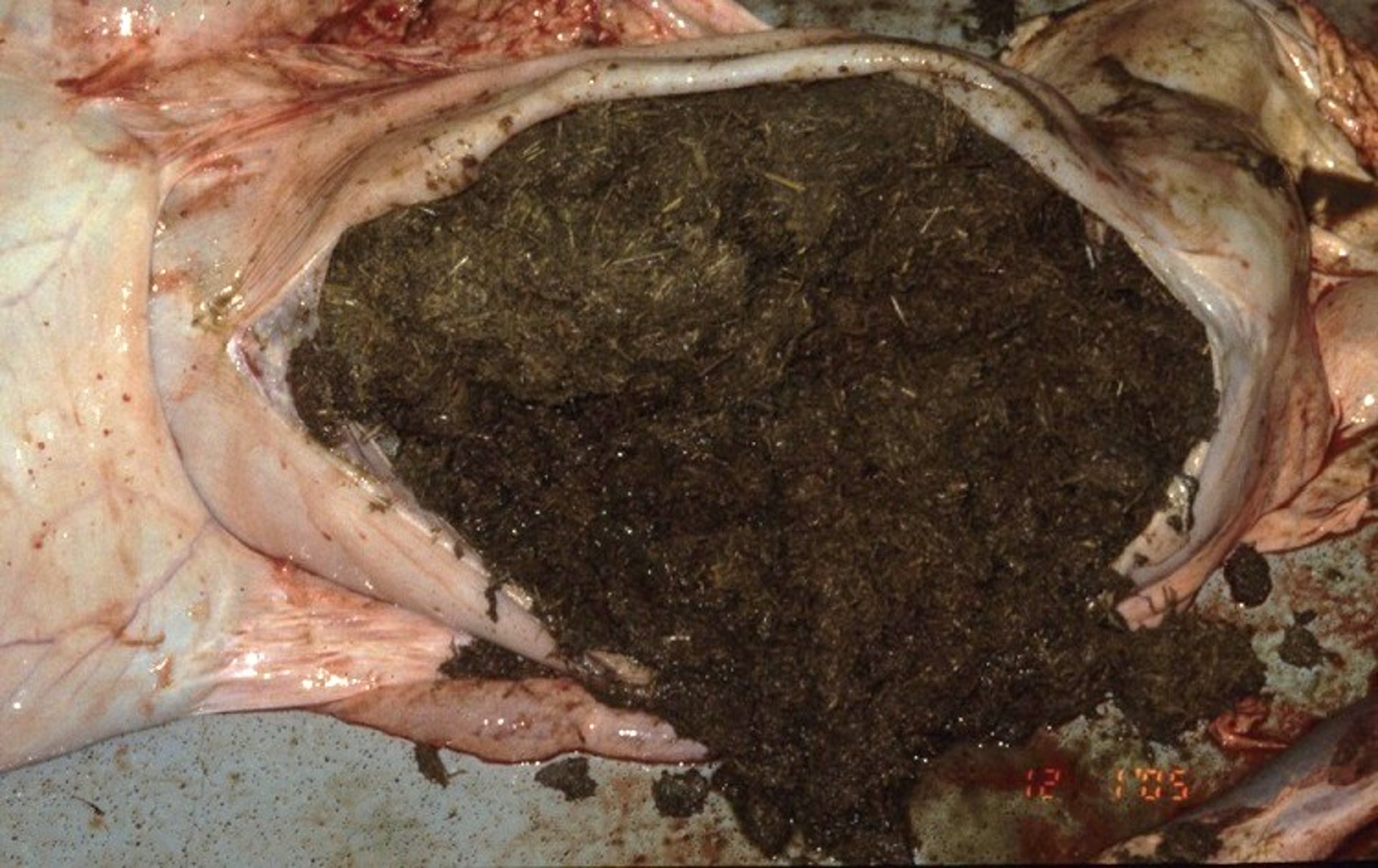
Necropsy photograph showing abomasal impaction in a pregnant beef cow. The abomasum is enlarged and contains coarse, dry ingesta.
Courtesy of Dr. Sameeh M. Abutarbush.
Abomasal impactions in cattle are usually located in the right lower quadrant on the floor of the abdomen. Deep palpation and strong percussion of the right flank might indicate the presence of a large, firm mass (impacted abomasum) and elicit a grunt (as is common in acute traumatic reticuloperitonitis), probably because of distention of the abomasum and stretching of its serosa.
Severely affected cattle die 3–6 days after the onset of abomasal impaction clinical signs. The abomasum ruptures in some cases, and death from acute, diffuse peritonitis and shock occurs precipitously in a few hours. With sand impaction, there is considerable weight loss, chronic diarrhea with sand in the feces, weakness, recumbency, and death within a few weeks.
Metabolic alkalosis, hypochloremia, hypokalemia, and hemoconcentration are common in cases of abomasal impaction. Total and differential WBC counts are usually within the normal range. At necropsy, the abomasum is commonly enlarged many times its normal size and impacted with dry, rumenlike contents.
In abomasal impaction cases, the omasum might be similarly enlarged and impacted. The rumen is grossly enlarged and filled with dry contents or fluid. The GI tract beyond the pylorus is characteristically empty and has a dry appearance. Varying extents of dehydration and emaciation are also present. If the abomasum has ruptured, lesions of acute, diffuse peritonitis are present.
In dairy cattle in early lactation, typically only the pyloric antrum is impacted.
Diagnosis of Abomasal Impaction in Cattle
Physical examination and history
Ultrasonographic examination
Presence of electrolyte abnormalities including metabolic alkalosis, hypochloremia, and hypokalemia
Exploratory laparotomy
Clinical diagnosis of dietary abomasal impaction is based on the nutritional history of the cow, clinical evidence of impaction, and laboratory results. Ultrasonography is a valuable tool to assess the size and position of the abomasum and to diagnose peritoneal lesions. Exploratory laparotomy is often necessary to reach a definitive diagnosis (2).
Impaction of the abomasum as a complication of traumatic reticuloperitonitis usually occurs in late pregnancy (3), and commonly only in one animal. Mild fever may or may not be present, and deep palpation of the xiphoid might elicit a grunt. The rumen is enlarged and can be hypermotile (early) or atonic (late).
In many cases, it is impossible to distinguish between dietary and nondietary causes of abomasal impaction, and examination via right-flank laparotomy might be necessary to explore the abdomen for peritoneal lesions.
Treatment of Abomasal Impaction in Cattle
Laxatives and prokinetic drugs
Surgery in some cases
Slaughter or culling of chronic cases
The challenge with dietary abomasal impaction is to recognize cases that will respond to treatment and cases that will not—ie, to determine which animals should be slaughtered immediately rather than treated. Cows that are weak and that have a severely impacted abomasum and marked tachycardia (100–120 bpm) are poor candidates for treatment, with a high risk of failure.
Pearls & Pitfalls
|
Medical treatment for abomasal impaction usually requires a confirmed diagnosis via examination by right-sided laparotomy. Lubricants can be used to try to move the impacted material; only when the impaction is severe is it necessary to empty the abomasum surgically.
Balanced electrolyte solutions are continuously administered intravenously for up to 72 hours, at a rate of 80–120 mL/kg/day, to correct the metabolic alkalosis, hypochloremia, hypokalemia, and dehydration that accompany abomasal impaction. Some cows respond well to this therapy and begin ruminating and passing feces within 48 hours.
Mineral oil should be administered by nasogastric or orogastric tube at 4 L/day for 3 days (2). In addition, the laxative dioctyl sodium sulfosuccinate (DSS) can be injected once into the abomasum during standing right-flank laparotomy at 50–180 mL of 5% solution for a 450-kg (1,000-pound) patient (2). DSS should not be administered orally, because it kills rumen protozoa. A beneficial response to DSS treatment cannot be expected in < 24 hours; cattle that do respond usually show improvement by the end of day 3 after the start of treatment.
Pearls & Pitfalls
|
Surgery may be considered, to decrease abomasal impaction by careful manual massage; however, results are often unsuccessful, likely because of abomasal atony, which appears to worsen after surgery. An alternative might be to perform a rumenotomy to empty the rumen and infuse mineral oil (2 L [1]) directly into the abomasum through the reticulo-omasal orifice in an attempt to soften and promote evacuation of the abomasal contents.
Cattle with secondary impactions that develop as sequelae of traumatic reticuloperitonitis or abomasal volvulus usually show signs of vagal indigestion, and abomasal impaction might be diagnosed during exploratory surgery.
The induction of parturition by administering dexamethasone (20–30 mg, IM, once [4]) might be indicated in cows that have abomasal impaction, are within 2 weeks of term, and have shown a positive response to treatment for a few days. Parturition might assist recovery by decreasing intra-abdominal volume.
For sand impaction, affected cattle should be moved off the sandy soil and fed good hay and a grass mixture containing molasses and minerals. Severely affected cattle should be treated with administration of mineral oil (4 L/day, by nasogastric or orogastric tube, for 3 days [2]).
Prevention and Control of Abomasal Impaction in Cattle
Dietary abomasal impaction can be prevented by providing the necessary nutrient requirements for wintering beef cattle. When low-quality roughage is fed to cattle, it should be analyzed for crude protein and digestible energy. Analysis usually indicates that the ration is too low in energy and protein requirements.
The nutrient requirements of beef cattle are guidelines for feeding during average conditions; higher nutrient levels might be necessary, particularly during periods of severe cold stress.
Adequate fresh drinking water should be supplied at all times. The practice of forcing wintering cattle to obtain their water requirements by eating snow while on low-quality roughage is not acceptable.
Key Points
Abomasal impaction is a rare condition in ruminants.
Abomasal impaction is caused either by alimentary effects (primary abomasal impaction) or by disturbed innervation and emptying (secondary abomasal impaction).
Treatment focuses on facilitation of abomasal emptying.
Cattle with primary impaction have a better prognosis than those with secondary impaction.
For More Information
Clarke R. Cold and abomasal impaction. Can Cattlemen. Published March 1, 2018.
References
Baker JS. Abomasal Impaction and related obstructions of the forestomachs in cattle. J Am Vet Med Assoc. 1979;175(12):1250-1253. doi:10.2460/javma.1979.175.12.1250
Wittek T, Constable PD, Morin DE. Abomasal impaction in Holstein-Friesian cows: 80 cases (1980–2003). J Am Vet Med Assoc. 2005;227(2):287-291. doi:10.2460/javma.2005.227.287
Ashcroft RA. Abomasal impaction of cattle in Saskatchewan. Can Vet J. 1983;24(12):375-380.
Koziol JH. Induction of parturition and abortion. In: Hopper RM, ed.Bovine Reproduction. 2nd ed. John Wiley & Sons; 2021:579-589. doi:10.1002/9781119602484.ch48