Cervical Lymphadenitis in Guinea Pigs
Cervical lymphadenitis is usually caused by Streptococcus equi zooepidemicus, which is considered part of the normal oropharyngeal and nasal microbiota. Abrasions of the oral cavity, secondary to premolar and molar malocclusion, abrasive feed, or bite wounds, allow bacteria to be transported to draining lymph nodes of the head and neck, causing suppurative lymphadenitis. Guinea pigs develop large, unilateral swellings in the neck. Often, affected individuals are in good body condition and might not show obvious evidence of disease. Differential diagnoses should include lymphoma and other causes for reactive lymph nodes.
Treatment is surgical excision of the affected lymph nodes and systemic antimicrobial treatment. Bacterial culture and susceptibility testing are recommended to guide antimicrobial choices.
Pneumonia in Guinea Pigs
Bacterial pneumonia is common in guinea pigs, and predisposing factors include poor husbandry, including hypovitaminosis C, and other causes of immunosuppression, such as young age. Common bacterial agents include Bordetella bronchiseptica, Streptococcus pneumoniae, S equi zooepidemicus, and Pseudomonas aeruginosa. B bronchiseptica is a cause of bronchopneumonia that often leads to consolidation of lung lobes and fibrinosuppurative pleuritis. It is an important cause of respiratory disease in guinea pigs, and can be passed from clinically normal dogs and rabbits that serve as carriers.
Viral pathogens have not been reported to induce pneumonia in pet guinea pigs; however, adenovirus, cytomegalovirus, and parainfluenza have been described in laboratory animals.
Clinical signs include nasal discharge, increased respiratory noise, dyspnea, lethargy, inappetence, and sudden death. CT, radiography, hematologic testing, and culture of respiratory secretions are useful for diagnosis (see and radiographs). Differential diagnoses for dyspnea are pulmonary neoplasia and cardiac disease.
Treatment includes antimicrobials, nebulization, supportive care, and correction of underlying husbandry deficits.


Radiograph of a guinea pig with severely decreased lung space due to pneumonia and pleural effusion (right lateral view).
Courtesy of Dr. Miranda Sadar.

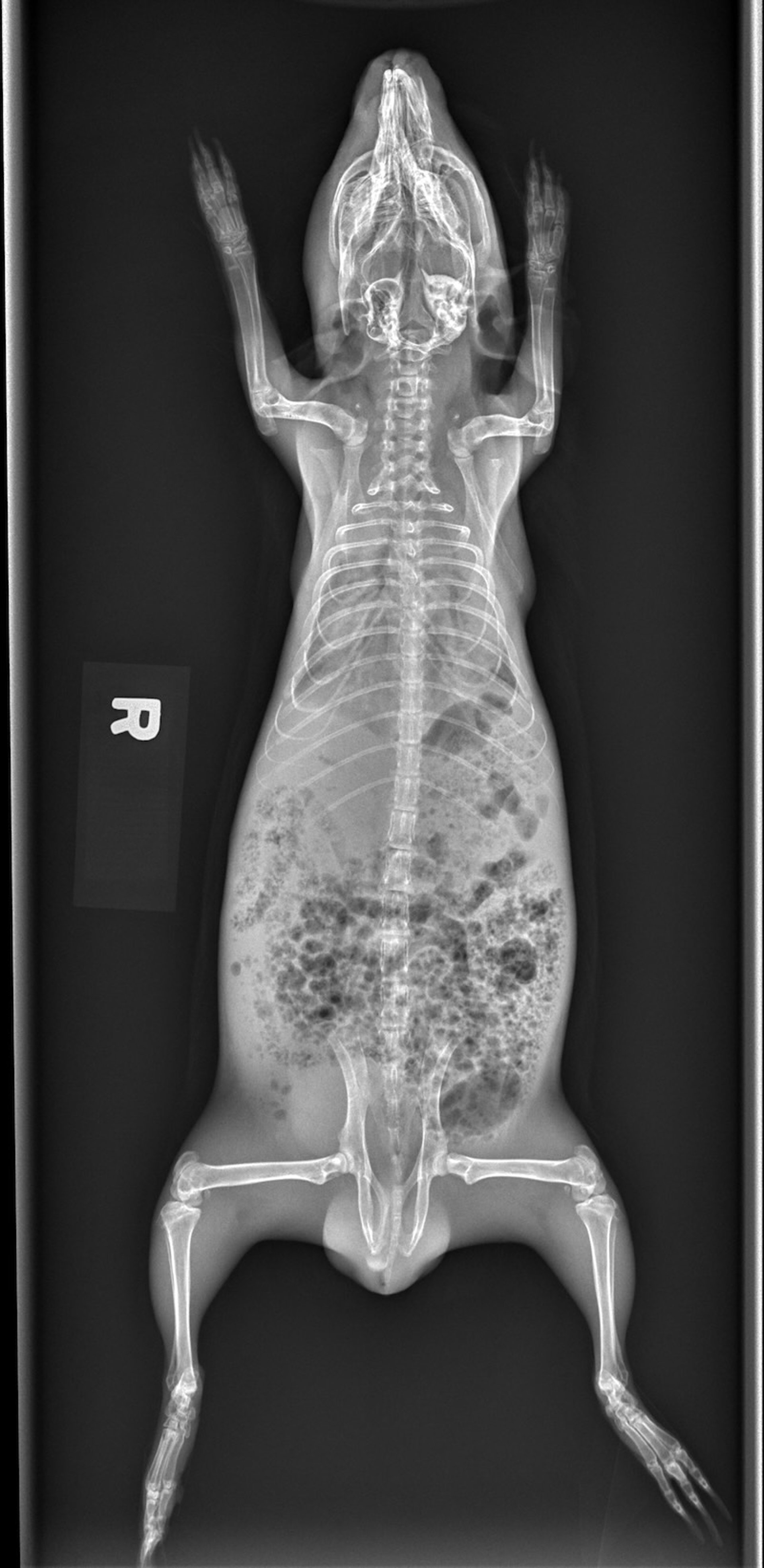
Radiograph of a guinea pig with severe bilateral pneumonia and air bronchograms (ventrodorsal view).
Courtesy of Dr. Miranda Sadar.
Chlamydia caviae in Guinea Pigs
Chlamydia caviae is a primary cause for conjunctivitis in young guinea pigs; however, various bacteria can be isolated from the conjunctival sac of affected animals. (Note that conjunctivitis is also a clinical sign of hypovitaminosis C.) Diagnosis can be made in-house through identifying intracytoplasmic inclusions on conjunctival scrapings or through outside laboratory submission with PCR assay on conjunctival swabs or scrapings. C caviae has zoonotic potential; however, the route of transmission is still unclear. Treatment with a topical tetracycline ophthalmic ointment should be considered because of the zoonotic potential, but this disease typically is self-limiting and clears in 3–4 weeks.
Dermatophytosis in Guinea Pigs
Dermatophytosis is common in young to middle-aged guinea pigs, and immunosuppressed animals are at higher risk of developing it. Clinical signs include scaly, patchy lesions on the face, feet, and dorsum. Typically, lesions are circular with a central area of alopecia surrounded by a ring of inflamed and crusted skin (see ).


Ringworm (Trichophyton) in a guinea pig. Dermatophyte infections on guinea pigs are often located on the face, back, or front feet.
Courtesy of Dr. Louise Bauck.
Most infections are caused by Trichophyton mentagrophytes and T benhamiae; however, Microsporum canis can be isolated as well. Diagnosis is confirmed through plucking affected hairs at the periphery of the lesions and using dermatophyte test medium or fungal culture or via PCR assay or next-generation DNA sequencing. Treatment consists of administration of topical antifungals, such as clotrimazole, in spray or shampoo formulations and/or oral agents, such as terbinafine. Lime-sulfur dips may also be used. Other guinea pigs in the household can be subclinically affected, and treatment of all animals is recommended.
Mites in Guinea Pigs
Mite infestation is often caused by either the fur mite (Chirodiscoides caviae) or the sarcoptic mite (Trixacarus caviae). Lice (Gliricola porcelli and Gyropus ovalis) and demodexes (Demodex caviae) can also be found on guinea pigs. These parasites are transmitted through direct contact between individuals or indirect contact with infested materials in the enclosure, such as bedding.
Fur mite infection can be subclinical, but severe cases can result in pruritus and alopecia. Sarcoptic mites often cause severe pruritus, which is a classic clinical sign of T caviae, causing such intense scratching that it appears that animals are having a seizure. The resulting trauma from the intense pruritus can also lead to secondary fungal or bacterial infections of the skin. Lice typically cause less severe clinical signs and spend their entire life cycle on the guinea pig, requiring direct contact for transmission. Heavy infestations of lice can result in alopecia and crusty lesions (see ).

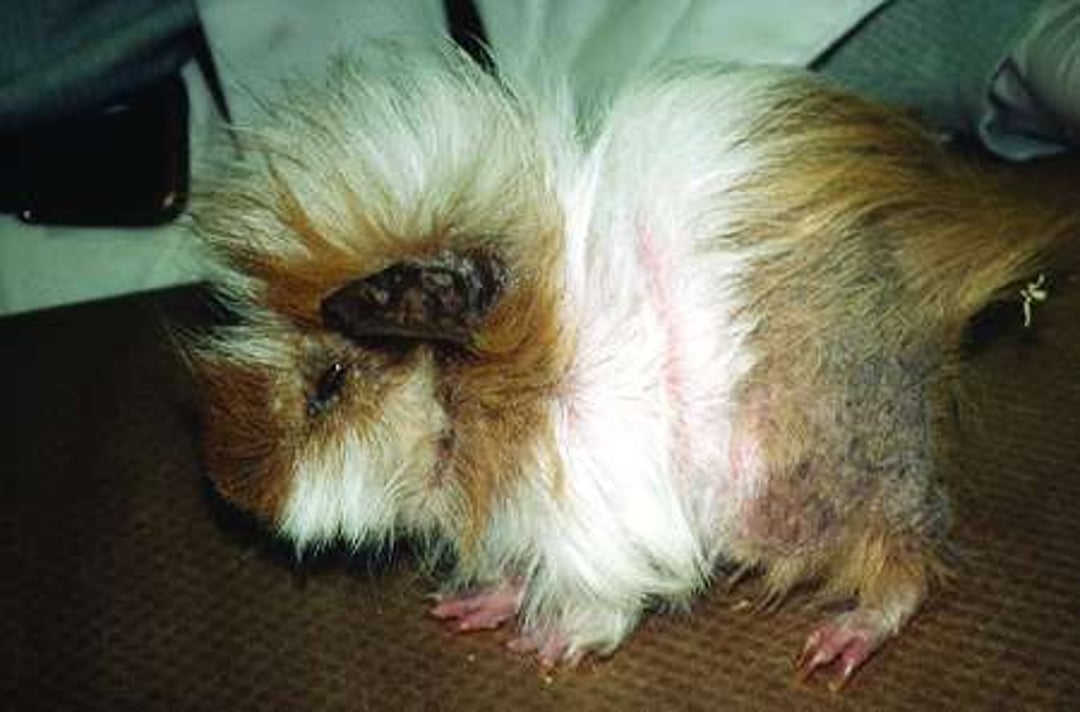
Guinea pig debilitated from severe mite infestation with Trixacarus caviae. Note the fur loss, erythema, and hyperkeratosis.
Courtesy of Dr. Katherine Quesenberry.
Diagnosis can be made through microscopic examination and direct visualization of the organisms or their eggs. Treatment with ivermectin (0.4 mg/kg, SC, every 10–14 days for four treatments) or selamectin (15 mg/kg, topically, once) has been shown to be effective for treatment of T caviae infection in guinea pigs (1). These drugs are effective against lice as well.
Severe pruritus should be treated with antihistamines, such as diphenhydramine or hydroxyzine, and NSAIDs, such as meloxicam. Subclinically affected animals should also be treated for ectoparasites and the environment disinfected. Lice and fur mites are usually species-specific; however, T caviae can be zoonotic.
Pearls & Pitfalls
|
Zoonotic Diseases in Guinea Pigs
Chlamydia caviae has zoonotic potential and is a cause of conjunctivitis, and less commonly affects the genital tract, in guinea pigs.
Lymphocytic choriomeningitis virus (LCMV) is an arenavirus that is uncommon in guinea pigs but leads to meningitis and pelvic limb paralysis. It is transmitted through inhalation, ingestion, or direct contact with contaminated urine, feces, and saliva. Clinical signs of LCMV in humans includes headache, vomiting, fever, and, rarely, death.
Dermatophytosis can be transmitted from guinea pigs to humans. Most infections are caused by Trichophyton mentagrophytes and T benhamiae, but Microsporum canis can be isolated as well. Organisms can survive in the environment, leading to reinfection.
The sarcoptic mite, Trixacarus caviae, has zoonotic potential, and owners of affected guinea pigs should be notified of this risk.
References
Eshar D, Bdolah-Abram T. Comparison of efficacy, safety, and convenience of selamectin versus ivermectin for treatment of Trixacarus caviae mange in pet guinea pigs (Cavia porcellus). J Am Vet Med Assoc. 2012;241(8):1056-1058. doi:10.2460/javma.241.8.1056