Contagious ecthyma, also known as orf, is an infectious dermatitis of sheep and goats that primarily affects the lips of young animals. It is zoonotic. The lesions are characteristic; however, diagnosis can be confirmed by PCR assay. The disease is often more severe in goats than in sheep. Treatment usually focuses on secondary infections. Control is by vaccination and hygiene.
Contagious ecthyma (orf) is a proliferative and pustular dermatitis of sheep and goats caused by a parapoxvirus. Lesions usually involve the lips of young animals; they can also involve other cutaneous junctions, such as the coronet, and extend onto the face and ears, as well as the udders of ewes.
Diagnosis of contagious ecthyma is confirmed by PCR assay. Affected animals go off feed, fail to gain weight, and can develop serious secondary infections at lesion sites, resulting in production losses.
Etiology of Contagious Ecthyma in Sheep and Goats
Orf virus (Parapoxvirus orf), the causative agent of contagious ecthyma, is a parapoxvirus closely related to pseudocowpox and bovine papular stomatitis viruses. It is an enveloped virus with a linear, double-stranded DNA genome. Orf virus is epitheliotropic, infecting keratinocytes and producing skin lesions.
Epidemiology of Contagious Ecthyma in Sheep and Goats
Contagious ecthyma is transmitted by contact with infected animals or with contaminated equipment and environments. Damage to the skin (a cut or abrasion) is thought to be essential for establishment of infection.
Orf virus is highly resistant in the environment and has been recovered from dried crusts after up to 12 years. The virus can also cause inapparent, persistent infections that can introduce infections into new flocks.
Contagious ecthyma is found worldwide.
Contagious ecthyma is zoonotic; humans who handle infected animals or fomites carrying the virus can be affected.
Clinical Findings of Contagious Ecthyma in Sheep and Goats
Primary lesions of contagious ecthyma develop at the mucocutaneous junction of the lips and around erupting incisor teeth, and they can extend to the mucosa of the buccal cavity. Occasionally, lesions extend to the face and ears (see , , and contagious ecthyma images).

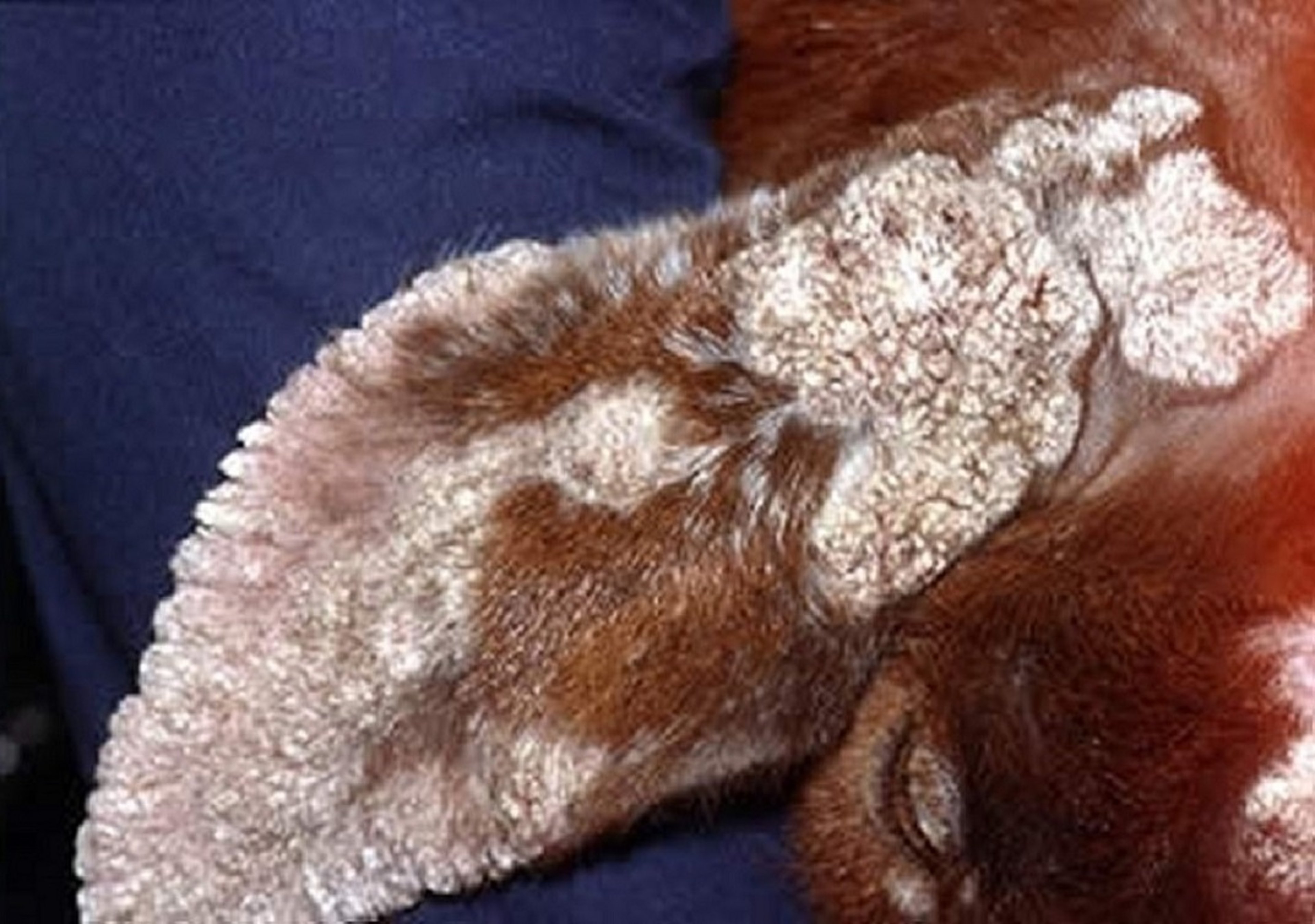
The effect of contagious ecthyma on the ear of a goat. Note the proliferative dermatitis in the pinna.
Courtesy of Dr. Robert Dunstan.


Sheep with proliferative contagious ecthyma (orf) lesions. (A) An ulcerative lesion extends from the mucocutaneous junction of the lips to cover both the lips and the nasal region in this sheep. (B) Chronic hyperkeratosis extends from the mucocutaneous junction of the lips to cover both the upper and lower lips in this sheep.
Courtesy of Dr. Philip Scott.

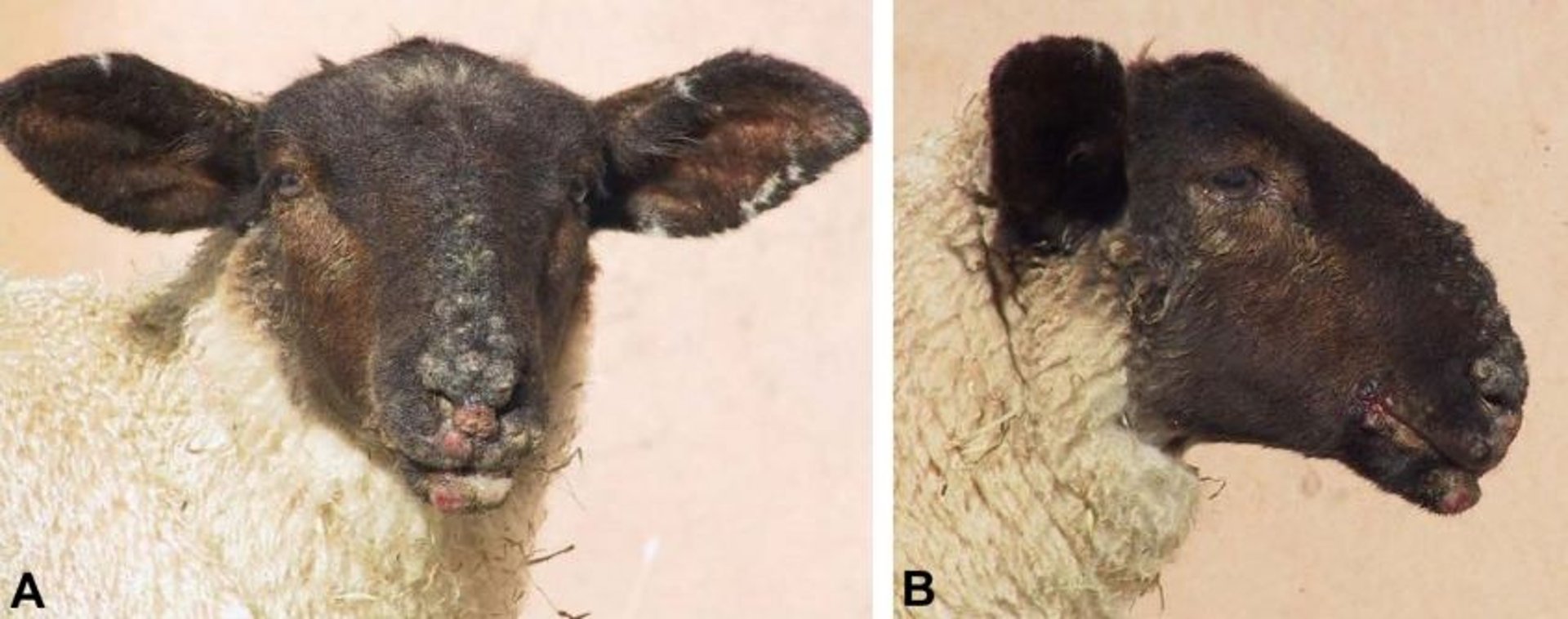
Chronic proliferative contagious ecthyma (orf) lesions in a lamb. (A) Lesions extend from the mucocutaneous junction of the lips. Scabs are present on the nasal and buccal regions and, to some extent, the pinnae. (B) The lips have scabby crusts.
Courtesy of Dr. Philip Scott.
Lesions can also occur on the feet and around the coronet, where secondary bacterial infection with Dermatophilus congolensis can lead to strawberry footrot (see ).

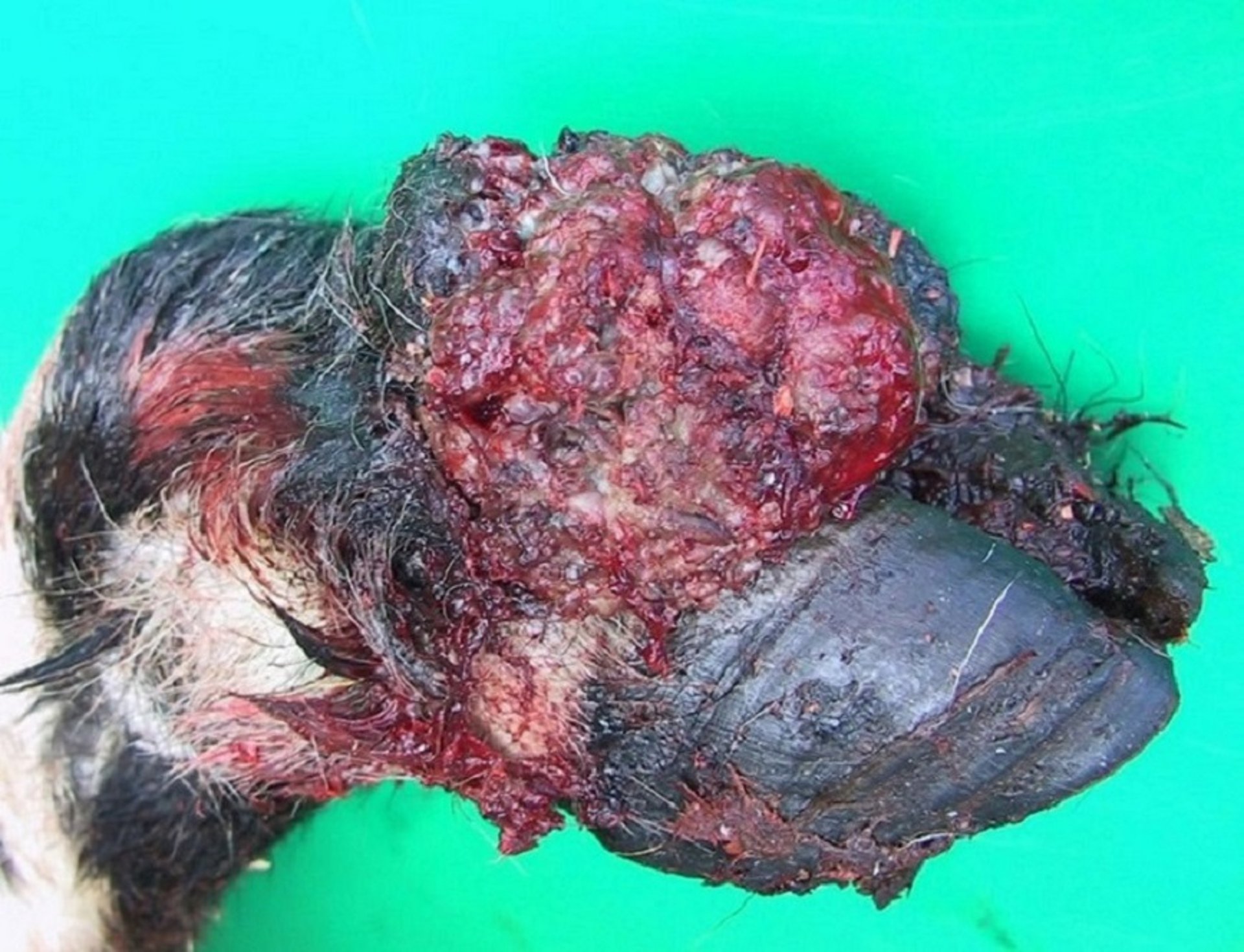
Strawberry footrot in a goat, resulting from secondary infection of a contagious ecthyma lesion at the coronary band by the bacterium Dermatophilus congolensis.
Courtesy of Dr. Philip Scott.
Ewes nursing lambs infected with contagious ecthyma can develop lesions on the teats that extend onto the udder skin. The lesions develop as papules and sometimes larger proliferative lesions before ulcerating and encrusting. Coalescence of numerous discrete lesions often leads to the formation of large scabs, and the proliferation of dermal tissue produces a verrucose mass under the scabs. When lesions extend to the oral mucosa, secondary necrobacillosis frequently develops.
During the course of contagious ecthyma (1–4 weeks), the scabs drop off and the tissues heal without scarring.
Lambs that are more severely affected by contagious ecthyma do not eat normally and lose condition. These signs are exacerbated by the ewe’s reluctance to nurse if she has infected teats. Extensive lesions on the feet result in lameness.
Mastitis, sometimes gangrenous, can occur in ewes.
Clinical signs of contagious ecthyma can appear similar to those of cowpox and pseudocowpox.
Diagnosis of Contagious Ecthyma in Sheep and Goats
Clinical signs
PCR assay
The ecthyma lesion is characteristic, and the disease is usually diagnosed on the basis of the host and clinical signs.
Ulcerative dermatosis, with tissue destruction and crateriform ulcers, appears to be caused by a closely related parapoxvirus, as are several similar diseases of camels and deer.
Foot-and-mouth disease, bluetongue and peste des petits ruminants all cause sores in the mouth that can look similar to contagious ecthyma lesions and should be considered differential diagnoses if the morbidity rate is high and other clinical signs are present.
Staphyloccocal folliculitis affects the skin of the muzzle and surrounding the eyes.
Electron microscopy of scab material has been replaced by PCR assay as the laboratory diagnostic method of choice for contagious ecthyma. Contagious ecthyma can be differentiated from similar diseases by PCR assay and sequencing of the ORF011 (B2L) gene.
Treatment and Control of Contagious Ecthyma in Sheep and Goats
Treating secondary infection
Vaccination
There is no specific treatment for contagious ecthyma. Antimicrobials might be required to combat secondary bacterial infection, and insect repellents and larvicides might also be required to prevent myiasis.
The virus that causes contagious ecthyma is transmissible to humans by direct inoculation; lesions in humans are therefore often on the hands and face. Although usually mild, these lesions can be proliferative, painful, and distressing. Veterinarians and sheep handlers should exercise care and wear disposable gloves.
Some cases of ecthyma in humans are misdiagnosed and mistaken for other diseases, leading to unnecessary treatment with antimicrobials or surgery. Typically, physicians suspect ecthyma only when the patient reports a history of contact with sheep or goats.
Biopsy of the lesion provides diagnostic confirmation of contagious ecthyma via PCR assay.
Sheep that have recovered from natural orf virus infection are highly resistant to reinfection at the same site, but not necessarily elsewhere on the body.
Pearls & Pitfalls
|
Several commercial live vaccines are available that produce fair but not total immunity, depending on the virulence of the infecting strain.
Vaccines against contagious ecthyma are live and best not administered on uninfected premises, to avoid environmental contamination. Most vaccines against this disease are administered by scarification, usually on the inside of the thigh or behind the elbow or caudal fold, and a proportion of animals should be examined a week later to check that the vaccine has taken.
During vaccination, gloves should be worn and care taken to avoid self-inoculation.
Vaccinated animals should be segregated from unprotected stock until the scabs have fallen off. Lambs should be vaccinated before the expected risk period, and ewes may be vaccinated 7–8 weeks before lambing; however, ewes should be vaccinated in premises separate from those used for lambing, to avoid contaminating the lambs’ environment.
Key Points
Contagious ecthyma (orf) is an infectious zoonotic disease that affects mainly sheep and goats.
The proliferative lesions are characteristic and usually affect the lips and face.
For More Information
Reichen C, Beirão BCB, Monteiro ALG. Contagious ecthyma in small ruminants: from etiology to vaccine challenges—a review. Vet Res Commun. 2025;49:115.
Rossi L, Tiecco G, Venturini M, Castelli F, Quiros-Roldan E. Human Orf with immune-mediated reactions: a systematic review. Microorganisms. 2023;11(5):1138.
Small E, Cresswell E, Lovatt F, et al. Do UK sheep farmers use orf vaccine correctly and could their vaccination strategy affect vaccine efficacy?Vet Rec. 2019;185(10):305.