Cowpox is an infectious viral skin disease. It is now rarely reported in cows. The host in which disease caused by cowpox virus occurs most frequently is cats. For that reason it is also known as catpox.
Etiology of Cowpox and Related Orthopoxvirus Infections
The causative agent of cowpox is cowpox virus (Orthopoxvirus cowpox), an orthopoxvirus. It is an enveloped virus with a linear, double-stranded DNA genome.
Cowpox virus is closely related to smallpox virus (the first, and so far only, human virus eradicated), ectromelia virus (the cause of mousepox in laboratory mice), mpox (formerly named monkeypox virus), camelpox virus, and the smallpox vaccine virus, vaccinia (unknown reservoir host).
Cowpox virus has the largest genome of all the orthopoxviruses. It also appears to have the most variable genomic sequences, which might be related to different reservoir hosts or to geography; this variation might be the basis for the virus's wide accidental host range, which includes humans.
Cowpox material was the likely source of Edward Jenner’s original smallpox vaccine (vacca is Latin for "cow"). Within a few decades after the vaccine was introduced, the properties of the smallpox vaccine and cowpox diverged. The vaccinia virus that is the basis of modern smallpox vaccines is different from both cowpox and smallpox viruses, and although it likely originated ashorsepox virus (1), its origins and reservoir hosts are unknown.
Epidemiology of Cowpox and Related Orthopoxvirus Infections
First described in cattle and humans, cowpox virus circulates in European wild rodent reservoirs, mainly voles (Microtus and Myodes spp) and some mice (Apodemus spp). No clinical signs occur in these animals; however, there are more subtle effects on their population dynamics.
However, cowpox virus has a wide host range, and disease has been reported in a range of domestic animals and captive species in various European zoos.
Human infection by cowpox virus seems to be associated mainly with transmission from cats; however, zoonotic transmission from rodents and other accidental hosts has also been reported; the proximate sources of human infections are often unknown.
Like all other poxviruses, cowpox virus can survive in the environment for several months, and possibly years.
Cowpox virus is found across much of Europe and into northern and western Asia.
Orthopoxviruses other than cowpox and vaccinia viruses can also infect livestock and other domestic animals, and they might also be zoonotic. They often have distinct geographical ranges. Orthopoxviruses also often have distinct rodent reservoir hosts.
Cowpox in Cats and Other Species
Domestic cats are the species in which cowpox is most frequently diagnosed. Skin lesions are the most common clinical sign; however, pulmonary signs can occur in more severe cases, especially in immunosuppressed cats.
Diagnosis of cowpox can be confirmed by histological evaluation or PCR assay, but isolation is easy in mammalian cell cultures, and electron microscopy, if available, is rapid.
Although antivirals might be used against cowpox, treatment is usually simply supportive, and corticosteroids are contraindicated.
Care must be taken when treating animals with cowpox, because it is zoonotic and the virus can survive in scabs shed into the environment.
Although cowpox was historically described as a disease of cattle, bovine cowpox is now very rare. Domestic cats in Europe are the most commonly recognized species clinically affected by cowpox virus. The virus has not been isolated in North or South America; however, there is a single report of raccoonpox virus (also an orthopoxvirus) causing a paw lesion in a cat in Canada (2).
Etiology of Cowpox in Cats and Other Species
All orthopoxvirus isolates from domestic cats in Europe are considered to be cowpox virus. However, molecular characterization indicates substantial heterogeneity in isolates that might be indicative of different rodent hosts in different geographical areas.
Epidemiology of Cowpox in Cats and Other Species
Cowpox virus is also infectious to humans, and cats are the most commonly identified source of human infection. Cat owners should be advised accordingly.
Most cats infected by cowpox virus come from rural environments. The initial lesion is often described as having originated as a small bitelike wound; however, it can become secondarily infected and is followed by viremia and widespread skin lesions.
Cowpox infection in cats has a marked seasonal incidence, with most cases occurring in late summer and autumn, when rodent populations are highest and infection prevalence in rodents also peaks.
Cat-to-cat transmission can occur; however, it usually results in only subclinical infection.
Pathogenesis of Cowpox in Cats and Other Species
The most common route of entry by cowpox virus appears to be through the skin; however, oronasal infection is also possible.
After local replication and development of a primary skin lesion, the virus spreads to local lymph nodes, and leukocyte-associated viremia develops.
The viremic phase of cowpox in cats can be associated with fever and depression, and during this period virus particles can be isolated from various tissues, including the skin, turbinates, lungs, and lymphoid organs. Widespread secondary skin lesions appear a few days after the onset of viremia, and new lesions continue to appear for 2–3 days, after which viremia subsides.
The viremic and systemic infection stage of cowpox is the most dangerous stage of the disease (often associated with death) in zoo-kept felids and other species.
Clinical Findings of Cowpox in Cats and Other Species
Most cats infected with cowpox virus have a history of a single primary skin lesion, usually on the head, the neck, or a forelimb. The primary lesion can vary from a small, scabbed wound to a large abscess, owing to secondary bacterial infection.
Approximately 7–10 days after the primary cowpox lesion appears, widespread secondary lesions begin to occur. Over 2–4 days, these develop into discrete, circular, ulcerated papules approximately 0.5–1 cm in diameter. The ulcers soon become covered by scabs (see ), and healing is usually complete by approximately 6 weeks.

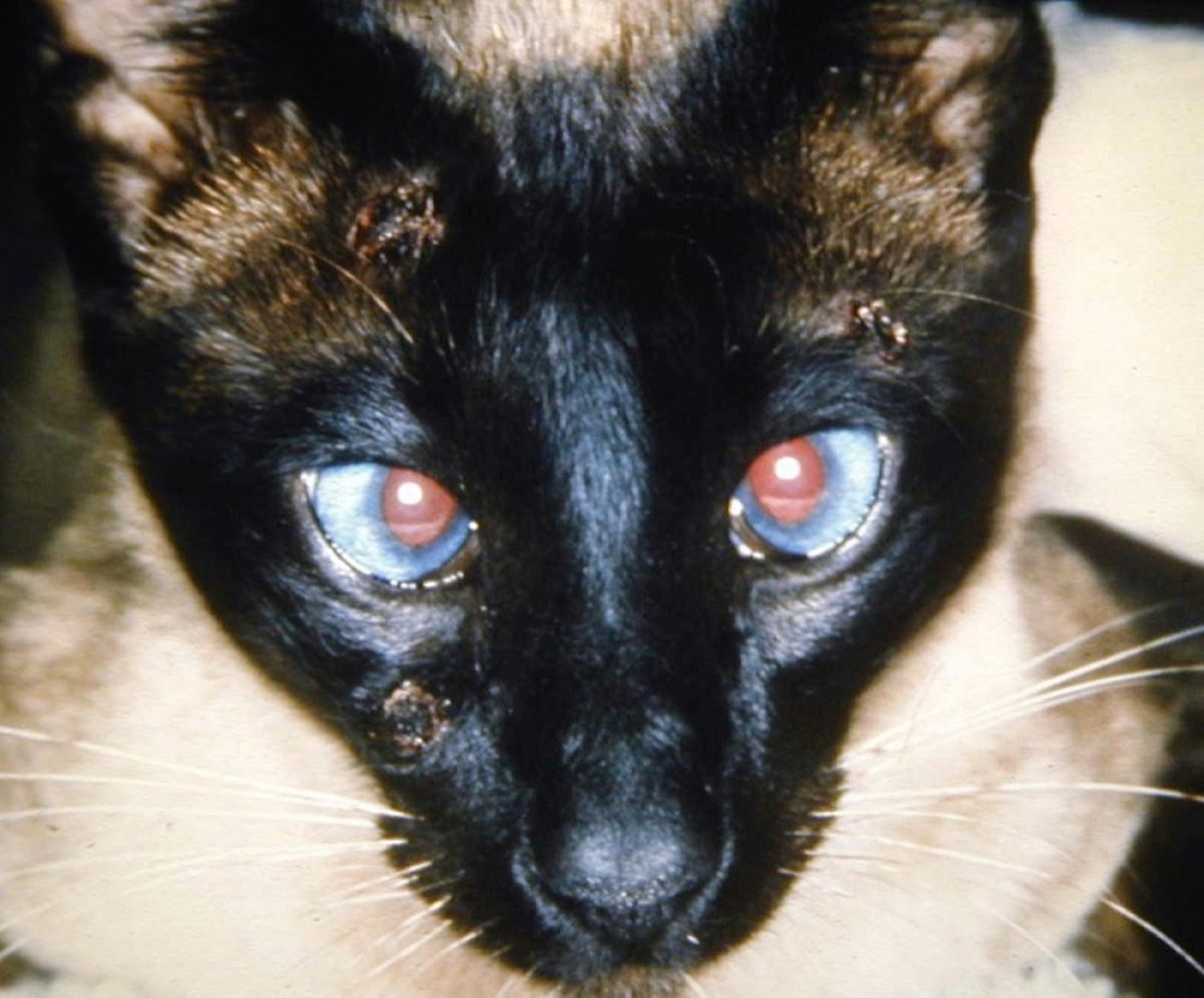
Scabbed cowpox lesions in a cat. Note several scabbed over, ulcerated, nodular or papular lesions.
Courtesy of Dr. Rosalind Gaskell, University of Liverpool.
Many cats show no signs of cowpox other than skin lesions; however, some cats develop mild coryza or conjunctivitis. Some affected cats might also show pyrexia, depression, and decreased appetite during the viremic phase just before and during the early development of secondary lesions.
Concurrent bacterial infection, particularly of the primary lesions, can give rise to systemic signs. However, most domestic cats recover from cowpox uneventfully.
More severe pulmonary disease associated with cowpox virus infection is uncommon in domestic cats but occurs frequently in zoo-kept felids and in some other zoo-kept mammals. Systemic disease is often fatal.
More severe cowpox in domestic cats is often associated with immunosuppression either after treatment with corticosteroids or associated with infection by feline leukemia virus or feline immunodeficiency virus.
Diagnosis of Cowpox in Cats and Other Species
Clinical examination
Histological evaluation
Culture
PCR assay
If multiple well-circumscribed skin lesions are present, along with a history of a single lesion on the head or forelimb, a presumptive diagnosis of cowpox can be based on clinical signs and the time of year. Differential diagnoses include the following:
feline herpesvirus
bite wounds
other bacterial or fungal conditions
In most cases, cowpox can be diagnosed quickly via examination of unfixed scab, exudate, or biopsy material using electron microscopy or PCR assay. Cowpox virus grows readily on most mammalian cell lines. Fixed biopsy material for histological evaluation and serum for antibody determination also can be sent to the laboratory.
Treatment and Control of Cowpox in Cats and Other Species
Supportive care
Antimicrobials for secondary infections
In domestic cats, supportive treatment of cowpox is generally successful, and the mortality rate is low.
Antimicrobials might be required to control secondary bacterial infections.
It is important to recognize cowpox promptly because steroid treatment, often used for other skin conditions, is contraindicated.
Pearls & Pitfalls
|
Cowpox is often more severe in zoo-kept felids and a range of other zoo-kept mammals, including some primate species. Other species can become infected and seroconvert, but they rarely show clinical signs.
Antivirals have been trialed for use against cowpox virus in humans and animals; however, they are rarely used in practice and are not often licensed for nonhuman use.
Because cowpox infection is usually acquired from infected rodents, it is difficult to control the exposure of outdoor cats to the virus.
In European zoological collections, where big cats, particularly cheetahs, and other animals (from elephants to anteaters) are at risk of cowpox virus infection because of contact with small wild rodents, vaccination may be considered.
Modern vaccinia virus vaccines (modified vaccinia virus Ankara [MVA]), as licensed and used for human mpox, is routinely used against cowpox virus in elephants in some European zoos; however, it is not currently licensed for use in nonhuman animals in many countries.
Vaccinia virus appears to be of low pathogenicity in domestic cats. However, management of cowpox outbreaks among large cats often depends on prompt diagnosis and segregation of affected animals to minimize the possibility of cat-to-cat spread. Rodent control should be evaluated and premises disinfected. At ambient temperatures, poxviruses are relatively resistant, and they can remain infective in dried crusts for months.
Cowpox in Cattle
In cattle, cowpox is now a rare, mild, eruptive disease, described mainly in dairy and suckler cows. An outbreak in 1968 might be the last recorded outbreak in dairy cattle in Europe. Lesions occur on the udder and teats (see ).


Cowpox ulcer on a cow's teat 7–10 days after the onset of lesions; photographed in England in 1968 during an outbreak of cowpox only a few miles from where Edward Jenner conducted his studies on cowpox and smallpox in the 1790s.
Courtesy of Dr. Paul Gibbs.
Before widespread vaccination against smallpox was discontinued, some outbreaks of "cowpox" in cows in North America, Europe, and elsewhere were due to vaccinia virus acquired from recently vaccinated humans.
Buffalopox virus appears to be a vaccinia virus clade that causes outbreaks of cowpoxlike teat infections in cattle and buffalo in the Indian subcontinent, the Middle East, and the Philippines (3). Similarly, vaccinia-like viruses have caused outbreaks of mammillitis in cattle, with zoonotic transmission, in South America.
The modern origins of these vaccinia-related viruses are unknown; however, it has been suggested that they are smallpox vaccine viruses that spread to animals during the smallpox vaccination campaigns (4). It is not known whether these viruses are endemic in these cattle and water buffalo populations or have spilled over from local rodent hosts to which they have adapted.
Once introduced into a herd, cowpox spreads among cattle probably via introduction of the virus into breaks in the skin during milking. After an incubation period of 3–7 days, during which cows might be mildly febrile, papules appear on the teats and udder. Vesicles might not be evident or might rupture readily, leaving raw, ulcerated areas that form scabs. Lesions generally heal within 1 month.
Handlers of infected cattle or other infected animals (particularly cats) might develop lesions on the hands, arms, or face, often accompanied by fever. Occasionally, cowpox in humans can cause generalized disease, and fatalities have been recorded.
Cowpox or vaccinia-like infections in cattle can be confused with unruptured and ruptured vesicles of bovine herpes mammillitis (caused by bovine herpesvirus 2). Similarly, pseudocowpox can look like scabbed or healing cowpox. The morphology of each virus is distinct when viewed by electron microscopy, and vaccinia virus, cowpox virus, and bovine herpesvirus grow in cell cultures. However, PCR assay is probably the most rapid method of diagnosis.
Measures to prevent the spread of cowpox within a herd are based on segregation and hygiene.
Key Points
Rodents are the reservoir hosts of cowpox virus, leading to spillover infections in other species (people, cattle, cats, and zoo-kept mammals).
Disease is usually limited to skin lesions, but cowpox can be systemic in both domestic cats and humans, and it is sometimes fatal.
Cowpox is largely limited to Europe; however, related orthopoxviruses might cause similar diseases elsewhere.
For More Information
Ortiz-Prado E, Kyriakidis NC, López-Cortéz A, et al. Current and emerging mpox vaccine strategies: A comprehensive review. Vaccine. 2025;62:127598.
Costa T, Stidworthy MF, Ehmann R, et al. Cowpox in zoo and wild animals in the United Kingdom. J Comp Path. 2023;204:39-46.
Diaz-Cánova D, Mavian C, Brinkmann A, Nitsche A, Moens U, Okeke MI. Genomic sequencing and phylogenomics of cowpox virus. Viruses. 2022;14:2134.
MacLachlan NJ, Dubovi EJ, Barthold SW, Swayne DE, Winton JR, eds. Fenner's Veterinary Virology. 5th ed. Elsevier/AP; 2017.
References
Esparza J, Schrick L, Damaso CR, Nitsche A. Equination (inoculation of horsepox): an early alternative to vaccination (inoculation of cowpox) and the potential role of horsepox virus in the origin of the smallpox vaccine. Vaccine. 2017;35(52):7222-7230. doi:10.1016/j.vaccine.2017.11.003
Yager JA, Hutchison L, Barrett JW. Raccoonpox in a Canadian cat. Vet Dermatol. 2006;17(6):443-448. doi:10.1111/j.1365-3164.2006.00553.x
Pattanaik A, Lodha L, Marate S, et al. Buffalopox: an emerging zoonotic challenge. Infect Dis Now. 2024;54(6):104954. doi:10.1016/j.idnow.2024.104954
Medaglia ML, Moussatché N, Nitsche A, et al. Genomic analysis, phenotype, and virulence of the historical Brazilian smallpox vaccine strain IOC: implications for the origins and evolutionary relationships of vaccinia virus. J Virol. 2015;89(23):11909-11925. doi:10.1128/JVI.01833-15