Pseudocowpox and bovine papular stomatitis are relatively mild and common infections of cattle and sometimes other bovids. Both occur worldwide. They are caused by different Parapoxvirus species closely related to the virus that causes contagious ecthyma, and a range (not fully studied) of other parapoxviruses have been reported in wild mammals and deer.
Although often differentiated by their clinical signs, pseudocowpox and bovine papular stomatitis can overlap in presentation, and molecular analysis is required to differentiate the causative viruses, especially in human cases for which the animal source is unknown.
Pseudocowpox and bovine papular stomatitis viruses are both zoonotic, causing superficial skin lesions in humans, usually milder than orf lesions, and often called "milker’s nodules."
Like most parapoxviruses, the viruses that cause pseudocowpox and bovine papular stomatitis grow in certain cell cultures. However, they grow relatively poorly, so formal laboratory diagnosis and characterization are based on PCR assay and sequencing.
Pseudocowpox lesions usually begin as small, red papules on the teats or udder. These might be followed rapidly by scabbing; however, small vesicles or pustules can develop before scabs form.
Scabs can be abundant and can be removed without causing pain. Granulation occurs beneath the scabs, resulting in a raised lesion that heals from the center and leaves a characteristic horseshoe-shaped or circular ring of small scabs. This stage is reached in approximately 7–12 days.
Some pseudocowpox lesions persist for several months, giving the affected teats a rough feel and appearance, and more scabs might form (see parts 2C and 2D of the ).

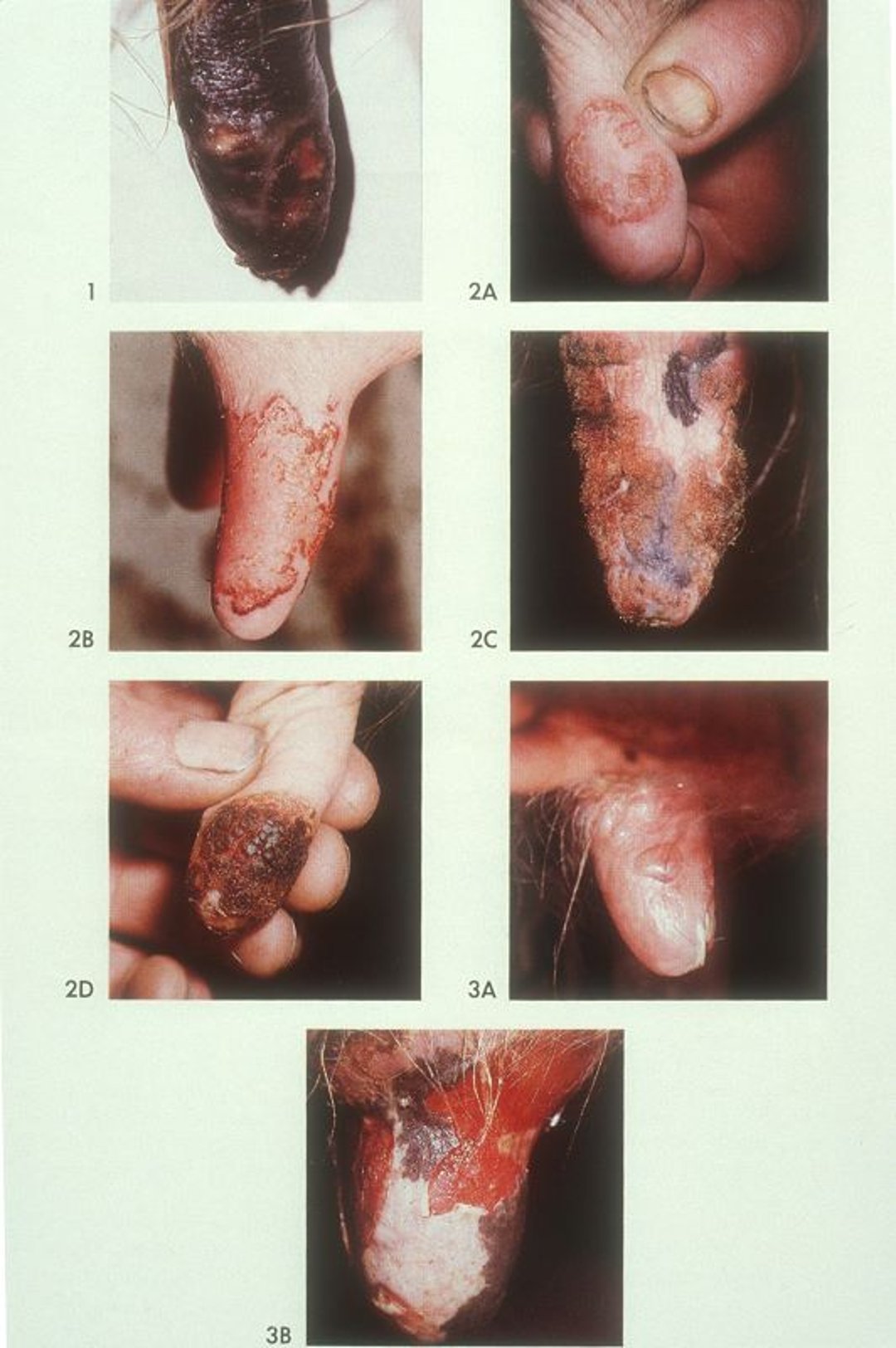
Viral skin infections on cow teats. Image 1: Ulcers associated with cowpox. Images 2A-2D: Pseudocowpox. Images 3A-3B: Unruptured and ruptured vesicles of bovine herpes mammillitis.
Courtesy of Dr. Paul Gibbs.
Bovine papular stomatitis lesions usually occur in the mouth, particularly on the hard palate of calves and young cattle. However, pseudocowpox virus can cause identical lesions, and both viruses have been detected in the mouth of cattle with no clinical signs. Furthermore, dual infections have been reported in the same animal, and in herds with pseudocowpox, bovine papular stomatitis, and vaccinia-like virus infection in South America (1, 2).
Although both pseudocowpox and bovine papular stomatitis are usually of little clinical importance, oral pseudocowpox virus has been identified as a coinfection in an ill-thrift syndrome in calves, and as the cause of an outbreak of pustular vulvovaginitis in cattle (3). Furthermore, the presence of circular lesions in the mouth or on teats can raise the suspicion that they are ruptured vesicles associated with reportable diseases, such as foot-and-mouth disease, vesicular stomatitis, or lumpy skin disease.
References
Matsumoto H, Setoyama H, Matsuura Y, et al. Sequential detection of pseudocowpox virus and bovine papular stomatitis virus in a same calf in Japan. J Vet Med Sci. 2019;81(3):440-443. doi:10.1292/jvms.18-0367
Shimizu K, Badr Y, Okada A, Inoshima Y. Bovine papular stomatitis virus and pseudocowpox virus coinfection in dairy calves in Japan. Arch Virol. 2020;165(11):2659-2664. doi:10.1007/s00705-020-04792-3
Blomqvist G, Ullman K, Segall T, et al. An unusual presentation of pseudocowpox associated with an outbreak of pustular ulcerative vulvovaginitis in a Swedish dairy herd. J Vet Diagn Invest. 2018;30(2):256-259. doi:10.1177/1040638717737126