The same structural anomalies of the brain as described for small animals are found in large animals.
Congenital Cerebral Disorders in Large Animals
Anencephaly in Large Animals
In anencephaly, the brain is largely absent at birth. Anencephaly is a rare disorder that occurs sporadically in calves; the cause is unknown. Because the pituitary gland can also be absent, affected calves might have a prolonged gestation.
Cerebral aplasia in calves is usually associated with complete absence of both cerebral hemispheres, and CSF might leak out of a small opening on the midline between the frontal bones.
Clinical signs of anencephaly include profound lethargy, head pressing, and blindness with normal pupillary reflexes.
Exencephaly in Large Animals
In exencephaly, the brain is exposed through a large defect in the skull (cranium bifida). The brain, meninges, or both might protrude through this opening. Protrusion of the brain (encephalocele) or of the meninges (meningocele) occurs in many species, and these defects are known to be inherited in pigs.
Protrusion of both the brain and the meninges is known as meningoencephalocele (see ).


Protrusion of tissue on the forehead of an American Miniature foal with meningoencephalocele. The meningoencephalocele is closed (covered with skin). In some animals, this defect is open externally. This foal had surgery to excise the protruded tissue and had a favorable outcome after physical therapy and bottle feeding. The only residual clinical sign as an adult was sporadic seizures.
Courtesy of Dr. Rebecca Packer and Dr. Paige Jackson.
Some evidence suggests that high doses of vitamin A during pregnancy can cause exencephaly in some species (1).
Exencephalic defects might be closed or open, in terms of communication with the environment through skin defects. There is too little information about these defects to reliably predict the outcome and resolution of any deficits. Good surgical outcomes have been achieved in some cases of closed meningoencephalocele, because the protruding tissue is generally not functional; however, improvement of existing clinical signs is not expected.
The goal of surgical correction of exencephaly is to prevent further trauma and to seal the CNS from the external environment. In open meningoencephalocele, CNS infection is an important factor in outcome. When the brain openly communicates externally through these defects, CNS infection should be presumed unless proven otherwise.
Pearls & Pitfalls
|
As in any case of ataxia, seizures, or mental compromise in large animals, safety must be considered when considering treatment of exencephaly.
Hydranencephaly in Large Animals
In hydranencephaly, there is a marked loss of cerebral cortical tissue (primarily the neocortex) within a cranial vault of normal conformation. The resultant cavity communicates with the ventricular system, has an incomplete ependymal cell lining, and is filled with CSF.
Clinical signs of hydranencephaly include lethargy, propulsive circling, head pressing, and blindness. Hydranencephaly develops as a result of the destruction of developing neural tissues and is sometimes accompanied by cerebellar hypoplasia and arthrogryposis. In large animals, hydranencephaly occurs sporadically or as an epidemic in calves, lambs, and, less commonly, piglets.
Known causes of hydranencephaly include infection in utero with a number of viruses, including Akabane virus in ruminants in Australia, Japan, and Israel; bluetongue virus in sheep and cattle in North America; Rift Valley fever virus and the virus of Wesselsbron disease in sheep and cattle in Africa; Cache Valley virus in sheep in the US; and Chuzan virus in calves in Japan.
Rarely, bovine viral diarrhea or border disease produces hydranencephaly in lambs and calves. Hydranencephaly and porencephaly (cystic cavities in the cerebrum) occur sometimes in lambs with in utero copper deficiency (swayback). Hydranencephaly also occurs in a rare syndrome of prolonged gestation in sheep in Scotland (cause unknown).
Hydrocephalus in Large Animals
Hydrocephalus, an increase in volume of the CSF, can appear similar to hydranencephaly; in hydrocephalus, however, the ventricles retain a complete ependymal lining.
When born alive, affected animals often have a characteristic dome-shaped head (see ); they might also have decreased appetite, seizures, lethargy, and altered mental status. There can be extensive expansion of the lateral ventricles in the frontal lobes.

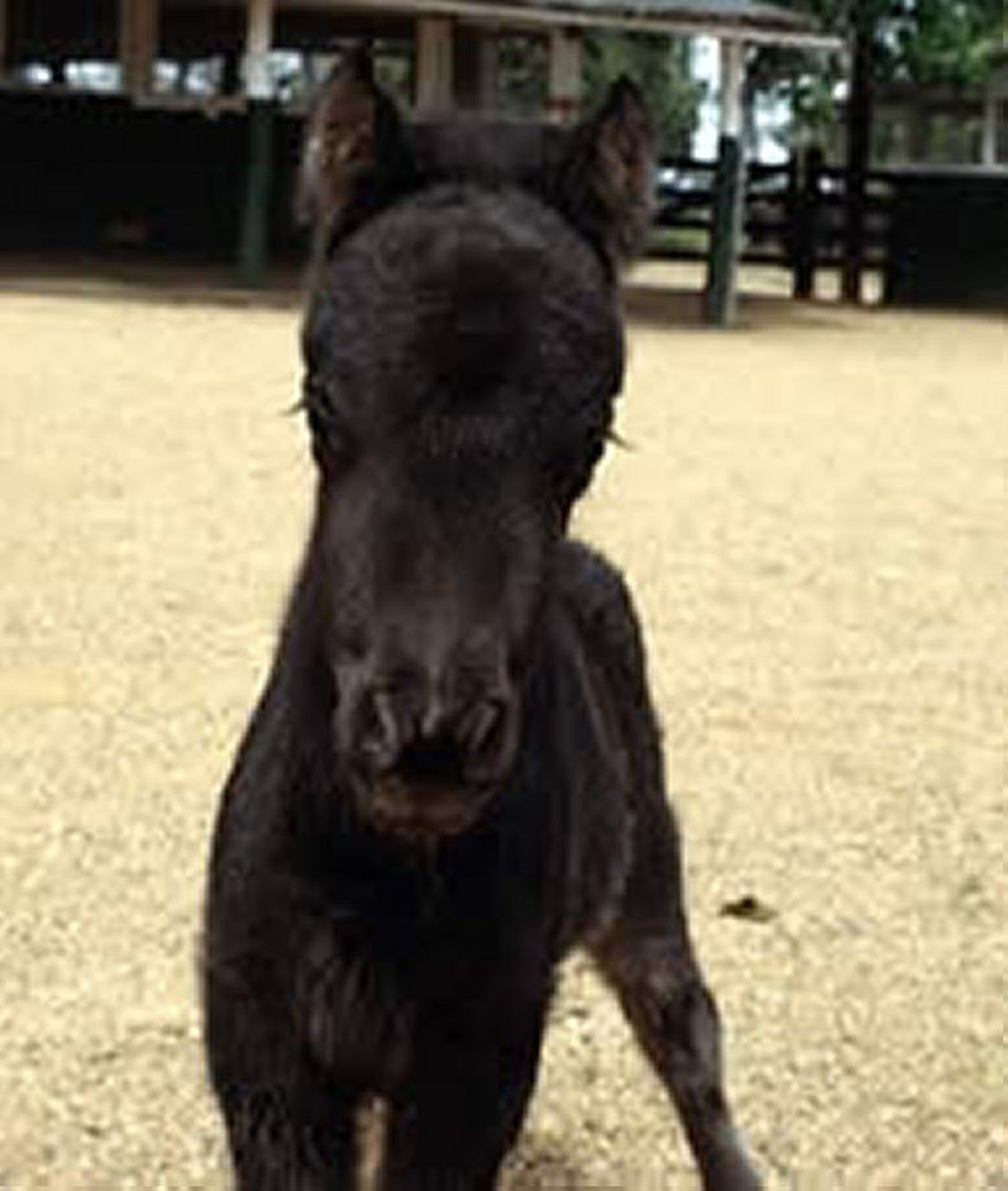
A foal with hydrocephalus. Note the enlarged appearance of the cranium. Fontanelles might be patent, and cranial sutures might be expanded.
Courtesy of Dr. Thomas Lane.
Hydrocephalus occurs sporadically in all large animal species; however, it is relatively common in calves, in which inheritance and vitamin A deficiency have been implicated.
Cyclopia in Sheep and Pigs
Cyclopia is characterized by the presence of only a single orbital fossa. One cause in lambs is ingestion by the gestating dam of alkaloids from the poisonous plant Veratrum californicum. This malformation occurs also in pigs.
Lissencephaly in Sheep
Lissencephaly, an absence of or decrease in cerebral gyri, is a rare disorder that occurs in Churra lambs. Lesions also include cerebellar hypoplasia.
Clinical signs of lissencephaly consist of weakness, inability to walk, difficulty suckling, and muscular rigidity. These signs are apparent at birth.
The disorder is caused by a mutation in the RELN gene.
Pendular Nystagmus in Cattle
Pendular nystagmus occurs in various breeds of dairy cattle. It is caused by an unknown congenital abnormality in the visual pathway. The pattern of nystagmus is variable and is generally noted a few days after birth. No other neurological signs are present. The condition is persistent but nonprogressive and is considered benign (2).
Inherited Cerebral Disorders in Large Animals
Idiopathic (Familial) Epilepsy in Large Animals
Idiopathic, or familial, epilepsy has been described in many large animal species. Benign epilepsy occurs in young foals, particularly Arabians, up to the age of 12 months. The foal might present with seizures, head injuries, or postictal blindness.
Foals usually recover from idiopathic epilepsy spontaneously within a few months. However, administration of an anticonvulsant (phenobarbital at a loading dose of 2–13 mg/kg, PO or IV, followed by dosage according to effect and serum phenobarbital concentrations, PO, every 12 hours; or potassium bromide at a loading dose of 100–150 mg/kg, followed by 25 mg/kg, PO, every 24 hours) is probably advisable for 2.5–9 months, followed by withdrawal over 2 weeks (3).
Epilepsy beginning by the age of 1 year has been recorded in Brown Swiss and Swedish Red cattle. Seizures can also occur in young Aberdeen Angus calves; if these calves survive, they show cerebellar signs but typically become clinically normal by the age of 2 years.
Narcolepsy and Cataplexy in Large Animals
Narcolepsy, a disorder of sleep-wake control (typically characterized by excessive sleepiness or sudden paroxysmal attacks of flaccid paralysis with conservation of consciousness), has been reported in several equine breeds, particularly Shetland ponies (4). Typically, affected animals are otherwise healthy.
During narcoleptic episodes, rapid eye movements occur. At the same time, the animal might also show cataplexy (sudden loss of muscle tone, with collapse).
Key Points
Congenital malformations of the cerebrum commonly involve either failure of cerebral development or protrusion of neural tissues outside the cranial vault.
Congenital cerebral disorders may or may not be externally apparent; normal appearance does not rule out a congenital or inherited condition.
Some congenital and inherited cerebral disorders have a known environmental cause (vitamin deficiency, toxins, viral infection) or genetic cause.
A congenital or inherited malformation should be considered in any animal presenting with neurological signs beginning at a young age (< 1 year old).
For More Information
Leipold HW, Hiraga T, Dennis SM. Congenital defects of the bovine central nervous system. Vet Clin North Am Food Anim Pract. 1993;9(1):77-91.
de Lahunta A, Glass E, Kent M. de Lahunta's Veterinary Neuroanatomy and Clinical Neurology. 5th ed. Elsevier; 2021.
Mayhew IG, Mackay RJ. Large Animal Neurology. 3rd ed. Wiley-Blackwell; 2022.
Also see pet owner content regarding brain, spinal cord, and nerve disorders of horses.
References
Smith CJ, Keller PC. Alpha-fetoprotein and albumin in experimentally-induced exencephaly in the rat. Teratology. 1977;16(1):71-78. doi:10.1002/tera.1420160112
McConnon JM, White ME, Smith MC, Stern ES, Hickey G. Pendular nystagmus in dairy cattle. J Am Vet Med Assoc. 1983;182(8):812-813. doi:10.2460/javma.1983.182.08.812
Aleman M, Gray LC, Williams DC, et al. Juvenile idiopathic epilepsy in Egyptian Arabian foals: 22 cases (1985–2005). J Vet Intern Med. 2006;20(6):1443–1449. doi:10.1111/j.1939-1676.2006.tb00764.x
Lunn DP, Cuddon PA, Shaftoe S, Archer RM. Familial occurrence of narcolepsy in Miniature Horses. Equine Vet J. 1993;25(6):483-487. doi:10.1111/j.2042-3306.1993.tb02998.x