Riemerella anatipestifer is a bacterial pathogen that affects ducklings, goslings, turkeys, and other fowl, including chickens. Clinical signs include ocular and nasal discharge, mild coughing and sneezing, watery green feces, and neurological signs progressing to obtundation and death. Diagnosis is on the basis of typical neurological signs, pathological lesions, and identification of the causative organism through bacterial culture or molecular diagnostics. Careful management practices are important for prevention. A limited number of antimicrobials are useful, and good biosecurity along with vaccination is critical to prevention in commercial flocks in endemic environments.
Riemerella anatipestifer (formerly Pasteurella anatipestifer) is a highly contagious, widely distributed bacterial pathogen that primarily affects young ducklings, older developer-aged ducks (less frequently), and breeder-aged ducks (rarely) as well as turkeys and geese. Other waterfowl, chickens, and pheasants can occasionally be affected.
In commercial duck and geese operations, mortality from R anatipestifer can be extensive and will mimic other high-consequence diseases. Surviving ducklings typically grow poorly and are often condemned at slaughter.
Etiology and Transmission of Riemerella anatipestifer Infection in Birds
Riemerella anatipestifer is a gram-negative, nonsporulating, catalase- and oxidase-positive, nonmotile bacterium. It grows microaerophilically in enriched media. Given that R anatipestifer possesses few characteristic phenotypic properties, isolation and identification procedures should be polyphasic. Definitive diagnosis should include genotypic identification. PCR assay amplification of a partial region of the rpoB or the 16S rRNA gene with subsequent sequencing is recommended.
Similar to Pasteurella multocida, R anatipestifer has many (> 20) immunotypes (or serotypes). This complicates efforts at widespread prevention using bacterins, because of limited and mostly ineffective cross-protection between serotypes. Cross-protective vaccine candidates using an immunoproteomics approach are in development.
The epidemiology and pathogenesis of R anatipestifer infection are poorly understood, and limited definitive virulence factors are readily identified for serotypes at this time. Many R anatipestifer serotypes are molecularly sequenced, and the need for serological testing is beginning to diminish.
Serological testing for R anatipestifer is susceptible to error for differentiating field infections. However, it can provide quick cross-match information for selecting appropriate vaccines.
Use of bacterins or vaccines for specific R anatipestifer serotypes might not provide cross-protection from serotypes not included in these biologics. Use of vaccines against certain serotypes can unmask additional serotypes that are not covered by vaccination, and mortality can continue. This is exacerbated by environmental stressors or coinfections.
Ducks are believed to be infected from the environment by the respiratory route or when R anatipestifer is introduced into lesions of the webbed foot. Turkeys can be infected by injuries or by the respiratory route when another pathogen disrupts the respiratory epithelium.
Once R anatipestifer infection is established in a facility, it frequently becomes endemic. It is common for multiple serotypes to be present in a single facility, with coinfections possible.
Clinical Findings and Lesions of Riemerella anatipestifer Infection in Birds
Clinical signs of Riemerella anatipestifer infection usually develop after an incubation period of 2–5 days. Affected ducklings, usually 1–7 weeks old, often have ocular and nasal discharge, watery green feces, mild coughing and sneezing, tremors of the head and neck, depression, and incoordination, progressing to obtundation and death.
In typical cases of R anatipestifer infection, affected ducklings in the terminal stages of disease lie on their backs, paddling their legs (see ).

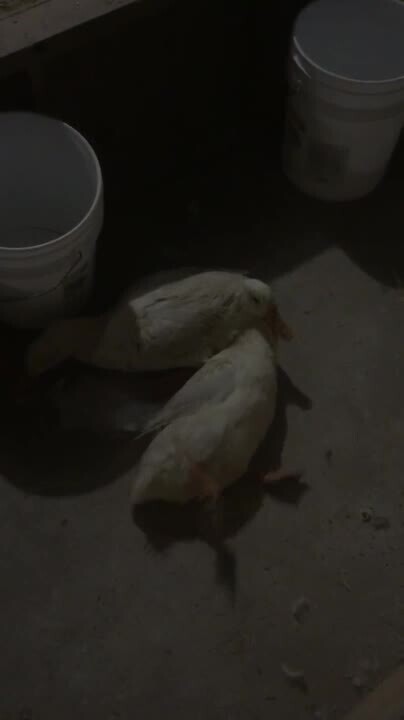
Stunting can occur in survivors, with scarring of air sacs and the pericardium resulting in condemnation at slaughter. Necrotic dermatitis on the lower back or around the vent can also occur.
Fibrinous exudate in the pericardial cavity and over the surface of the liver is the most characteristic lesion of R anatipestifer (see ). Fibrinous airsacculitis is common, and infection of the CNS can result in fibrinous meningitis, although this is rarely appreciated on gross examination. The spleen and liver can be swollen and often are mottled red and tan (see ). Pneumonia can occur, particularly with coinfections with Escherichia coli.
Pearls & Pitfalls
|

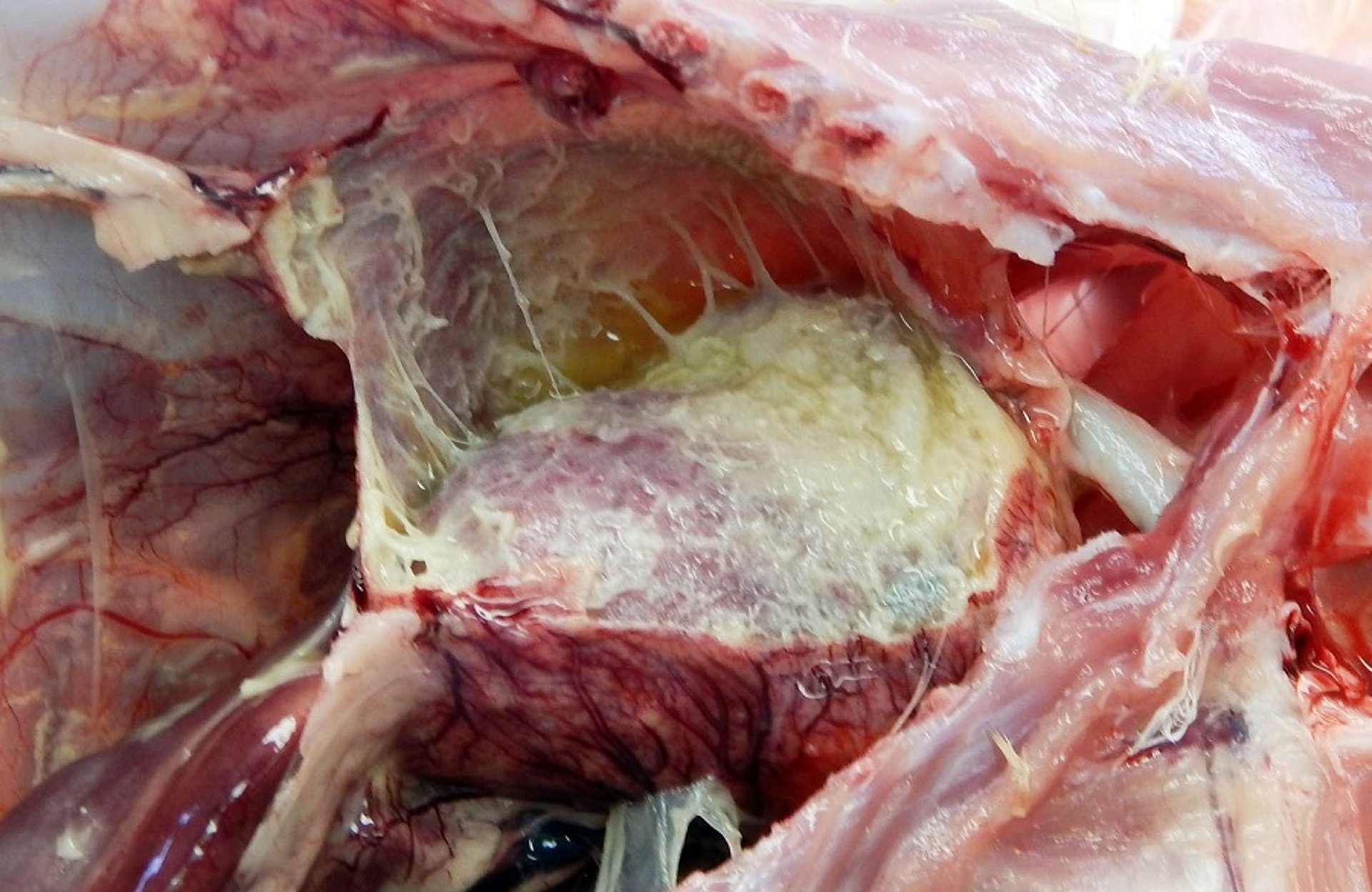
Gross pathology photograph of a duckling with skin, ribs, and keel bone reflected. Notice marked fibrinous adhesions between the epicardium and pericardial sac. The pericardium is diffusely congested, thickened, and adhered to the keel bone ventrally. This is an acute to subacute lesion commonly found in natural infections with Riemerella anatipestifer. Cranial to right of image and caudal to left of image.
Courtesy of Dr. Gavin Hitchener.

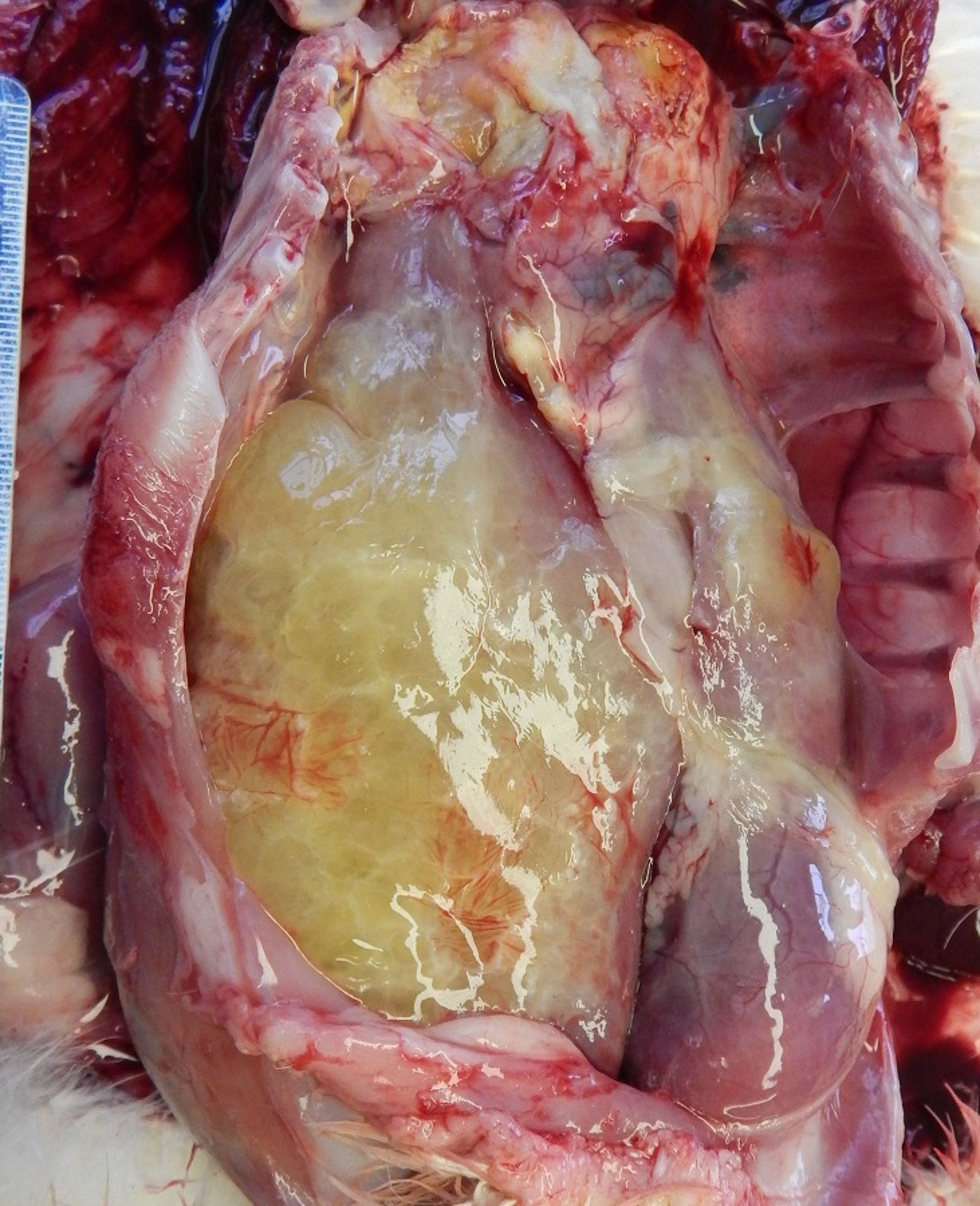
Gross pathology photograph of a duckling with skin, ribs, keel bone, and abdominal skeletal muscles reflected. Notice marked fibrin deposition along the capsular surfaces. The pericardium is diffusely thickened and lined by similar fibrin. This is a subacute lesion commonly found in natural infections with Riemerella anatipestifer. Cranial to top of image and caudal to bottom of image.
Courtesy of Dr. Gavin Hitchener.
R anatipestifer mortality in ducks is usually 5-75% (1). A high proportion of affected birds develop mucopurulent or caseous salpingitis. Affected breeding stock should be culled.
Affected turkeys (usually 5–15 weeks old) often exhibit dyspnea, droopiness, hunched back, lameness, and a twisted neck. Fibrinous pericarditis and epicarditis are the most pronounced lesions. There can also be fibrinous perihepatitis, airsacculitis, and purulent synovitis. Osteomyelitis, meningitis, and focal pneumonia occur occasionally. Mortality in turkeys is up to 80% (2).
Diagnosis of Riemerella anatipestifer Infection in Birds
CNS signs
Lesions
Matrix-assisted laser desorption ionization time-of-flight mass spectrometry
PCR assay
Organ sampling
Serotyping
Diagnosis of Riemerella anatipestifer is on the basis of typical CNS signs (if present), lesions, and isolation and identification of the causative organism (using historical biochemical characterization). Other diseases (eg, colibacillosis, salmonellosis, Pasteurella multocida infection, and chlamydiosis) can produce similar lesions.
Matrix-assisted laser desorption ionization time-of-flight mass spectrometry (MALDI-TOF MS) has been used successfully for identification of R anatipestifer and is quickly becoming the preferred diagnostic method for most larger laboratories.
Several PCR assay-based diagnostic tests to detect R anatipestifer have been described, including assays for the ompA gene, 16S rRNA, rpoB gene, and an ERIC fragment. Because of the high rate of false-positive results, PCR assay amplification of a partial region of the rpoB or the 16S rRNA gene with subsequent sequencing is recommended to confirm identification.
The R anatipestifer isolate should be serotyped or have whole genomic sequencing performed with single nucleotide polymorphism (SNP) analysis, because the information can be useful for vaccine selection and epidemiological studies. Plate agglutinations are rapid and convenient for most facilities; however, this method is subject to cross-reactions, with the consequence of bacterin protection being inadequate at times.
Unless titrations are carried out, only absorbed sera should be used, because of the existence of multiple antigenic factors within a single strain.
Biochemical characteristics can be used to differentiate R anatipestifer from other bacteria that cause important diseases of ducks and turkeys, particularly Escherichia coli, P multocida, Salmonella enterica, Coenonia anatina, Avibacterium gallinarum, and Bordetella avium.
Impression smears help to determine whether there is concurrent Chlamydia infection associated with an R anatipestifer infection; however, PCR assay-based diagnostic testing is preferred, because of the health risk to humans associated with chlamydiosis.
Prevention and Control of Riemerella anatipestifer Infection in Birds
Strict biosecurity
Appropriate vaccines or bacterins
All-in/all-out management systems with downtime
Careful management practices are important for prevention of Riemerella anatipestifer infection. A high level of biosecurity is essential. Cleaning and disinfection between flocks and separation of flocks on multiple-age facilities are also of major importance.
Rigid sanitation and depopulation are necessary for elimination of R anatipestifer from endemically infected facilities. Allowing facilities to dry out and be exposed to hot, dry air can decrease pathogen burdens in some facilities.
A bacterin and a live vaccine, both including the three most common serotypes of R anatipestifer (ie, serotypes 1, 2, and 5), are available for use in ducks and naive ducklings, respectively. Autogenous bacterins for other serotypes are available from multiple vaccine makers. An autogenous oil-emulsion bacterin can be used in turkeys. Breeder ducks can be vaccinated with a bacterin or live vaccine to provide protection to the ducklings that can last until duckings are 2–3 weeks old.
Sulfa drugs (eg, sulfaquinoxaline, sulfamethazine) or a combination of penicillin and streptomycin can be used for initial treatment of R anatipestifer; however, antimicrobial susceptibility testing should be performed, because multidrug-resistant strains are becoming more prevalent. As ducks and turkeys are food animals, antibiotics must only be administered by a licensed veterinarian following strict regulations regarding withdrawal times.
Enrofloxacin is highly effective in preventing death in ducklings from R anatipestifer when administered in the drinking water; however, use of quinolones and most other antimicrobials in poultry operations is strictly prohibited in many countries, including the US. Antimicrobial restrictions and development of antimicrobial gene resistance make biosecurity and prevention of introduction of disease critical to commercial operations.
Key Points
Riemerella anatipestifer causes acute bacterial septicemia of young ducklings and goslings and, less commonly, turkeys and other fowl.
Clinical signs include neurological disease and watery green feces; mortality approaches 30–50% with virulent serotypes in commercial flocks.
Grossly, R anatipestifer infection is indistinguishable from Escherichia coli, Salmonella, or Pasteurella multocida infections and requires aerobic culture for diagnosis.
Because of increasing antimicrobial resistance, vaccination and strong biosecurity are essential for control in commercial operations.
For More Information
Ruiz JA, Sandhu TS. Riemerella anatipestifer infection. In: Swayne DE, ed. Boulianne M, Logue CM, McDougald LR, Nair V, Suarez DL, associate eds. Diseases of Poultry. 14th ed. Wiley Blackwell; 2020:846-853.
Tripathy DN. Riemerella anatipestifer infection. In: Brugère-Picoux J, Vaillancourt J-P, Shivaprasad HL, Venne D, Bouzouaia M. Manual of Poultry Diseases. AFAS. 2015:336-338, Chapter 49.
Hao J, Zhang J, He X, Wang Y, et al. Unveiling the silent threat: A comprehensive review of Riemerella anatipestifer - From pathogenesis to drug resistance. Poult Sci. 2025;104(4):104915.
References
Hao J, Zhang J, He X, et al. Unveiling the silent threat: A comprehensive review of Riemerella anatipestifer – From pathogenesis to drug resistance. Poult Sci. 2025;104(4)104915. doi:10.1016/j.psj.2025.104915
Turni C, Omaleki L. Riemerella anatipestifer diagnostics. Poultry CRC Australia. 2013. Accessed April 30, 2026.https://www.poultryhub.org/content/uploads/2017/05/1.2.4-Turni-Final-Report.pdf