Enteropathogenic salmonellae cause inflammation and necrosis of the small and large intestines, resulting in diarrhea. Infection with certain serotypes can be accompanied by generalized sepsis. Pigs of all ages are susceptible; however, intestinal salmonellosis is most common in weaned and growing-finishing pigs.
Etiology and Pathogenesis of Intestinal Salmonellosis in Pigs
Salmonella enterica serotype Choleraesuis, variety Kunzendorf (S Choleraesuis), is one of the most common Salmonella serovars affecting pigs. It sometimes produces necrotizing enterocolitis; more commonly, it is associated with septicemic disease characterized by hepatitis and pneumonia.
Intestinal salmonellosis in pigs has historically been associated with either S Choleraesuis or S Typhimurium. However, S enterica serotype 4,[5],12:i:- has been detected with increasing frequency in pigs with clinical signs of disease and is now the dominant serotype isolated from diseased swine (1). S serotype Typhisuis infection is less common and is associated with chronic ulcerative colitis. Sources of infection with these serotypes are primarily clinically normal carrier pigs; however, rodents and contaminated feed and premises can also be sources. Enteric salmonellosis often occurs as a sequela of enteric viral infections.
Numerous other serotypes of salmonellae are present in pigs, some of which have been associated with human foodborne illness. Common serotypes isolated from swine in addition to those previously noted are S Agona, S Derby, S Heidelberg, and S Infantis. These serotypes may be associated with mild to moderate diarrhea in swine and may be resistant to multiple antimicrobials.
Clinical Findings of Intestinal Salmonellosis in Pigs
Intestinal salmonellosis is most often observed in pigs from weaning up to approximately 5 months old; however, it can occur at other ages. Affected pigs are commonly febrile, with decreased feed intake, and have liquid yellow feces that can contain shreds of necrotic debris. Diarrhea in individual pigs usually lasts 3–7 days, and it can recur for multiple bouts.
Lesions of Intestinal Salmonellosis in Pigs
Pigs infected with enteropathogenic salmonellae (S Choleraesuis, S Typhimurium, and S 4,[5],12:i:-) have an inflamed, segmentally thickened distal small intestine and colon, usually with necrotic debris on the mucosal surface (see ). Mesenteric lymph nodes are variably enlarged, edematous, and reddened.Mucosal ulceration may be evident, and a small amount of hemorrhage might be observed in acute cases. Rectal strictures occasionally occur as a sequela. S Typhisuis infection produces distinctive lesions that include multifocal, chronic, deep mucosal ulcers with central cores of caseonecrotic debris ("button" ulcers).

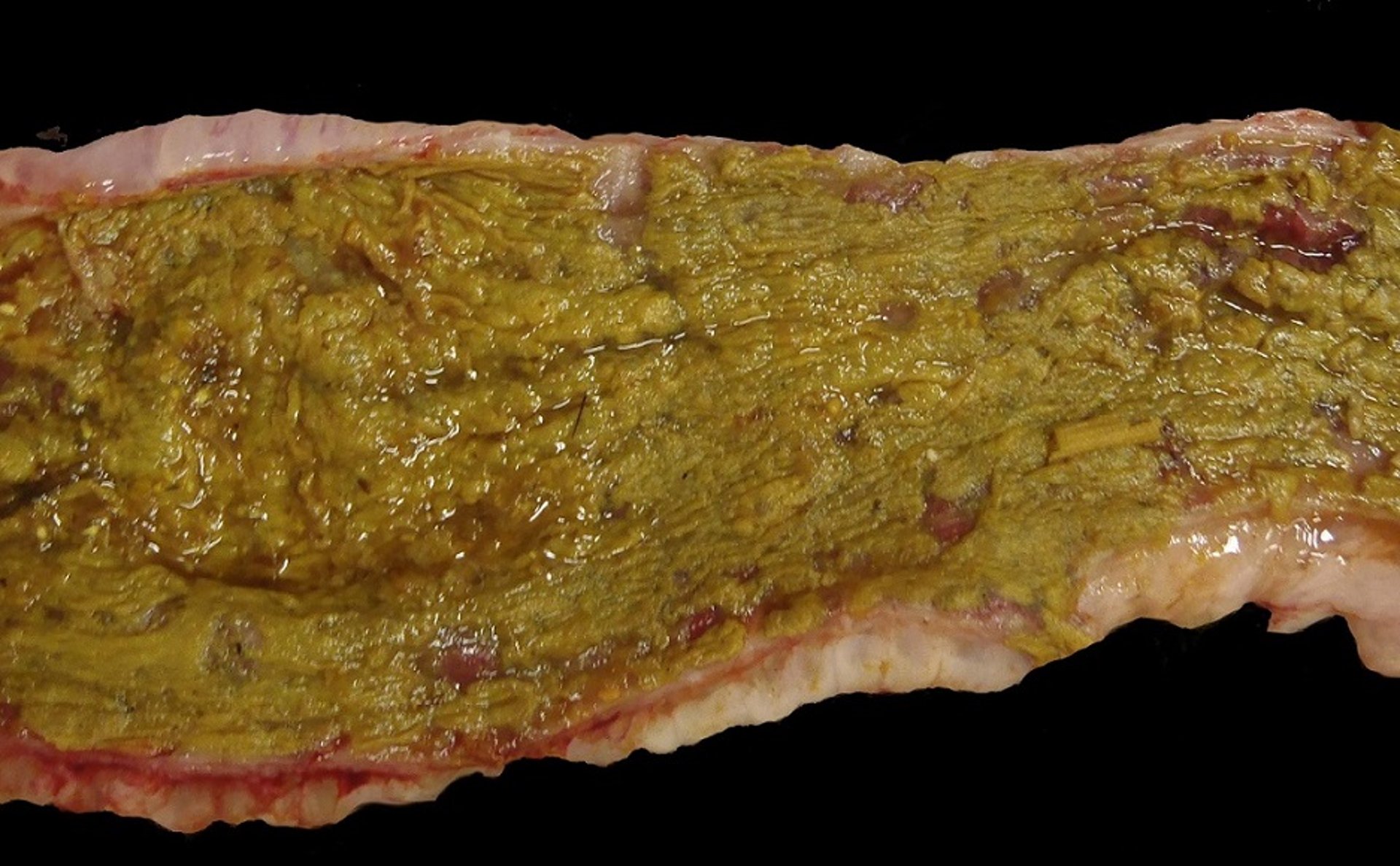
Gross lesions typical of intestinal salmonellosis in a pig. Note the edematous intestinal wall and thick accumulation of fibrin and necrotic debris along the mucosal surface.
Courtesy of Iowa State University Veterinary Diagnostic Laboratory.
Diagnosis of Intestinal Salmonellosis in Pigs
Confirmation via culture and serotyping
Histological examination
Culture of feces or intestinal mucosa using selective media, with or without enrichment, is useful to isolate salmonellae from clinical samples and can be completed in a few days. Culture of enlarged mesenteric lymph nodes is of higher diagnostic specificity for enteropathogenic strains and should ideally be performed in tandem with mucosal or fecal cultures.
Culture is typically followed by serotyping to confirm the serotype involved. PCR assays are increasingly available, often with serotype-level specificity, that can shorten the time to final etiological diagnosis. Histological examination of affected intestine and liver tissue to differentiate intestinal salmonellosis from proliferative enteropathy and swine dysentery is of high diagnostic value.
Treatment and Control of Intestinal Salmonellosis in Pigs
Antimicrobial treatment based on results of minimum inhibitory concentration testing
Vaccination
Parenteral administration of antimicrobials to acutely ill pigs and medication of the affected group via water or feed may decrease the severity of an outbreak of intestinal salmonellosis. Neomycin and lincomycin-spectinomycin are commonly administered water medications. Susceptibility testing of isolated organisms is useful to select an appropriate antimicrobial.
Thorough cleaning and disinfection of contaminated facilities and elimination of the source of the organism decrease the likelihood of repeated bouts of disease. Most animals recover; however, some are persistently infected and shed the organism intermittently. Subclinically infected animals are a contamination risk around the time of slaughter.
Live avirulent vaccines administered either intranasally or via drinking water are effective for prevention of disease caused by S Choleraesuis and S Typhimurium. Avirulent vaccines may also effectively decrease levels of salmonellae in the tissues of swine at slaughter.
Key Points
S Typhimurium, S 4,[5],12:i:-, and S Choleraesuis are common causes of intestinal salmonellosis in pigs.
Culture is important for confirmation of diagnosis and serotyping.
Vaccination may help prevent disease and decrease shedding.
For More Information
Bearson SMD, Mainenti M. Salmonella. In: Zimmerman JJ, Burrough ER, Karriker LA, Schwartz KJ, Zhang J, eds. Diseases of Swine. 12th ed. John Wiley and Sons, Inc; 2026: 1073-1087.
References
Naberhaus SA, Krull AC, Bradner LK, et al. Emergence of Salmonella enterica serovar 4,[5],12:i:- as the primary serovar identified from swine clinical samples and development of a multiplex real-time PCR for improved Salmonella serovar-level identification. J Vet Diagn Invest. 2019;31(6):818-827. doi:10.1177/1040638719883843